Our world is burning, and not everyone is looking away. Several artists are exploring wildfires fueled by climate change. Their work questions our relationship with the living world and reveals the fragility of a world in flames. Taken together, these works also expose our ambivalence toward technology, seen as both a cause of the crisis and a potential remedy. Welcome to the hell of the Pyrocene.
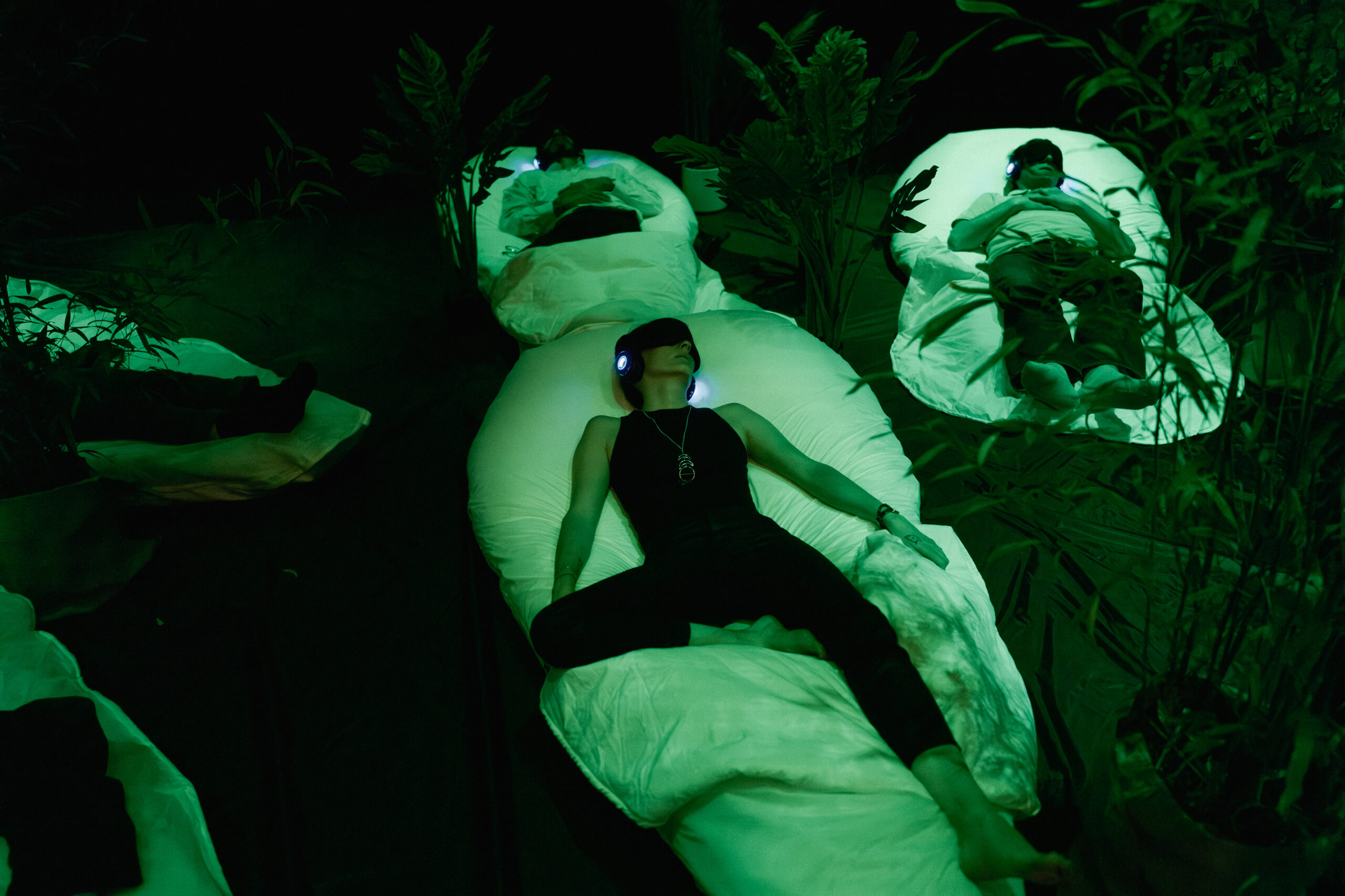
While the Anthropocene has become a familiar concept, the Pyrocene remains far less well known. Coined in the mid-2010s by American Stephen Pyne and popularized by philosopher Joëlle Zask, the term describes a new geological era in which fire will play a central role in the evolution of ecosystems. This era is defined by the combustion of the living world, starting with forests reduced to ashes by megafires, but also extending to underground forests, in other words, fossil fuels. The digital sector’s voracious energy consumption contributes to this conflagration, providing inspiration for a number of artists. Some, like Australian artist Dennis Del Favero, imagine immersive systems for simulating extreme wildfires, as in IA iFire (2026). Others take a more anthropological approach. In And Beneath It All Flows Liquid Fire (2019), (2019), Julian Charrière stages a fountain engulfed in flames, evoking the coexistence of opposing elements, water and fire. The French-Swiss artist reminds us, in spectacular fashion, that fire is not merely a destructive force. It is also considered humanity’s oldest conquest, marking the dawn of civilization.
Aesthetic power and digital derealization
Artist Gwenola Wagon, who co-authored the essay Les Images pyromanes (2025) with Pierre Cassou-Noguès, takes this analysis further. Fire carries an unmistakable symbolism of ecstasy. “In cinema, fire often serves as a form of release,” she observes. “It’s also fireworks, a gathering around a fire where people come together to tell stories. Fire evokes our origins, which is why it’s so hypnotic.” This observation finds a striking echo in Octavia Butler’s novel Parable of the Sower (1993), where fire takes on an ecstatic dimension through a pyromaniacal orgasm induced by a drug called pyro. Fire thus embodies a paradox: does its aesthetic and symbolic power, this process of sublimation, stand in contrast to the actual environmental consequences of wildfires?
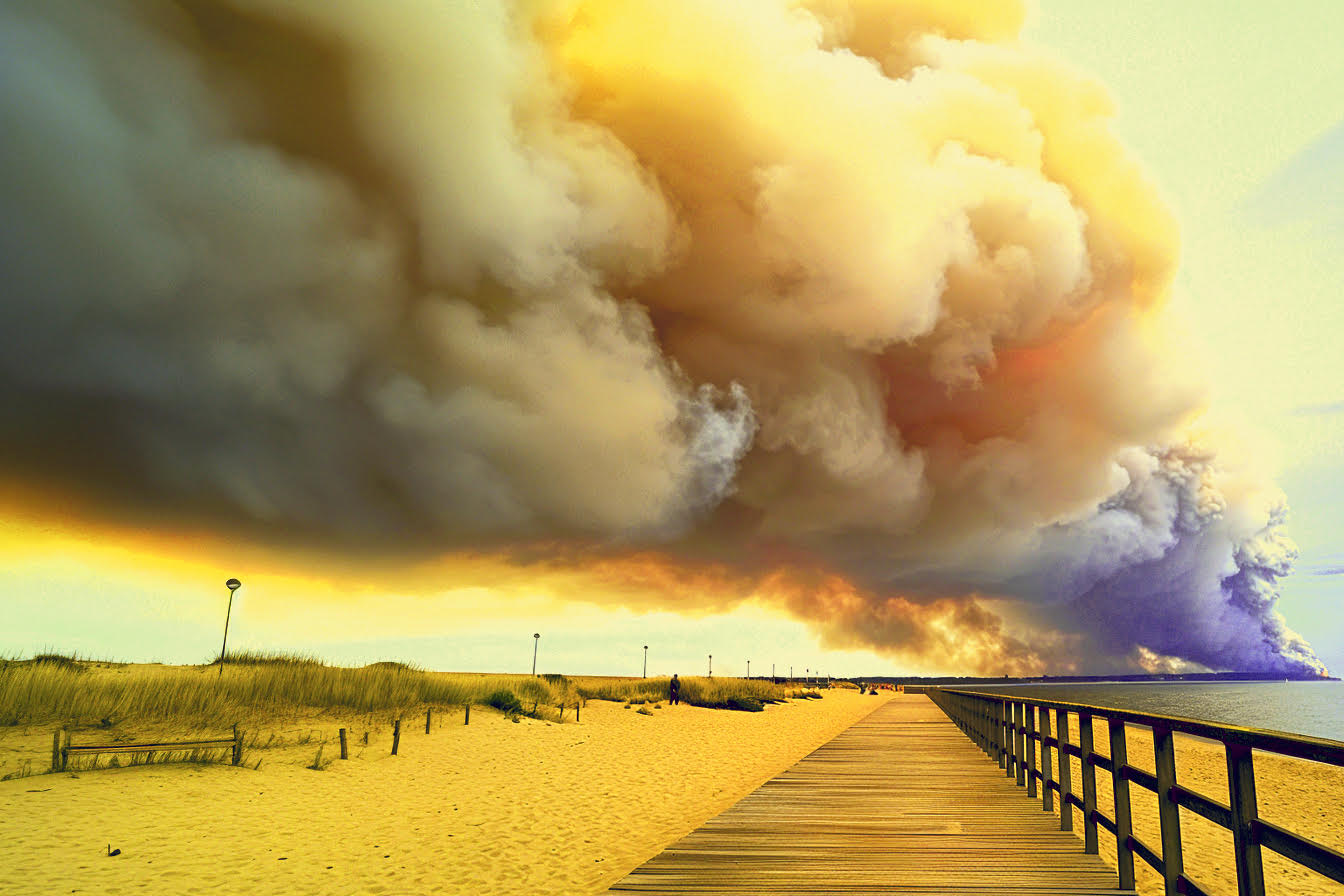
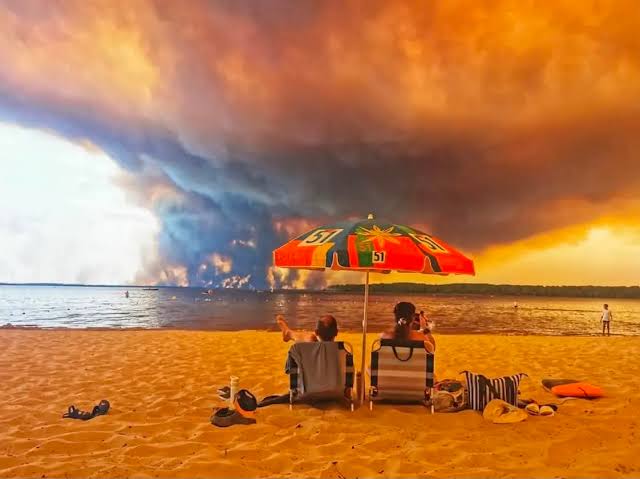
Our era has never produced or circulated so many images of wildfires, from those shared on social media during the megafires in Australia and the Amazon in 2019 to, more recently, the fires in France’s Gironde region in 2026. Philosopher Pierre Cassou-Noguès recalls the fires that swept through the Arcachon Basin in 2022: “Images quickly began circulating on social media. We collected them to examine the visibility of disaster and, at the same time, how it becomes invisible.” These images are often aestheticized by the very conditions of the fires themselves. “Smoke changes the atmosphere of sunsets; these extraordinary images lend an almost sublime quality to environmental disaster. It’s a deeply ambivalent perspective, especially since these fragmented views prevent us from grasping the full extent of the problem. It’s a synaptic form of perception that exists only through these new media.”Images of wildfires thus have the effect of derealizing disaster, allowing us to exorcise our own sense of helplessness before forgetting it once the fire season has passed. Gwenola Wagon takes the argument a step further: “ In this moment of planetary overheating, with nine planetary boundaries under pressure, we also need to consider the full range of conditions and consequences associated with wildfires. Water scarcity and the loss of biodiversity are also manifestations of the Pyrocene.” These absences are often harder to show than the flames themselves.
Using digital technology to reveal the invisible
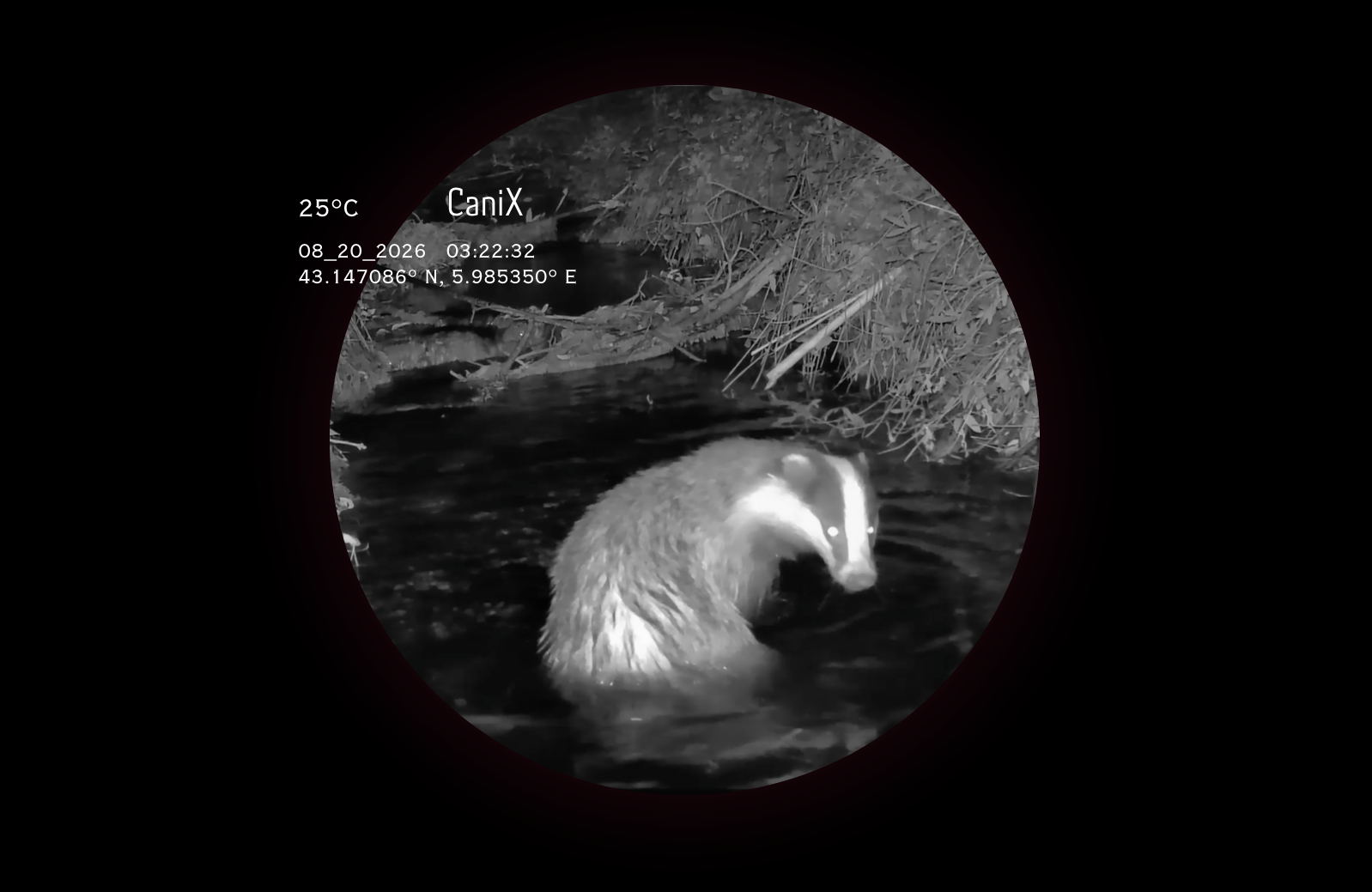
It is precisely these invisible traces that some artists seek to bring to light in the Pyrocene. Artist and researcher Magalie Martinsupported by the PEPR-ICCARE research program, has been exploring infrared imaging technologies that capture radiation invisible to the naked eye. This is also the subject of her dissertation, “The Pyrocene Through Infrared Vision: Climate Predation and Hyperspectral Imaging in Contemporary Art” (Aix-Marseille University, LESA). “What interests me is the perception of heat, which only becomes visible to humans above a certain threshold. This raises questions of sensory perception and, consequently, representation.” Already used by photographer Richard Mosse in Broken Spectre Broken Spectre (2022), a work about deforestation in the Amazon, these technologies are being repurposed here to investigate the consequences of wildfires and land artificialization. Haunted by the traumatic experience of a fire in Portugal, Magalie Martin returned to the site after the disaster to understand its socioeconomic dynamics. “These burned lands were bought up by a major company, which installed vast solar farms across them. Some infrared photographs look like black holes: there’s no life left.” In Mégafeu sous IR (2025), she also examines the condition of soils subjected to artificialization and the health of plants, revealing transformations that ordinary observation cannot always capture. Magalie Martin continues her exploration of infrared imaging and sousveillance in another project, Nuits Fauves (CaniX) (2026). She installs cameras in areas weakened by drought and wildfires to observe animals during heatwave nights. The aim is to shift our gaze toward animal life and thermal phenomena that lie beyond our direct perception.
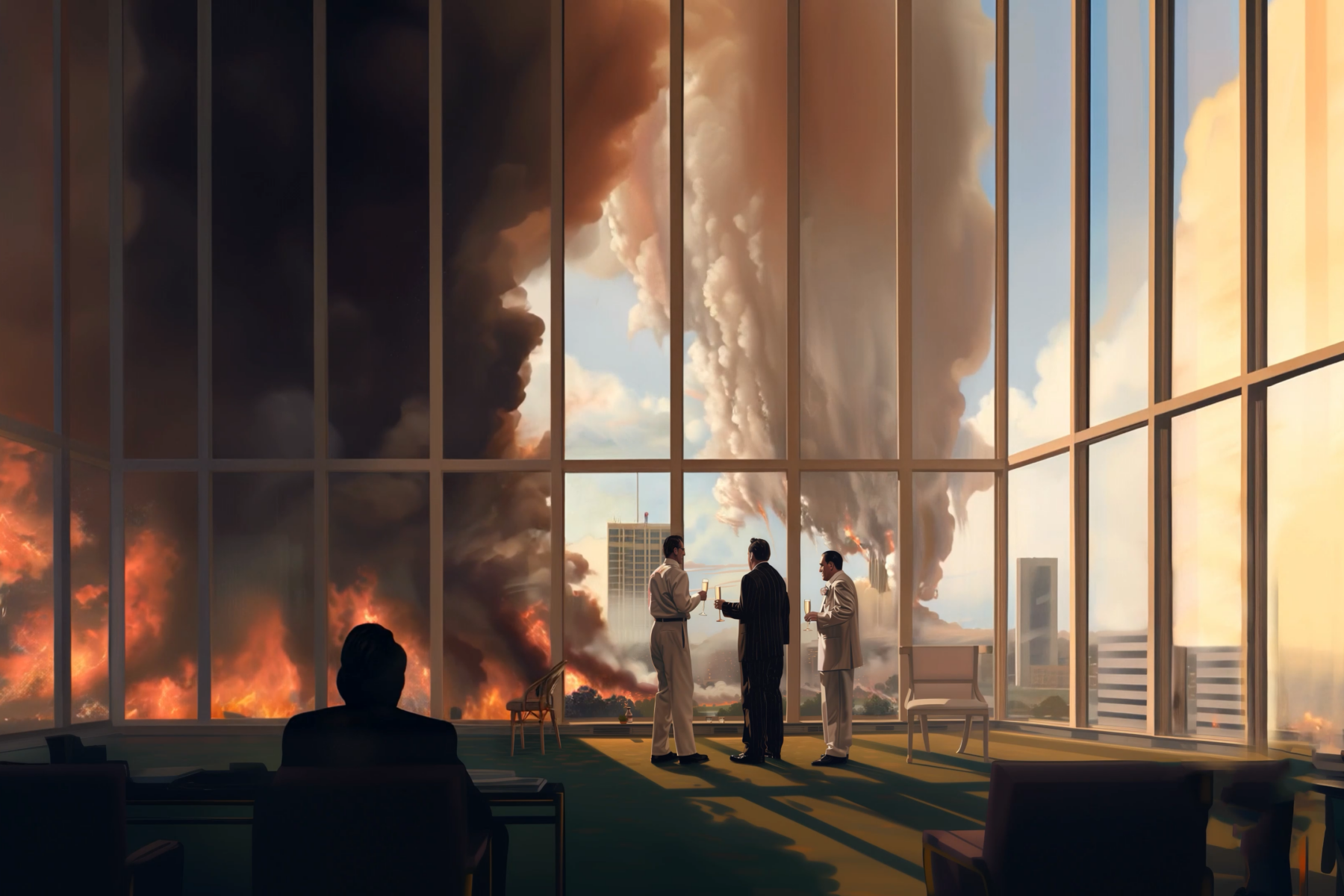
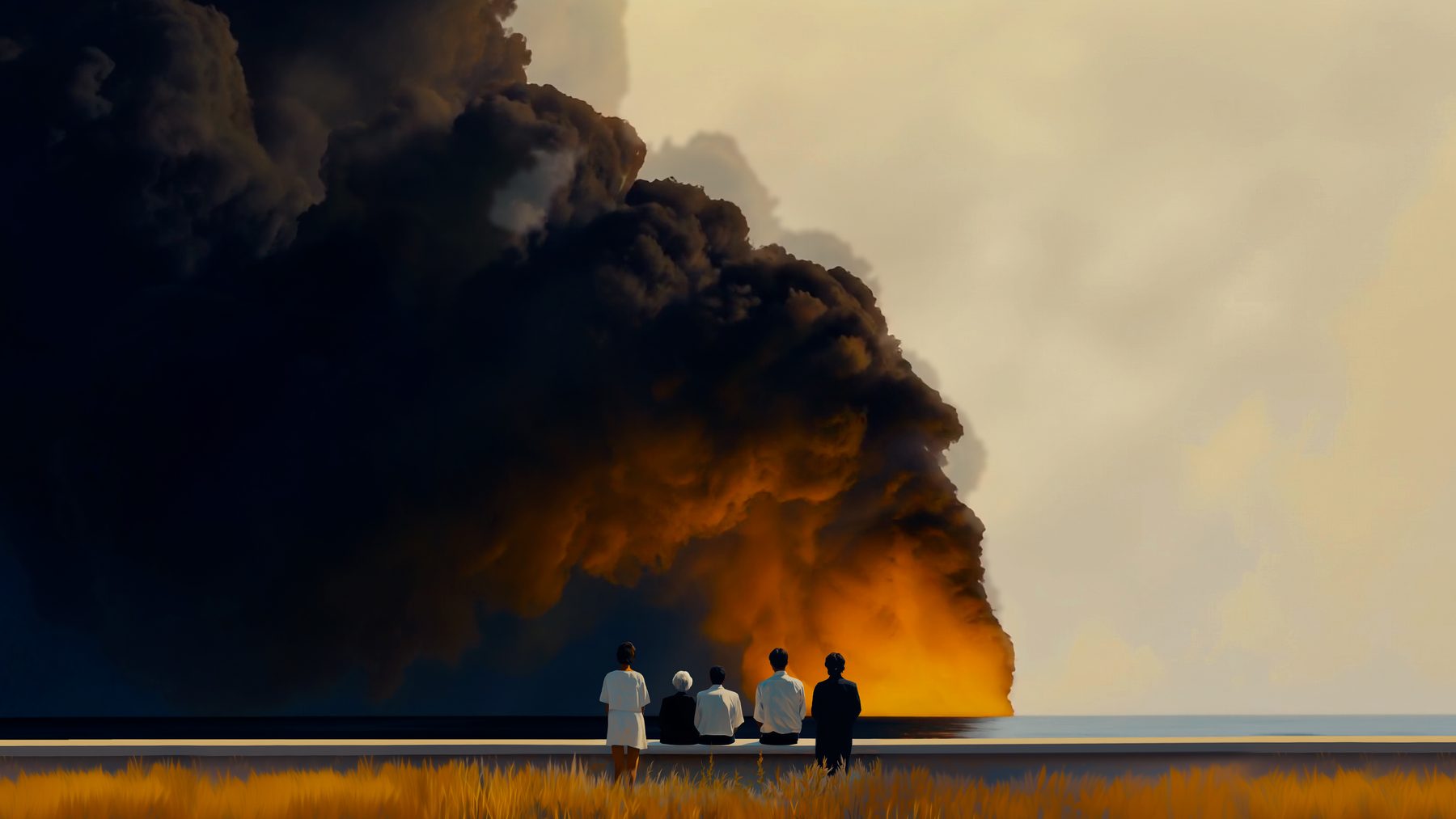
Louis-Paul Caron also carries the memory of a wildfire he experienced as a child. “Watching fires without being able to do anything is both spectacular and frightening.” This experience has informed his artistic practice ever since. In Pacific Palisades (2026), dedicated to the Los Angeles neighborhood of the same name, devastated by flames in 2025, the artist draws on paintings based on Google Street View images, which are then fed into an AI algorithm to generate videos. This dialogue between human perception and algorithmic processing raises questions about landscape memory in the digital age. Digital images become witnesses to a vanished territory, but also to the imaginaries associated with it. “Satellite views showed us a field of ashes. But on Street View, we could still find photographs from before the fires, bearing witness to the American Dream. What do these images tell us?”
Our pyromaniac machines
Let’s take the question further: what do these images say about us? Gwenola Wagon and Pierre Cassou-Noguès offer one possible answer: “ Our theory, pyropictomania, describes this addiction to producing and displaying images.” Their film The Dune is on Fire (2025) brings together hundreds of videos posted by users on social media, primarily Instagram and TikTok, during the summer of 2022. The edit follows the course of a wildfire, from ignition to extinction. Images no longer simply represent fire; they also participate in a system of energy production and consumption with material consequences. Magalie Martin reminds us that this entanglement of images and combustion predates the digital age. From the earliest days of photography, handling certain flammable chemicals exposed practitioners to the risk of burns. “In photography’s earliest days, particularly during colonial expeditions into the Sahara Desert, photographers burned their hands with collodion. Our machines are inextricably bound up with the Pyrocene. ” Fire, sometimes invisible, is therefore embedded in the material conditions under which images are produced, as well as in what they depict. Jacques Perconte was already exploring this connection in 2010 with Après le feu (Corse). As the film unfolds, its textures take on the appearance of embers and incandescent waves. The image melts, liquefies and breaks apart, swept through by intense, saturated colors. Digital technology carries the traces of combustion within it.
The impossible dilemma facing artists
This systemic reading leads to another question: how much responsibility do artistic practices themselves bear when they rely on digital tools? Inspired by the computing power required to generate a digital “still life” depicting fire, David Claerbout’s Wildfire meditation (2019-2020) pushes this ambiguity to its extreme. Generating these images can cause a computer system to overheat. The work thus exposes the tension between representing fire and the resources required to produce that representation, confronting us with our own participation in this pyromaniac process.
For Louis-Paul Caron, maintaining this artistic position is becoming increasingly difficult as digital artists face a rise in hostile rhetoric. “The debate has taken on a Manichean tone. Yet this artistic ambivalence should be informing our civic debates.” The challenge is to preserve a space for discussing the contradictions inherent in digital creation, without reducing artistic practices to a sterile opposition. Under these circumstances, creating new fictions becomes difficult, all the more so because reality so often seems to catch up with fiction. In 2026, a photograph by Maximilien Lamy, taken in the Arcachon Basin, bore a disturbing resemblance to the series Incendies. “Everything is becoming too real. I need to step back a little from the subject of wildfires,” Louis-Paul Caron admits.
This sense of being overwhelmed conceals a more general loss of control. It is a symptom of an extractivist world built on ever-increasing energy consumption. The ubiquity of digital technology represents the culmination of this model. In the same process, we have delegated our relationship with fire to machines, to the point of losing certain forms of knowledge. This is a paradox, since controlled burning techniques, for example, can help prevent wildfires. This ambivalence runs through artist Garance Maurer’s research in Pyroscapes (2024), a project dedicated to regenerative fire practices. In her work with textiles and materials, nothing is lost; everything is transformed. But in the age of the Pyrocene, this formula reaches its limits: what will remain when everything has burned? A world emptied of life, where only a few symbols of a pyromaniac civilization will survive, like John Gerrard’s Western Flag (2017).
Adrien Cornelissen