Conspiracy Theories & the Digital Age: Through the Eyes of Artists
Article published on 10 September 2026
Reading time: 10 minutes

Maxime Arnould - Passion 4 Fear
Article published on 10 September 2026
Reading time: 10 minutes
Conspiracy theories are often dismissed as irrational beliefs—or, at best, as expressions of skepticism. Yet they reveal far more complex mechanisms. They reshape our intimate relationship with reality in a world increasingly defined by uncertainty, while digital technologies add an entirely new layer of complexity. How are digital artists engaging with this phenomenon? We spoke with researchers and artists exploring the imaginaries that fuel contemporary conspiracy culture.
In Bugonia, Yorgos Lanthimos’s 2025 film, two young men obsessed with conspiracy theories kidnap Emma Stone, who plays a tech executive they believe is an alien sent to destroy humanity. As gripping as the film is in both pacing and direction, it nevertheless falls into a familiar trap: portraying conspiracy believers as irrational—or worse, simply foolish. Media representations over the past decade, often centered on flat-earthers, Pizzagate followers, or reptilian believers, have reinforced this reductionist image. Yet conspiracy theories deserve a more nuanced analysis. They are frequently discussed through the lens of misinformation, an approach that Kenzo Nera, a social psychologist and postdoctoral researcher at the Université libre de Bruxelles specializing in conspiracy beliefs, considers incomplete: “Misinformation doesn’t necessarily involve conspiracy theories. They’re fairly distinct areas of research. Research on misinformation focuses on distinguishing truth from falsehood. Research on conspiracy theories deliberately sets that question aside because we rarely have direct access to the truth.” Rather than evaluating factual accuracy, conspiracy research examines the psychological mechanisms underlying these beliefs.
Conspiracy thinking can therefore be understood as an alternative framework for interpreting the world. It offers a way of making sense of events and assigning meaning to what surrounds us. As Nera explains: “We’re constantly trying to reconcile what we think we know about the world with the world as it presents itself through the information available to us. If we’re already suspicious, we’ll naturally pay more attention to information that confirms those suspicions.” This perspective invites us to move beyond the image of the conspiracy theorist as an isolated or fringe figure. The term conspiracy theory says less about one’s relationship to truth than about one’s position toward institutions, dominant narratives, and structures of power.
As artist Grégory Chatonsky writes in his essay Paranoïa-critique et rudiments artificiels: “Despite claiming heightened awareness, the conspiracy-minded subject remains fundamentally passive. They see themselves as the victim of a hidden plan they merely decode, subjected to forces beyond their control that govern everything. Their horizon is revelation—making public what has been concealed—not transformation, because transformation would imply the possibility of acting upon a reality already entirely prearranged by others.” Social Identity Theory offers another perspective. As Nera notes: “It shows how we strive to construct a positive image of ourselves. Beliefs can play an important role in shaping that identity.”
Across the history of cinema, literature, and visual art, conspiracies have long served as compelling narrative devices. Yet relatively few artists have chosen to examine the mechanisms of conspiracy thinking itself. Perhaps because doing so requires navigating a difficult balance: observing conspiracy theories without reinforcing them, and dismantling their logic without reproducing it. Conspiracy theories spread through branching narratives that constantly connect, overlap, and reinforce one another. Understanding them therefore requires examining how these stories are constructed, circulated, and transformed.

This was precisely the ambition of False Positive, an exhibition by the collective U2P050 presented in 2024 at Avant Galerie Vossen. Visitors became investigators tracking imaginary conspiracies unfolding throughout the gallery, moving between printers and unexpected phone calls. Structured like an escape room, the installation echoed the central imperative of conspiracy culture: “Do your own research.” Diagrams mapped imaginary relationships between different theories, while AI-generated imagery questioned how evidence itself is manufactured. At the center of the gallery, an installation transformed the space into a collaborative investigative newsroom composed of multiple workstations that visitors could activate.
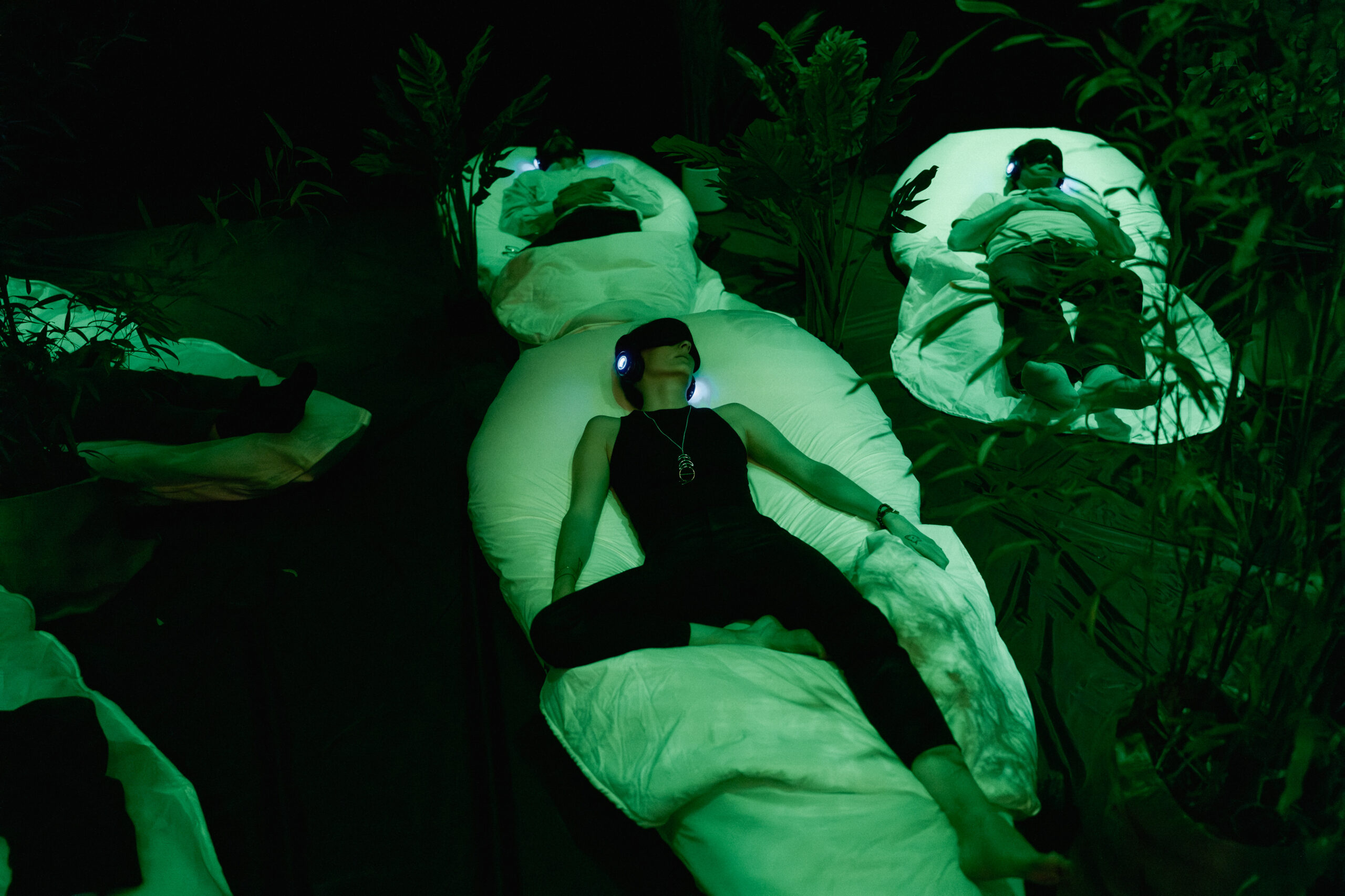
With Passion 4 Fear, a performance scheduled to premiere at the Chroniques Biennale in January 2027, artist Maxime Arnould also investigates the dynamics of conspiracy culture. “When I was a kid, I watched a lot of conspiracy documentaries with my father, especially about 9/11. I became fascinated by the storytelling mechanisms—their ability to communicate violence and generate fear. Then COVID became a major catalyst for conspiracy thinking. I kept the images and the conversations. Since then, I’ve joined around fifty conspiracy groups online. I wanted to understand how these mechanisms work and what actually takes place inside these communities.” Arnould raises a provocative question: “Can art—which necessarily creates fictions—help untangle conspiracy theories, which also create fictions?” That question runs throughout the performance. “We’ve witnessed an explosion of conspiracy beliefs as the capitalist world begins to fracture. We all need to create fictions; perhaps that’s one of art’s essential functions.” The performance begins as audience members interact with the artist through a Telegram group. It then shifts into a performative lecture where Arnould projects documents, glitches and dubs video excerpts, and manipulates various objects. The result is a subjective historiography stretching from 9/11 through the COVID pandemic to the online narratives still emerging today. “Outside the performance, I also continue the discussion online, where audiences can ask questions. I host Twitch livestreams because it’s important to create space for debriefing rather than leaving people in a state of shock.”

One constant defines conspiracy narratives: the extraordinary effort devoted to connecting clues, accumulating evidence, and constructing interpretive systems that eventually become lost within their own branching logic. The sheer amount of time invested in proving these claims often produces labyrinthine narratives in which every apparent answer generates yet another hypothesis. In The New Dark Age: Technology and the End of the Future (2018), artist and writer James Bridle devotes an entire chapter to the chemtrail conspiracy theory—the belief that airplanes deliberately release chemicals into the upper atmosphere. He writes: “Chemtrail theory is complex and protean; its believers subscribe to multiple versions of the same underlying idea. (…) Secret geoengineering, climate skepticism, and the New World Order converge in a vortex of online misinformation, amateur videos, competing claims and rebuttals, and contagious distrust.” These narrative constructions often borrow from New Age spirituality, esotericism, and contemporary forms of visual hallucination. This is precisely what artist Joey Holder explores in The Woosphere (2025), which examines the digital imaginaries and belief systems circulating online.

Likewise, artist Karin Ferrari investigates video-sharing platforms in search of esoteric and conspiratorial narratives. In works such as DECODING The iPhone (2018) and DECODING Lady Gaga (2022), she analyzes historical and contemporary symbols as supposed evidence of extraterrestrial activity or hidden global secrets, particularly those surrounding Antarctica. Using archival footage alongside original animations, Ferrari constructs dizzying chains of causality. On one hand, these meticulously assembled decoding scenarios exert a genuine fascination through their apparent precision. On the other, they expose the absurdity of conspiratorial reasoning, showing how highly improbable associations gradually come to function as evidence. The voice-over that ties the images together ultimately dismantles the very narratives it constructs. By ironically adopting the conventions of algorithmic storytelling, Ferrari reveals the strategies through which credibility itself is manufactured in the age of the internet.
Conspiracy culture has developed a recognizable visual language of its own. It relies on the craft of storytelling, the careful orchestration of suspense, and a narrative grammar built around revelation and dramatic reversals—often amplified through editing. The French-German broadcaster Arte captured these mechanisms in its Underscore series: “The way extraordinary secrets hidden from the world are staged—using everything from Super 8 and 16mm film to digital formats—shows how each medium successfully evokes the fantasies and imaginaries of the era it references.” It is difficult not to see echoes here of Adam Curtis’s documentary aesthetics, particularly in HyperNormalisation, whose dense archival montages and associative editing have often been compared to certain conspiratorial modes of reasoning. Indeed, collage lies at the heart of conspiracy aesthetics.
Memes and symbols also play a distinctive role because of their evocative power and their ability to forge unexpected associations, often almost subconsciously. “The first time I stumbled into a conspiracy network was by scanning a QR code at a bus stop,” recalls Maxime Arnould. “It was on a sticker featuring the White Rose, a symbol of the German anti-fascist resistance. But the community behind it was actually anti-vaccine.” The circulation of symbols has therefore become central to understanding how conspiratorial narratives operate. Although it does not explicitly address conspiracy theories, the collective disnovation.org’s project Online Culture Wars maps the symbolic appropriations and ideological mutations that occur across platforms such as Reddit and 4chan. One striking example is Pepe the Frog. Originally a comic-book character embraced by meme communities as an emblem of internet absurdity, Pepe gradually became politicized, eventually serving as a symbol of ideological affiliation, white supremacist movements, and support for Donald Trump.

Conspiracy thinking did not emerge with the internet. Its underlying mechanisms long predate digital media. What digital environments have fundamentally transformed, however, is the way these narratives emerge, circulate, and reinforce one another. Belgian artist Emmanuel Van der Auwera, whose work explores conspiracy theories surrounding the Sandy Hook school shooting in the United States, identifies the event as a major turning point. The 2012 massacre, which claimed twenty-six lives, was portrayed by certain conspiracy communities as a staged operation orchestrated by gun-control advocates. “To me, this event provided the blueprint for modern conspiracies and anticipated the era of post-truth long before that concept became capable of defining our time.” His performance Can You Make a Hurricane? (2026) examines how conspiratorial narratives are constructed in a postmodern media landscape, weaving together authentic conversations, live-action footage, and archival material.

Digital technologies have undeniably reshaped our relationship with information itself. In The New Dark Age, James Bridle writes: “Paranoia in an age of excessive connectedness creates a vicious circle: our inability to comprehend an increasingly complex world generates an ever-greater demand for information, which only further obscures our understanding, revealing ever more complexity that must then be explained through increasingly Byzantine theories of the world. More information does not produce more clarity—it produces more confusion.” Kenzo Nera extends this analysis:
“Interactions have become frictionless—you can talk to anyone anywhere in the world. Communities form much more easily. The most marginal theories, once believed by only a handful of people, have become widely accessible. Since conspiracy narratives often depend on collecting clues, the traceability of all these online exchanges makes it much easier to construct this kind of story.” The recent emergence of generative artificial intelligence adds yet another layer of complexity. “When people don’t want to believe an image, they can simply dismiss it as AI-generated. But when they want to believe an image, they’re often much less concerned about its origin. That can create the illusion of consensus.”
Grégory Chatonsky reaches a similar conclusion in Paranoïa-critique et rudiments artificiels: “The generative model becomes an accelerator of conspiracy thinking. It densifies existing semantic clusters, progressively narrowing the field of possibilities to an ever more limited and predictable set. This is precisely the effect of recommendation algorithms: they optimize for engagement—that is, for keeping users on the shortest possible path between desire and confirmation. This isn’t a technical anomaly; it’s the intended outcome.”
Online bots further reinforce this impression of collective opinion by amplifying confirmation bias and spreading synthetic misinformation, as illustrated by projects such as Fake Fake (2020). (2020). Will the proliferation of automated interactions and AI-generated content ultimately force us to become more critical media consumers? Maxime Arnould offers a surprisingly optimistic possibility: “If 80 percent of the web ends up being fake, maybe people will spend less time online searching for evidence to support conspiracy theories.”
It is an amusing observation, not least because it echoes the Dead Internet Theory—the online hypothesis claiming that much of today’s internet has already been overtaken by automated content and artificial interactions. A few years ago, this idea was widely dismissed as just another conspiracy theory. Today, however, researchers studying algorithms and generative AI have begun investigating aspects of the phenomenon. For once, conspiracy fiction may end up becoming reality.
Adrien Cornelissen