What place does creative coding have in arts education?
Article published on 21 October 2026
Reading time: 12 minutes
Romain Astouric
Article published on 21 October 2026
Reading time: 12 minutes
“Creative coding”: the expression sounds like an oxymoron, and the misunderstanding has proved remarkably persistent. Yet from its earliest days, computer programming has been used to produce images and sounds. Now an essential part of digital creation, creative coding nevertheless requires specific skills. So what exactly is creative coding? Is it taught as part of artists’ education? And is AI redefining the way it is practiced?
Today in France, eleven of the country’s forty-three public higher art and design schools award a state-recognized degree whose title explicitly refers to digital practices. This year,ésam Caen/Cherbourg is launching a master’s-level degree in Digital Environment Creation. A European master’s degree has also been launched in Saint-Étienne. Yet none of these degree titles contains the word “code”, and you have to look to France’s Ministry of Education, where a DN MADE at Gobelins is actually called “Coding Your Creativity.” Historically, code has occupied a significant place in arts education. At the turn of the 2000s, the internet was recovering from the dot-com crash and preparing to become portable. Code began leaving computer science curricula and gradually making its way into art schools and higher education. It opened up a new range of visual, sonic and interactive experiments, alongside Flash, Director and the multimedia tools already in use, while giving more people the keys to understanding a world that was already clearly becoming irreversibly digit
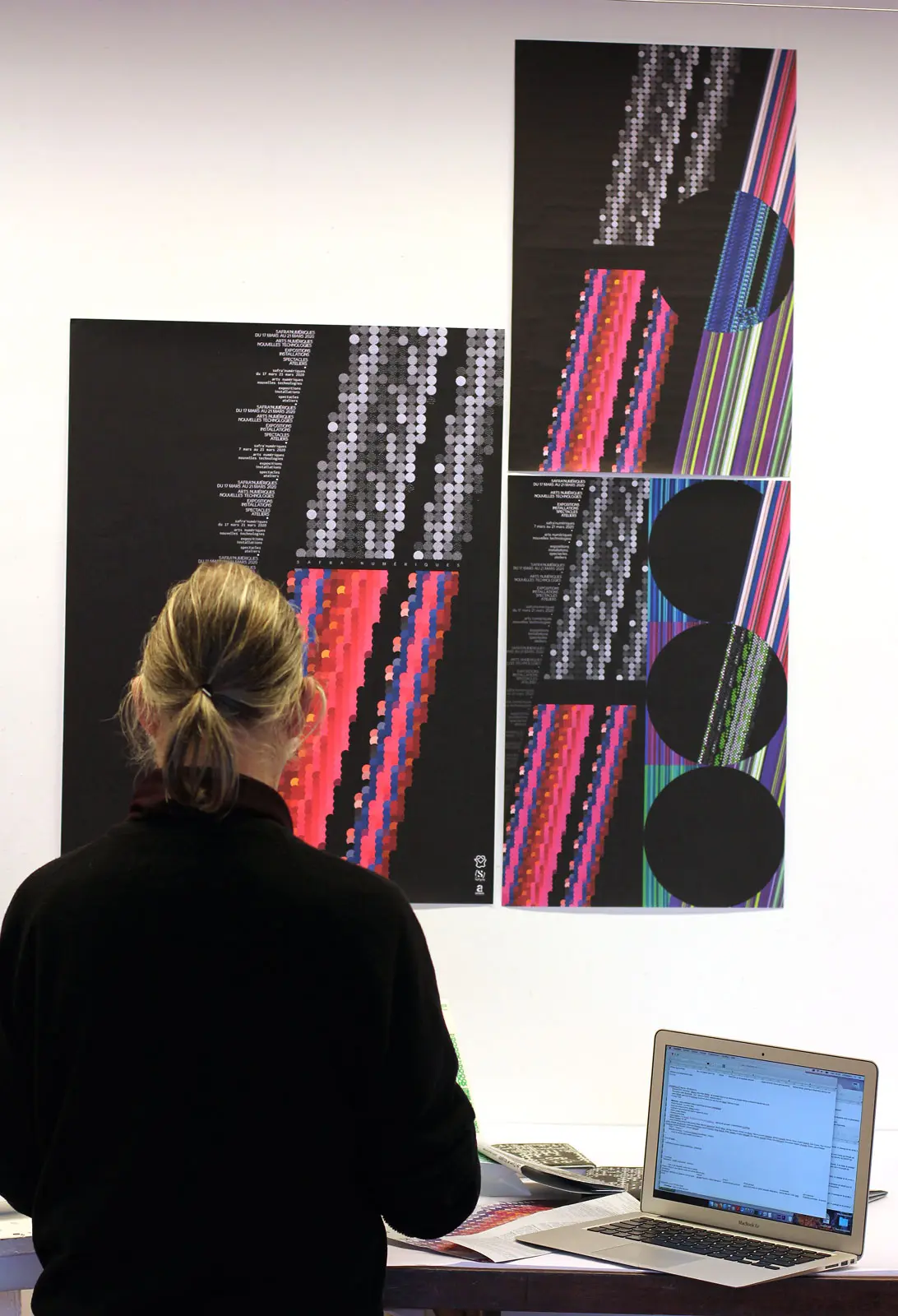
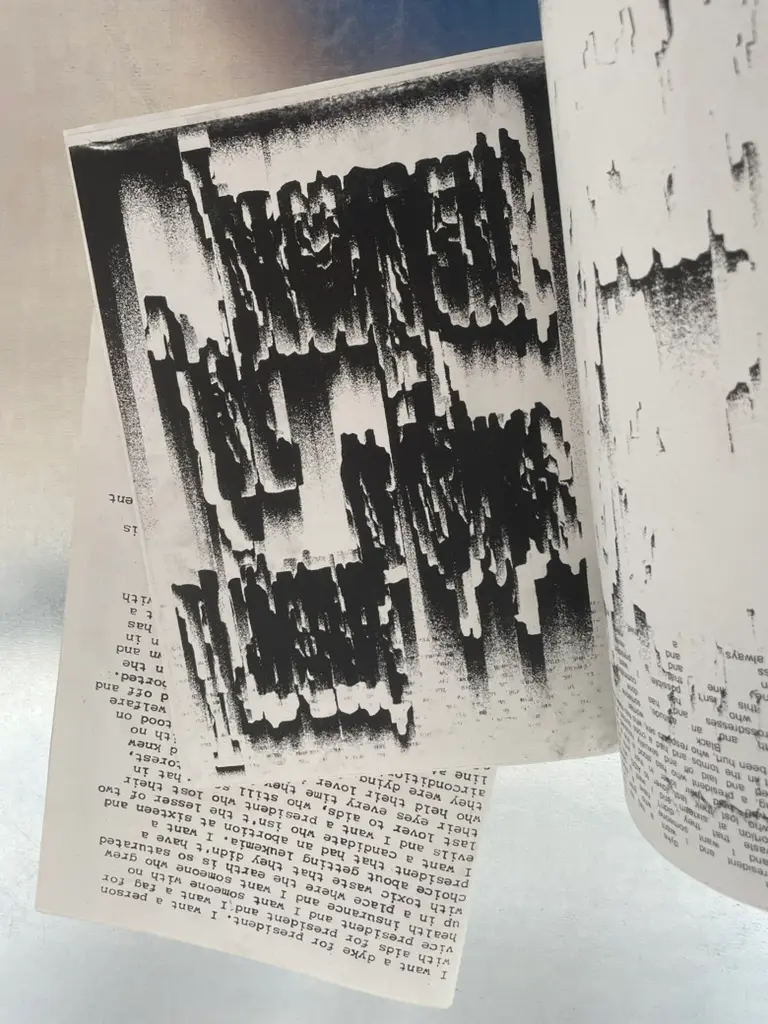
It is worth remembering that while conventional computer programs are written to accomplish something specific, creative coding works differently. Tim Rodenbröker, an independent educator whose online courses are widely regarded as a reference in the field, defines it through this shift: the process is based on “the discovery, variation and exploration of often unexpected results” (author’s translation), with no fixed objective at the outset. This reversal changes the status of error. In software development, unexpected behavior is a bug to be fixed. Here, it is often the starting point: a glitch, a loop running off course, or a parameter pushed beyond its normal range can produce forms that no deliberate intention would have found. The bug becomes material.
What is being taught, then, has less to do with a programming language than with a medium. Mark Webster,a generative artist and teacher at the École supérieure d’art et de design d’Amiens, does not worry much about the label: “I rarely use the term. I simply teach code, and I focus more on code as a creative medium.” Coming from one of the pioneers of this kind of teaching in the French-speaking world, the remark matters: a medium has to be worked with, it pushes back, and it is learned much like screen printing or plaster. This discretion is widespread. The term circulates extensively outside institutions, in tutorials, independent workshops and online communities, but tends to disappear as soon as you enter an art school. Arthur Baude,an artist and teacherat the École de design de Villefontaine,gives a more prosaic, rather than ideological, explanation: “I don’t really use the expression ‘creative coding’ because I don’t want to confuse them.” What this teaching changes is not simply a technique. Programming, even badly, transforms the relationship with computing: the machine stops being a black box that you simply have to deal with and becomes something you can open up. And the gesture changes scale: you are no longer producing a single image, but a system capable of producing a thousand, whose parameters you can adjust without knowing in advance what the result will be.
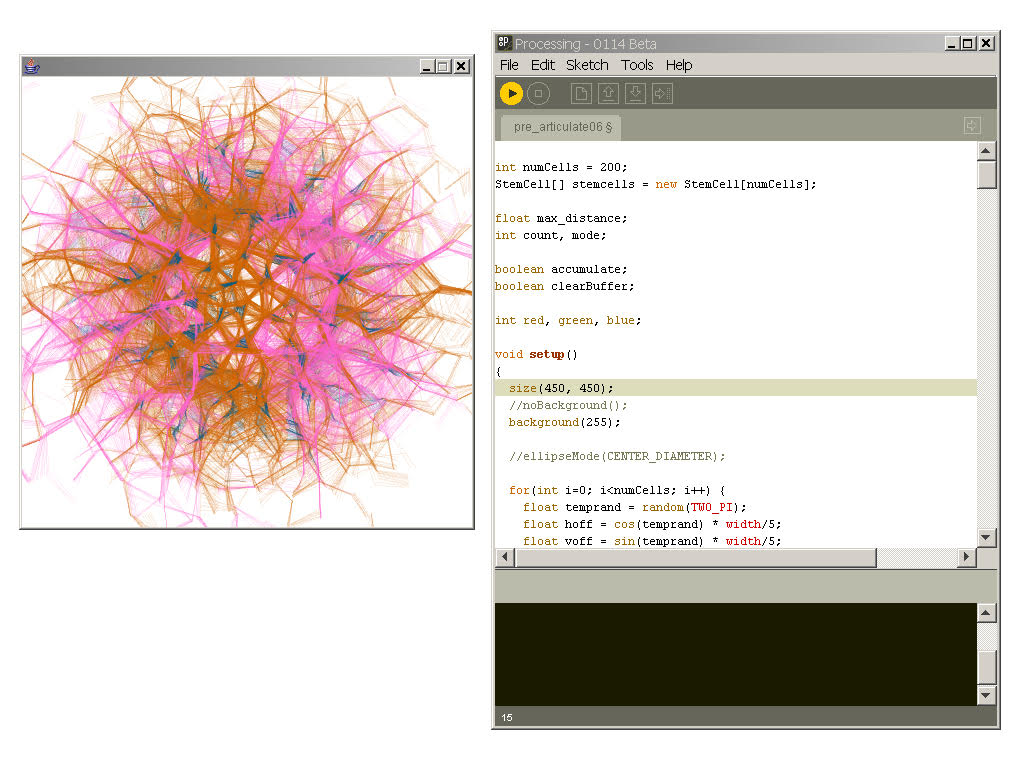
Outside computer science programs, text-based code can be intimidating. A page of syntax, semicolons, incomprehensible error messages: many students get stuck there and never return. Without solving all these obstacles, alternatives exist, including visual environments where you connect boxes rather than write lines of code (TouchDesigner,Max, Blender geometry nodes,or Unreal’s Blueprints), which are generally considered more accessible. Programming or simply manipulating tools? The teachers interviewed arrive at the same conclusion, for much the same reasons. Lucie MRC,a technical instructorat the École de design Nantes Atlantique,focuses on what actually happens: “I consider it programming because you still have algorithmic logic, state machines and functions. In TouchDesigner, I often compare nodes to functions that transform the input data.” Arthur Baude reaches the same point from the other direction: “For me, it is still programming because it is the act of programming actions.” More than syntax, what is being taught is a way of breaking a problem down into operations, the very principle of algorithmic thinking. With or without semicolons… The tools themselves have largely developed outside institutions: Processing, p5.js and openFrameworks are open-source software, and the field has been shaped as much by shared libraries and forums as by schools.
This way of teaching is not a recent adaptation of code to art: it is where creative coding came from. In 1999, John Maeda published Design By Numbers with MIT Press, a programming environment designed for one purpose: teaching designers how to code. Two of his students at the MIT Media Lab, Casey Reas and Ben Fry, soon developed a software tool that would become the field’s reference platform: Processing. Creative coding did not have to be integrated into the pedagogy of art schools: the tool emerged from the classroom, not the other way around.
The challenge was to invent this kind of course in opposition to an established model. In Code as Creative Medium (MIT Press, 2021), Tega Brain and Golan Levin put the issue plainly: for more than half a century, computer science departments have defined the standards for teaching programming, creating a persistent mismatch with art and design students, who have different goals and different ways of learning. What is taught is not simply syntax, but rather a way of thinking about systems, their rules and their effects: a form of “computational literacy.” Code is the means of accessing it, not the end goal.
Where is it taught, and at what level?
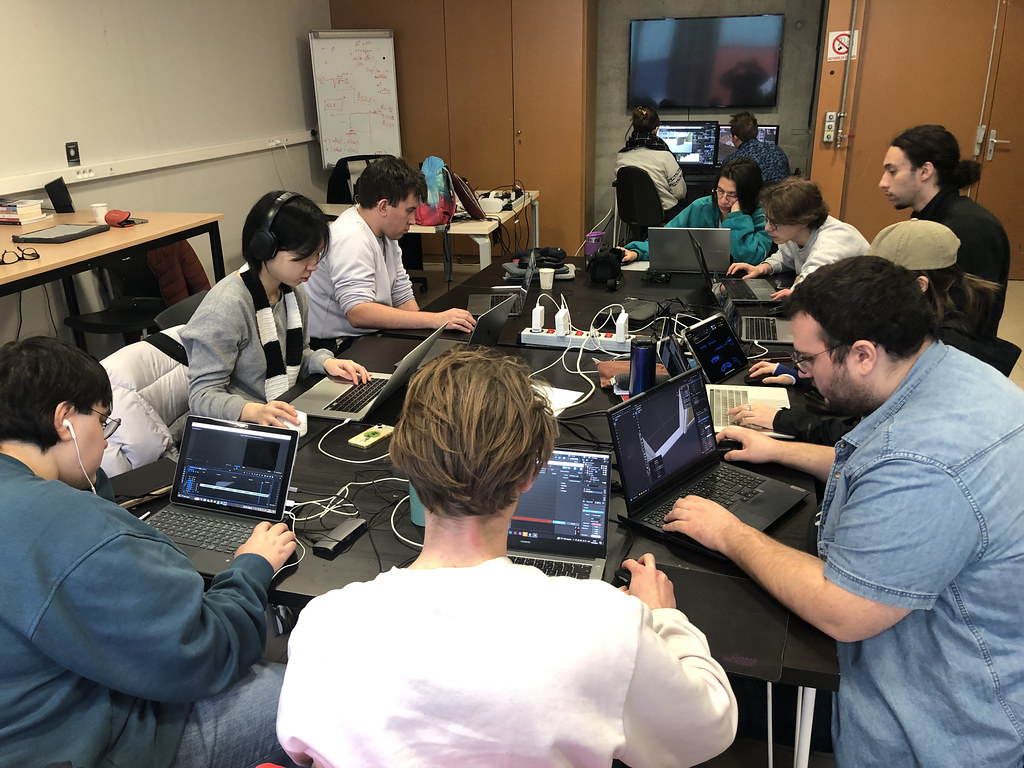
The next question is where this is taught, and how much. Eleven of France’s forty-three public higher art and design schools award a state-recognized degree whose title explicitly refers to digital practices, interactivity or computing, representing one quarter of the network. They are joined by seventeen institutions offering a DN MADE in Digital Design,several university master’s programs and, since last year, a European master’s degree. The numbers challenge the idea that this is merely a supplementary subject. Among the three teachers interviewed, the format varies: two full days every two weeks over two semesters in one case, an intensive workshop combined with ongoing classes in another, but the underlying structure remains the same: the subject is mandatory and is part of the core teaching of the degree. At computer science and development schools, by contrast, creative coding is not a course but a workshop: one week, an outside instructor, an exercise outside the regular curriculum. When it comes to the level of mastery expected, however, institutions diverge, and two recently launched programs take opposite approaches.
In Caen,ésam is launching a DNSEP with eight students per cohort. David Dronet, director of Station Mir, who designed the program, places code alongside other media: “We consider code like any other medium, that is, as a tool. We emphasize that we are not training technicians, but authors who need to give themselves the means to develop their projects. Knowing the tools, without necessarily mastering them, at least means understanding their limits and pitfalls.” In Saint-Étienne, the European DIGICREAshared between three universities in three countries, is geared toward the film, video game and music industries. Lucas Martinet advocates a considerably higher level of technical proficiency: “Students need to maintain an in-depth technical understanding in order to remain critical of AI and know how to guide it. The students we train need to be project leads or architects, with AI as the worker.” Know it on one side, master it on the other.
Because AI will likely be one of the major educational and artistic challenges of the coming years. Lucie MRC in Nantes explains: “For now, the main benefit is saving time, which allows students to push their projects further. But in electronics, for example, with Arduino in our program, students lose some basic skills and quickly end up with code that is too complex for them to understand.” Benoit Wimart, confirms the point:an independent teacher and graphic designer, “In a graphic design class working on a website, it can lead to great projects, but it can also produce things that are difficult to control, using complex methods or concepts.” Arthur Baude takes the argument further: “They are increasingly realizing for themselves that depending on how they use AI, they are shooting themselves in the foot. […] They end up with fairly poor results because they haven’t exercised the creative and memory muscles they need for their profession.” The same observation therefore emerges: students obtain a working result that they cannot read or understand. The problem is not that a model writes the code, but that no one is subsequently able to assess it. Evaluation becomes the essential skill.
Which brings us to the question underlying all the others: if a model writes the code, what is left to teach? Asked to Mark Webster, the question is sent back to the sender: “I don’t think that’s the right question! The real question, for anyone, is this: what do I have to learn by working with a model to accomplish this task?” He is pointing directly at what vibe coding proposes to abandon, a term coined by computer scientist Andrej Karpathy in February 2025 to describe a specific practice: accepting generated code without reading it, and sending error messages back to the model without examining them.
Nicolas Becqueret heads e-artsup, a group of private schools whose main argument is employability, and it is from there that the clearest formulation comes: “We have never needed responsible designers more. The more technology allows us to produce and automate, the more we need to decide what we want to create, for whom, and with what consequences. Among the six people interviewed, none argues that learning to code has become unnecessary. The disagreement concerns the degree of mastery, never the principle itself. And that makes sense: vibe coding precisely assumes that you do not look at the code, which is the exact opposite of what Processing was designed to make possible…