Projections: from architectural heritage to natural heritage
Article published on 24 June 2026
Reading time: 14 minutes
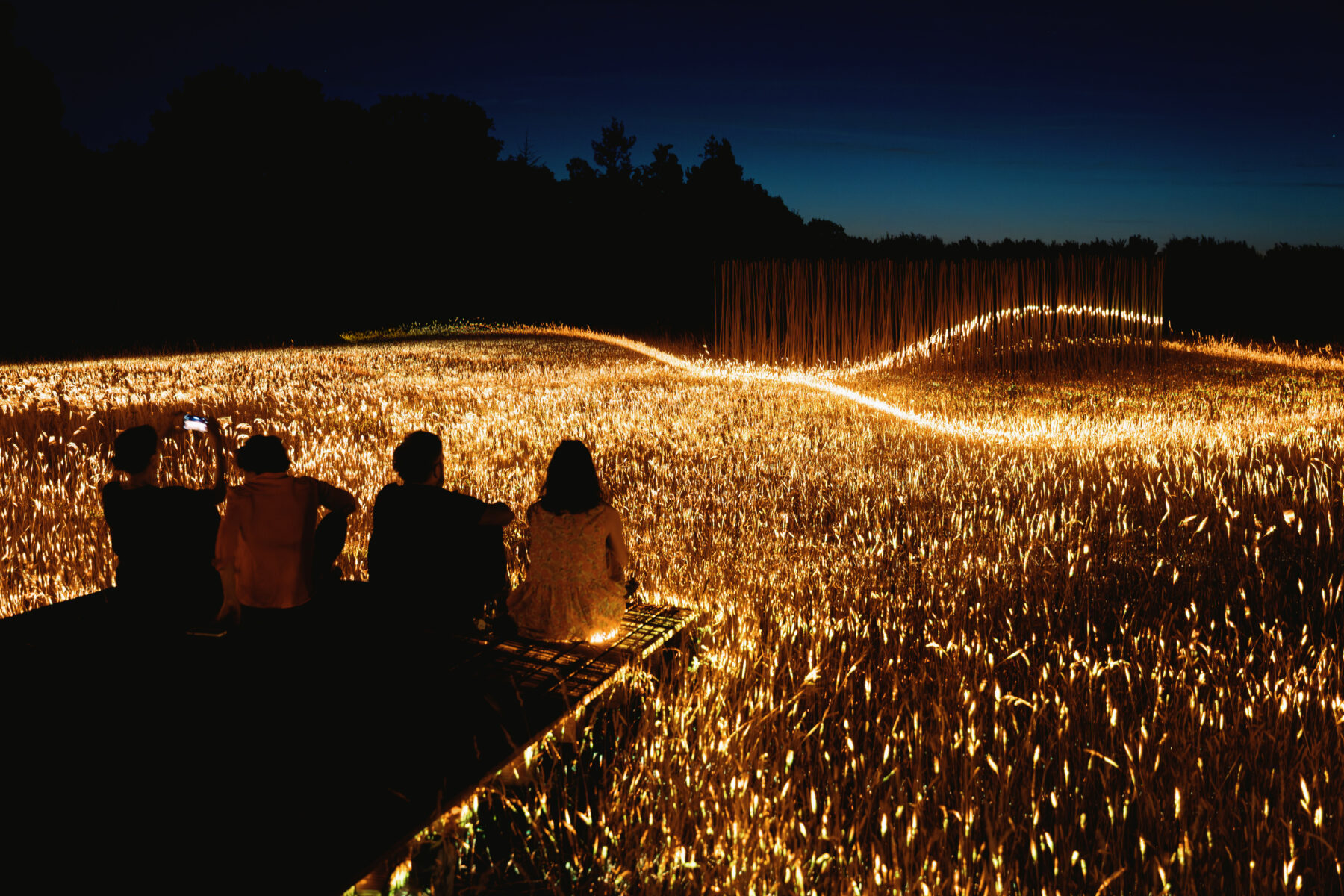
1024 PHOREST - 2025 - Nicolas Trouillard
Article published on 24 June 2026
Reading time: 14 minutes
If historic buildings and architectural heritage have long contributed to the glory of monumental projections, natural environments and living heritage now reveal a renewed artistic interest and reflect the naturalistic concerns at play. This shift aligns with a broader technological movement toward more eco-compatible practices.
Artistic events have embraced monumental projection as a creative mode of occupying public space, one that adapts particularly well to urban heritage (cathedrals, façades of historic monuments). Buildings endowed with historical and symbolic significance prove to be ideal projection settings, well suited to technological spectacle designed to be seen by the widest possible audience. Architectural heritage is therefore especially predisposed to hosting such demonstrations, and major studios have specialized in 3D mapping on heritage sites. Artist Bruno Ribeiro and Moment Factory, for instance, reshaped the dome of Les Invalides through the Aura Invalides installation. Others, such as AV Extended, Studios Creativ Light or Inook, have created multiple configurations—whether thematic or playful—particularly within internationally renowned events such as the Fête des Lumières in Lyon. Beyond city centers, post-industrial sites have also benefited from this form of ephemeral transformation, as illustrated by the mapping presented in 2025 for the twentieth anniversary of the Rockhal on the blast furnaces of the former Belval steelworks in Esch-sur-Alzette. Beyond mapping itself, lighting design applied to auxiliary structures—often purpose-built for performance—has also developed. With Globoscope, Collectif Coin deploys series of luminous globes to create a digitized representation of space. In his piece Frame Perspective, notably installed in the Franciscan cloister of the Maison de la Région in Metz, Olivier Ratsi employs geometric anamorphic light architectures to establish a visual dialogue with the surrounding built environment.
Beyond purely heritage and architectural considerations, some artists seek to expand the creative dialogue of mapping toward more naturalistic concerns. This extension particularly involves bodies of water and other liquid surfaces within urban environments (basins, rivers, waterways), which become integral components of the audiovisual treatment devised by artists. With her project Tornare Alla Fonte, Martina Stella creates a shared artistic surface between the water of a basin and the adjacent architectural walls, working around a principle—expressed directly in the projected words—of returning to the source, both literally and metaphorically, while highlighting restoration efforts dedicated to historic fountains that once played a central role in urban life. “It was upon discovering this magical site—one of the oldest fountains in Macerata, a city in northern Italy—that I conceived a project whose purpose was to bring people back to the source [editor’s note: the literal translation of Tornare Alla Fonte],” she explains. “It was somewhat remote and neglected. There was waste in the water and the basins were dirty, but I wanted to shine a light on this place, now located outside the old city walls, although in the fourteenth century it was one of Macerata’s main public squares.”
Bringing architecture and the liquid element together quickly became the project’s modus operandi. “My initial idea was to project onto the stone and play with reflections in the water, but during testing I realized that the reverberations of the projection between walls and water were particularly compelling,” she continues. “It became necessary to treat both surfaces in the same way, because for me they form a unified whole. There is no architecture without water, and no water without architecture.” The resulting performance piece, created in collaboration with musician Amadeo Savio, developed a metaphorical, ritualistic approach, accompanied by the constant sound of falling water, evoking the rhythm of a deep incantation that envelops the projected phrases. “When working with water, the question of depth becomes strongly involved,” she notes, explaining that “it was necessary to actively search for the words on the surface, since depending on the projection angle onto the wall, reflections of certain phrases appeared much deeper than expected,” thereby distorting the perceived depth of the basin itself. This exploration of texture and text resonates with her ongoing doctoral research on the concept of emersive mapping—a framework linking political and relational concerns rather than spectacle in public space, and drawing on the principle of emersion, which evokes emerging sensations produced by a living body.
Other creations further demonstrate the possibilities offered by water. During the 2025 edition of the Signal Festival in Prague, audiences encountered the project Tzolk’in Light by Taiwanese studio Peppercorns, featuring geometric forms projected onto a mist surface. This work recalls the seminal piece Constellations by Studio Lemercier, led by artist Joanie Lemercier and artistic director Juliette Bibasse. In this case, however, the installation benefits from breaking the physical distance between device and audience characteristic of Tzolk’in Light—where spectators remain on the riverbank while the installation unfolds midstream—and instead fully integrates a sensory dimension aligned with Martina Stella’s emersive approach.
Created in 2018, Constellations forms part of a broader body of work by the studio, including more contemplative projects such as Brume and the permanent installation Lightfall in Miami, all reflecting the duo’s sustained interest in working with fully immersive water curtains. “Our starting point in working with water came from a desire to move beyond the screen and toward immersive, sensory devices,” emphasizes Juliette Bibasse. “There is no projection surface more intangible or magical than water. It allows us to create an image suspended in space, appearing almost like an apparition.” The sensory dimension is essential within such installations. “We try to allow audiences to pass through the image, to enter it, to feel this barely perceptible mist,” she adds. “For me, this represents an additional layer in our work—this idea of sensation has become absolutely essential. The presence of water is also increasing in our practice. We are currently developing a new work based on a drip-by-drip mechanism that will be presented at HEC in August.”
”
Water as a central subject in digital installations? The phenomenon is far from isolated in this era often described as the Anthropocene, marked by pressing questions surrounding access to water. Many artists are therefore redirecting their aesthetic choices and mapping surfaces toward more critical and political dimensions. With projects such as Lightwave and Phorest—now renamed Plankton, a large rectangular surface composed of 500 bamboo stakes that generate a pulsating, meditative choreography evocative of ocean movements—studio 1024 Architecture demonstrates this commitment to re-engaging with natural heritage. “This is one of our current research directions,” explains François Wunschel. “Reconnecting with nature and landscape, and emancipating ourselves from computing—at least regarding the operational aspects of implementation.” The studio’s forthcoming project, tentatively titled Sauterelles and scheduled for presentation at the next edition of Chroniques, will combine bamboo structures and LEDs.
Over recent years, Studio Lemercier has similarly expressed this naturalistic inclination through works such as All The Trees and Prairie, involving projections within natural environments and advocating a more low-tech, “conscious, measured and reasonable” use of technology, particularly regarding energy consumption. In 2024, the studio even created a “studio within the studio,” Solar Lab, dedicated to supporting projects more directly connected to real-world ecological contexts and revolving around the concept of the “third landscape.” “For our project All The Trees, we wanted to talk about all trees, without focusing on exceptional specimens—century-old trees or whatever classifications we often impose,” Juliette Bibasse explains. “Working with the third landscape means paying attention to plants that have seeded and reseeded themselves in neglected or abandoned spaces.” In this sense, Solar Lab explores both botanical gardens and urban wastelands, enabling the development of local nature-based projects without transporting audiences into fragile wild environments. “In projects such as All The Trees or Prairie, we are not working with mapping at all,” she adds. “We deliberately limited color palettes and rhythms. What is truly beautiful in these works is the geometric structure created by nature itself—extremely detailed and refined. Since we aim to minimize technological tools, we use lasers, for which Joanie has developed deep expertise, as they require compact batteries and recharge quickly.” ”
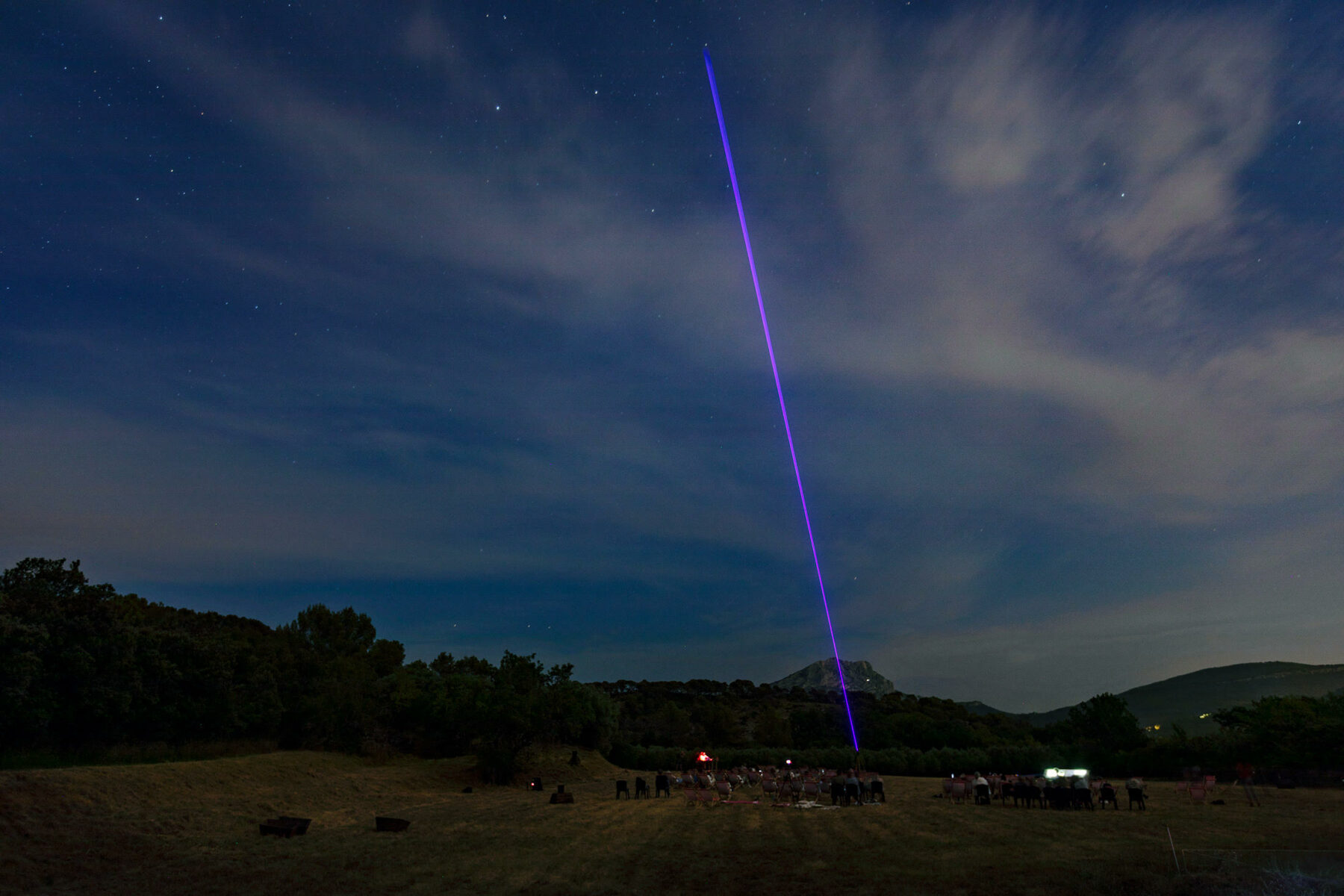
Lasers are also the central tool of Exo, a project by digital artist Félicie D’Estienne d’Orves and composer Julie Rousse, which uses the most visible natural surface of all—the sky—as its medium. In this case, there is no mapping or projected imagery, but rather a real-time reading of a score composed of celestial objects (planets, stars, exoplanets, galaxies, black holes, supernovae, pulsars), tracked by a laser acting as a gigantic reading head. Developed over several years—particularly following an artist residency in the high-altitude Atacama Desert in Chile, along with multiple scientific collaborations, notably with the CEA and the Marseille Astrophysics Laboratory—the project first materialized in 2018, before being recently restaged in July at Domaine Aubrun near Aix-en-Provence. “The project’s aesthetic relies on the real-time perception of celestial objects present in the sky on the evening of the performance,” explains Félicie D’Estienne d’Orves. “Each sound composed by Julie corresponds to a celestial object whose characteristics, distance from Earth and precise position are known. We also collaborated with Fabio Acero, an astrophysicist at the CEA, who developed visualization tools categorizing objects by type and distance, and programmed a customized sky map.”
Live performance provides wide visual freedom and amplitude for spectators, who can follow the laser ascending into the sky and pointing toward celestial bodies in a full-scale naturalistic orchestration. “Each performance adapts to the sky map of the day,” she continues. “We select around one hundred objects to be pointed to during the performance, based on their position, distance and type. The sound composition evolves in relation to the sculptural qualities of the lasers and the dynamic lines traced across the sky.”
The existence of a venue such as the Carrières des Lumières demonstrates that this turn toward natural environments as sites for creation and presentation can deeply resonate with large audiences. Managed since 2012 by Culturespaces—which also operates urban immersive venues such as
L’Atelier des Lumières in Paris and Bassin des Lumières in Bordeaux, respectively located in a former metal foundry and a former Second World War submarine base—Carrières des Lumières stands out as the only projection and 3D mapping venue located within a fully natural environment, near the village of Les Baux-de-Provence. Its distinctive aesthetic identity is rooted in the specific character of the site itself, defined by towering granite blocks that create strong verticality. “Carrières des Lumières is a vast and impressive space—over 2,500 square meters of floor area—with the appearance of an underground cathedral formed by massive granite pillars,” confirms Grégoire Monnier, director of Culturespaces Studio. “We project images up to ten meters high, and in some areas even beyond twenty meters, reaching the ceiling. To adapt to such a unique topography, we deploy a highly flexible projection system. We have chosen to multiply the number of projectors to cover every corner of stone surrounding visitors. ”
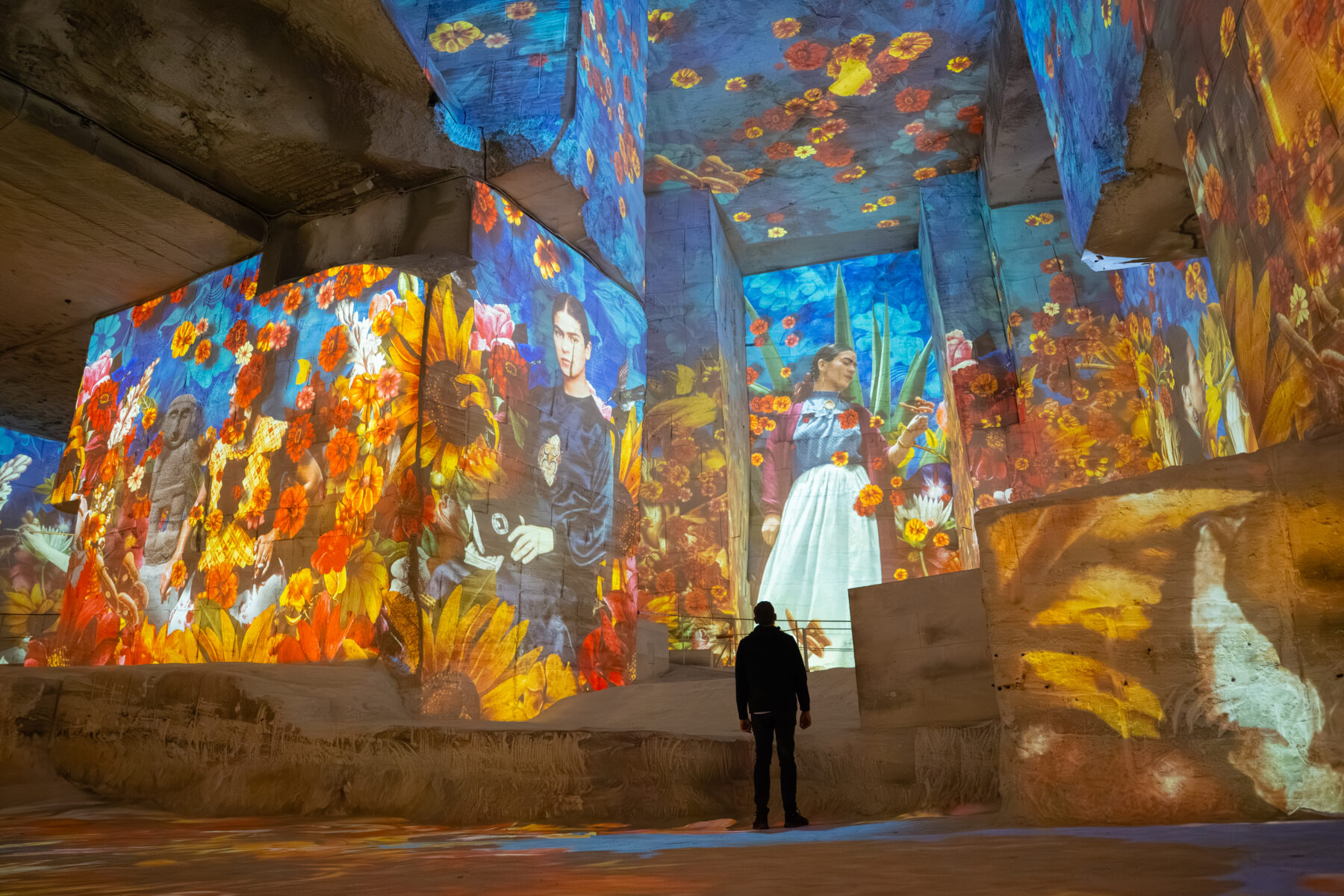
Granite, however, presents significant technical challenges, both visually and acoustically. “The granite makes things considerably more complex,” Monnier notes. Monnier notes.“There are numerous echoes in the quarry—it is essentially every acoustician’s nightmare. To compensate, we use highly directional speakers: when you stand in a specific location, you hear only the speakers aimed at that area, not those positioned farther away. For image projection, the granite is relatively light in color, which is not ideal in terms of contrast. We therefore dedicate substantial effort to calibrating our image settings to ensure that each color appears as faithfully as possible.” By focusing exhibitions on works by major classical artists (Van Gogh, Monet, Picasso) or thematic universes such as L’Égypte des Pharaons in 2024—whose raw, mineral qualities proved particularly suited to the site — Carrières des Lumières achieves a synergy between immersive proposals designed for broad audiences and the occupation of a unique environment already aligned with this emerging direction toward natural spaces. “In reality, Carrières des Lumières is often visitors’ favorite site,” Monnier observes. “Yet it is essentially just a cavity carved into a mountain. You enter through a modest doorway, only to find yourself in an immense space. There is something deeply surreal about discovering such a place, whose existence is barely imaginable from the outside.” Its exceptional nature also underscores the scarcity of natural sites capable of accommodating large audiences for such performances, given the fragility of their ecosystems. In this sense, it both confirms and embodies the increasingly prominent trend toward eco-compatible artistic and technological practices—one that now engages studios, programmers and large audiences as much as visionary contemporary creators.
Laurent Catala