New forms of narration, augmented dramaturgy, storytelling… “Narrative” now takes shape in many forms—whether in writing, staging, or communication. Yet they all seem to point toward the same ambition: interacting with audiences and turning them into active participants in a sensory experience.
“People have been telling stories since the dawn of time,” says Emanuela Righi, co-founder of Novaya, a production company specializing in immersive installations. Yet XR technologies and social media have disrupted the way audiences are addressed, giving stories a new dimension while paradoxically bringing the importance of storytelling back to the forefront.
Engaging audiences
“Ten years ago, at the beginning of VR, producers—often coming from film and audiovisual backgrounds—were betting that everyone would own a headset,” explains the producer, who also serves as secretary of the professional network PXN. At the time, she notes, many works leaned toward gaming. “Then the field began drawing inspiration from live performance, which relies heavily on storytelling,” she continues. At the intersection of these disciplines lies the immersive work Noire, which she produces—an adaptation of Tania de Montaigne’s essay. It recounts the story of Claudette Colvin, a young girl convicted for refusing to give up her seat to a white passenger, just months before Rosa Parks. At the center of the experience, audiences are invited to discover her story and adopt different points of view. “They become co-directors, because they decide how to look at this story, how to experience it, how to move through it,” explains Emanuela Righi. Here, narration acts as a guide, enabling what she describes as “a fluid, embodied experience,” supported by a combination of elements—set design, spatialized sound, headsets, lighting effects, and more.
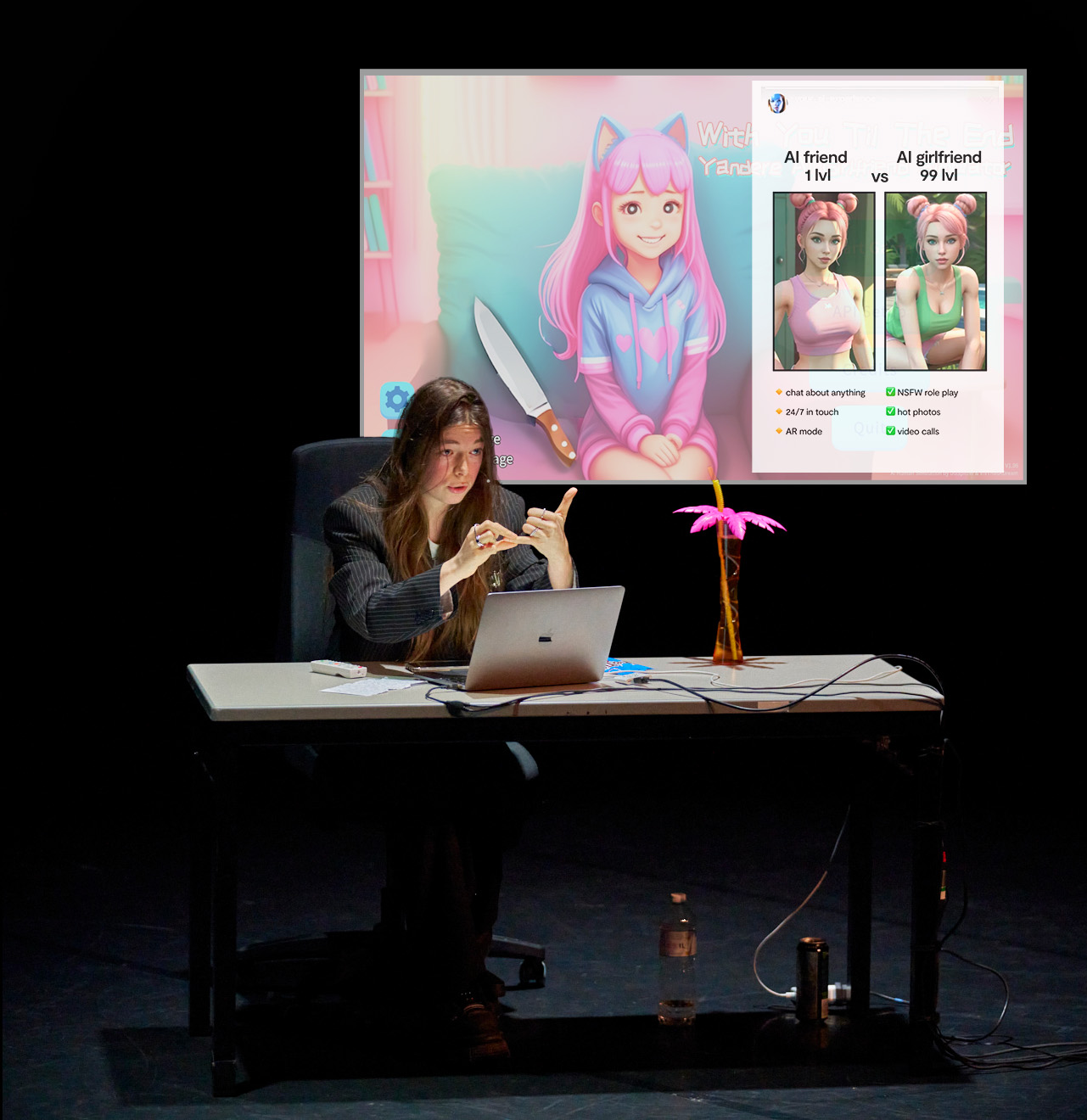
“We offer an in-situ experience: the body is fully engaged,” adds Jérôme Fihey, founder of Le Crabe Fantôme and co-president of PXN, describing the contribution of narrative thinking. A member of the Expo committee, he develops immersive exhibition design projects. “Narration creates engagement and tension,” he says. It is not necessarily synonymous with linear storytelling or fiction; it can also be experimental. In the summer of 2025, the magazine Théâtre public devoted a special issue to intersections between theater and digital technologies, linking them to the question of new imaginaries. Co-coordinated with Jean-Louis Besson, theater director Jean Boillot presented the augmented dramaturgy laboratory he initiated. Building on experiments in remote theater developed during the COVID period, Le Nouveau Décaméron is based on the premise that digital media require a specific form of writing. His production L’Arbre de Mia takes the form of “ready-to-play theater”: a theatrical experience in which spectators also become performers through a smartphone that delivers their role.
Rethinking an ecosystem
While he speaks of “a transformation underway,” Jean Boillot also notes that “an entire ecosystem still needs to be rethought.” The challenge, he explains, is to create dialogue between venues and artists in order to better integrate narrative-based works into theater spaces—by questioning, or reinvesting, the frontal layout of traditional stages. Providing a shared space for reflection and experimentation around digital transformations is precisely one of the goals of the TMNLab community. While skepticism toward digital tools may have lingered among venue directors a few years ago, Clément Coustenoble sees this resistance diminishing today. The TMNLab project manager points out that “digital culture, as a social phenomenon, has transformed practices that are not themselves digital.” New forms of narration are also reshaping institutions in multiple ways—particularly in communication and audience engagement, with the goal of “improving dialogue with audiences and reaching new ones.” This is the focus of a self-learning platform dedicated to data-driven management and marketing strategies. Through the project Unlock théâtre, the association is also seeking to “leverage social media to rekindle interest in theater outings among thirty-somethings.” Among the tools developed is #tapremiereautheatre, a Reel format in which non-attendees share their first theater experience, before and after attending.
Dramaturgy, storytelling, narration…
“Many terms cover the same idea, and the same term can carry different meanings depending on the perspective,” the project manager reminds us. For him, the real challenge lies in collaboration, shared knowledge, and collective cultural literacy among all stakeholders in a project—artists, technical teams, audience engagement staff, and more. These questions will be at the heart of the event Chaillot Augmenté x Rencontre TMNlab — Performing Arts and Digital Environments, taking place on May 5 and 6, 2026, in Paris. And if the word narration is so often paired with new, does that imply a constant push for novelty and innovation? Jérôme Fihey calls instead for the “standardization of technologies, without falling into rigid formatting.” Emanuela Righi, for her part, highlights the diversity of audiences targeted by her narrative projects: “Our approach is to make the technology invisible, so it serves only as a support for the story.”
Driven by Cie La Spirale, the 2nd European Encounters on New Writing Practices will take place in Metz in October 2026. Among other topics, they will examine the durability of formats, addressing the challenge of “anchoring them over time” in order to move beyond perpetual prototyping, as Jean Boillot explains. He adds: “Digital culture is the new popular culture, and a powerful lever for renewing audiences and reaching those who are distant or excluded.” But this requires dedicated writing practices capable of guiding audiences into—and back out of—these sensory experiences.
Diversity of narratives: a political issue
“The new buzzword is ‘story,’” says Jérôme Fihey, who also notes that “far-right movements are heavily investing in these media, which allow for strong emotional engagement with audiences.” This observation is echoed by historian Martial Poirson, professor at Université Paris VIII, who analyzed what he described as “an ongoing offensive” in the newspaper L’Humanité. As a producer and co-president of PXN, the head of Le Crabe Fantôme emphasizes the importance of using these new narrative forms to “guarantee a diversity of perspectives, including those that have long been invisible.” He calls for a genuine “network of cultural venues” that would allow a wide range of works and narratives to exist.