BOOK CLUB #5 (AI SPECIAL)
Article published on 18 June 2026
Reading time: 5 minutes
Article published on 18 June 2026
Reading time: 5 minutes
How does digital technology impact artistic creation? What if we looked for answers in recently published or upcoming books? HACNUMedia has selected several titles to fuel your reflections and sharpen your critical perspective. A selection dedicated specifically to generative Artificial Intelligence.
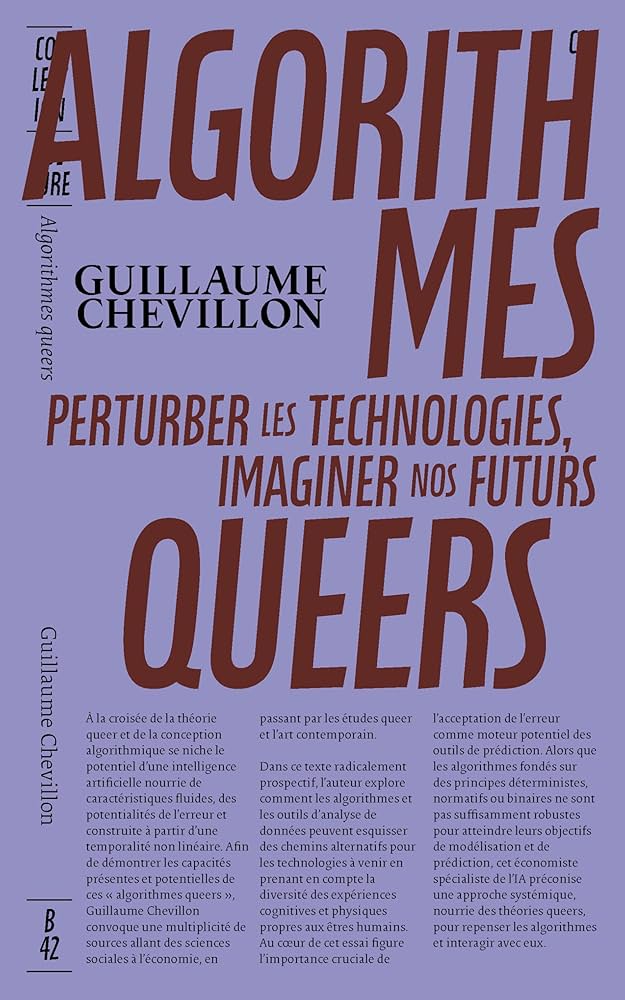
Guillaume Chevillon
B42 – avril 2026
“Where queer theory and algorithmic design intersect lies the potential for a fluid, cooperative, non-linear AI, one that is nourished by the possibilities of error.” This sentence, printed on the cover, strongly resonates with the research of many digital artists. Although the book never directly addresses artistic practices, the connections with the field of creation quickly become clear. Guillaume Chevillon, a researcher in economics and data science at ESSEC Business School, asks a simple question: how can we move beyond deterministic logics? But also: why should we? Because in a world where Big Tech promises are reduced to optimization and productivity, it may be time to consider an alternative technological approach, one better aligned with the challenges of our time. The researcher’s reflection unfolds across five short chapters. The first ones establish the context before leading to the heart of the book, “Shaping a Queer AI,” the third chapter, which outlines a methodology: opening spaces for experimentation, rehabilitating error, fostering forms of solidarity, embracing uncertainty… Guillaume Chevillon sketches concrete paths toward imagining less normative technologies, capable of welcoming hesitation and collective intelligence. Utopian (and that feels refreshing), this essay develops a theory where artists themselves create images, in both the literal and figurative sense. A must-read!
AC
Albertine Meunier
L’avant galerie Vossen – avril 2026
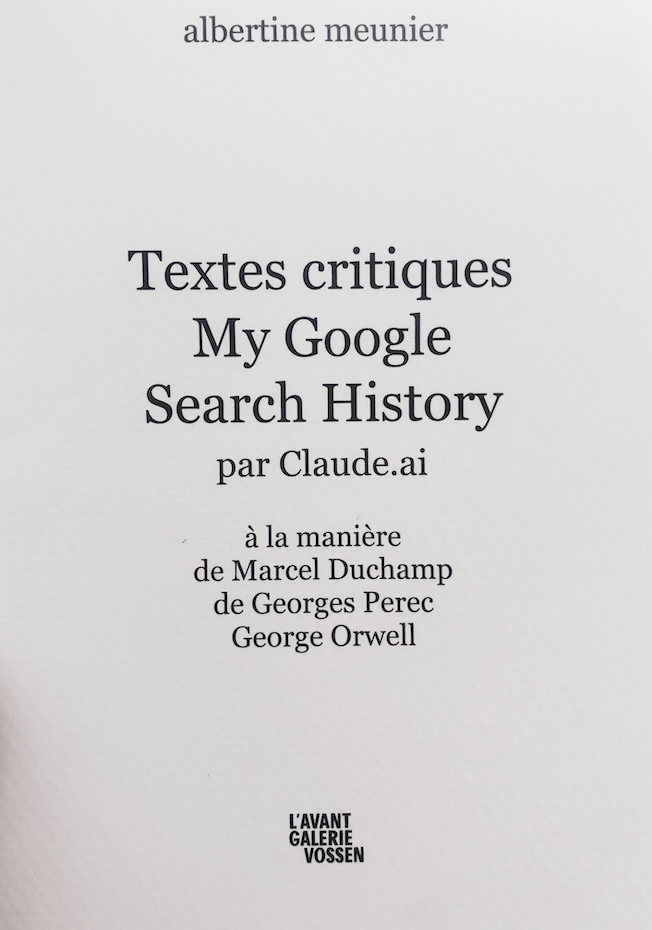
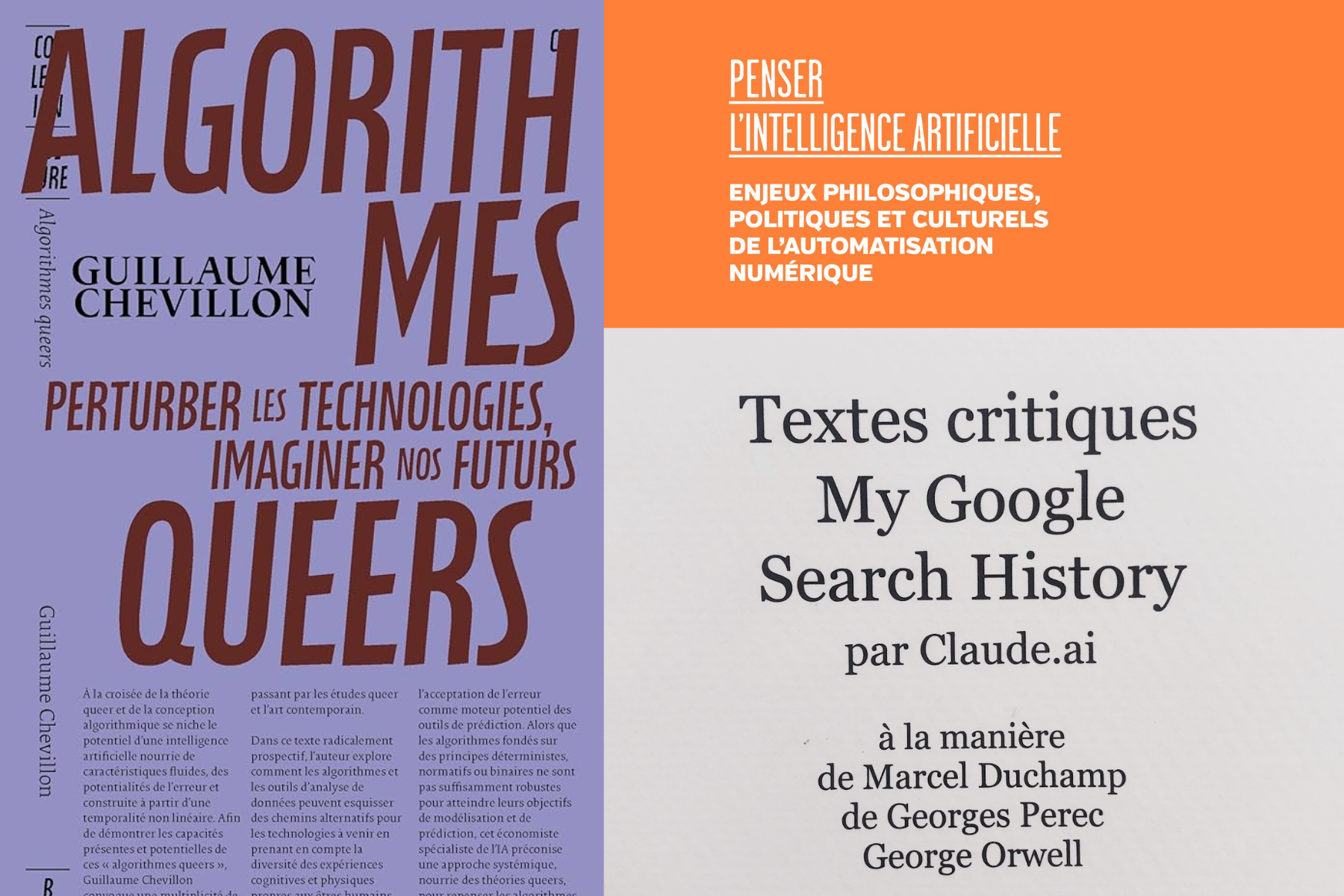
While we all leave traces on the web, few of us transform this material into an artistic work. The exception is Albertine Meunier. For twenty years, the French artist has archived and compiled her search histories into three volumes. These Google queries document less her own life than a way of interacting with machines… which have continuously evolved. Naturally, generative AI had to be part of the story. This is precisely the focus of her fourth volume, Critical Texts: My Google Search History. Here, Claude successively adopts the style of Marcel Duchamp, Georges Perec, and George Orwell to comment on the artist’s search history. Three texts with a strangely compelling relevance. Georges Perec’s contribution (a dream alter ego for Albertine Meunier) stands out through its Oulipo-inspired evasions. Beyond the technical demonstration, the book primarily reveals a paradox: an artificial intelligence trained on web data producing a discourse about that very same data. A loop that is both absurd and not without interest. The result is playful, humorous, and coherent. Duchamp, the artistic gesture… Perec, the structure of language… Orwell, manipulation and control… These authors were clearly not chosen by chance.
AC
Sous la direction d’Anne Alombert, Alban Leveau-Vallier, Baptiste Loreaux
Les Presses du Réel – 2026
Contrary to the narrative of “technological replacement,” this book develops an epistemological and ethical reflection on AI. Bringing together around twenty contributions from philosophy, mathematics, political science, and the arts, the volume focuses less on technical performance than on the democratic and cultural transformations brought about by automation. The authors trace the emergence of these technologies since the 1960s and their effects on our attention systems, our uses of language, and our imaginaries. Several artist-researchers enrich the book with their perspectives: Gregory Chatonsky and Yves Citton examine the reconfiguration of memory in the age of generation, while Pierre Cassou-Noguès and Gwenola Wagon, whose brilliant essay Les Images Pyromanes we previously discussed, sketch the outlines of an algorithmic neo-romanticism. Within this paradigm, images are produced to capture attention and necessarily carry a power of fascination. A special mention goes to Judith Descamps’ text, “Can AI Teach Us How to Grow Old?”, which shifts the focus toward imaginaries of fragility and disappearance, far from contemporary demands for constant performance. Her contribution, based on an experiment conducted with people living with disabilities, ultimately reflects the book itself: analytical, demanding, accessible, and grounded in concrete examples.
AC
Are you an editor, author, or artist publishing a book aligned with our editorial line? Get in touch with us: we can feature it in our next Book Club article.