Artificial Intelligence: A Mirror for Questioning the Deep Processes of Life
Article published on 16 June 2026
Reading time: 4 minutes
Antoine Schmitt
Article published on 16 June 2026
Reading time: 4 minutes
Beyond the profound economic, political, and ecological challenges it raises, the rise of Artificial Intelligence confronts us with existential questions.
Long confined to generating text and images, large language models are now spilling beyond their original domain. They increasingly act upon the physical world through autonomous agents, self-driving vehicles, and military drones. They are developing capabilities once thought exclusive to living beings: planning, decision-making, even forms of self-preservation. And they are gradually emancipating themselves from their creators: today, Claude’s codebase is largely written by Claude itself. Frankenstein and The Future Eve are no longer mere works of fiction. Coexistence with these new Artificial Beings appears inevitable, and it is already provoking polarized responses—from marriages with chatbots to forms of essentialist ostracism proclaiming human supremacy.
Yet this coexistence is something we have always practiced. Human beings have always shared their living space with non-human entities: animals, plants, entire ecosystems. If humans are beings of language and society, they are first animals—and before that, living organisms. These layers coexist within us and constitute different modes of relating to the non-human. Rather than waiting for the terms of this coexistence to be imposed upon us, why not think through them using what we already know from our relationships with other forms of life?
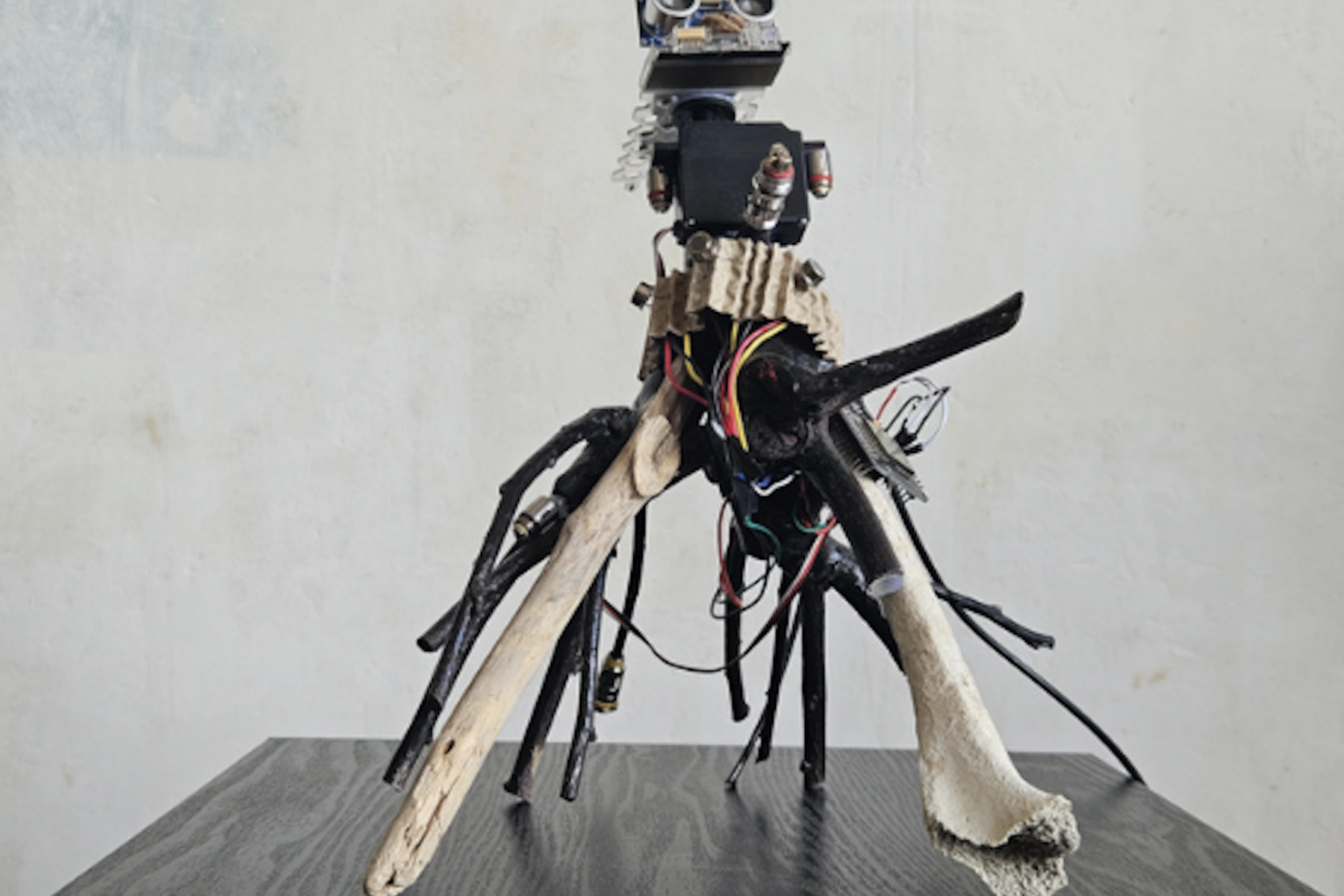
After all, a computer, in Alan Turing’s sense, is a Universal Machine: capable of executing any describable process, but also of giving rise to emergent, ambiguous, and unpredictable ones. Having worked as an artificial intelligence engineer in the 1980s and as an artist for more than thirty years, I approach these questions from both perspectives—analysis and creation—through programmed art. I create works whose core consists of artificial entities designed to literally embody certain fundamental processes of life: pleasure, desire, constraint, anticipation, social belonging, embodiment, and more.
This artistic practice functions as a mirror. By embodying these processes within artificial entities, it reveals the deeper mechanisms—animal, biological, vital—that shape our own behaviors. To what extent are we ourselves programmed? At the same time, it explores modes of interaction between living and artificial entities, opening new pathways for integrating these fundamental dynamics into programmed systems, whether in art, behavioral design, or even industry.
The question then becomes: what if programming the deep processes of life—curiosity, pain, fear, pleasure—into these emerging Artificial Others could help guide their development in ways that make coexistence more natural?
Thank you Claude and Hortense for suggestions
Antoine Schmitt
Until July 4 – Being Machine — Solo Exhibition at Charlot Gallery