Book Club #6
Article published on 26 November 2026
Reading time: 7 minutes
Article published on 26 November 2026
Reading time: 7 minutes
How does digital technology shape artistic creation? What if we looked for answers in recently published books? HACNUMedia has selected several titles to fuel your thinking and sharpen your critical perspective.
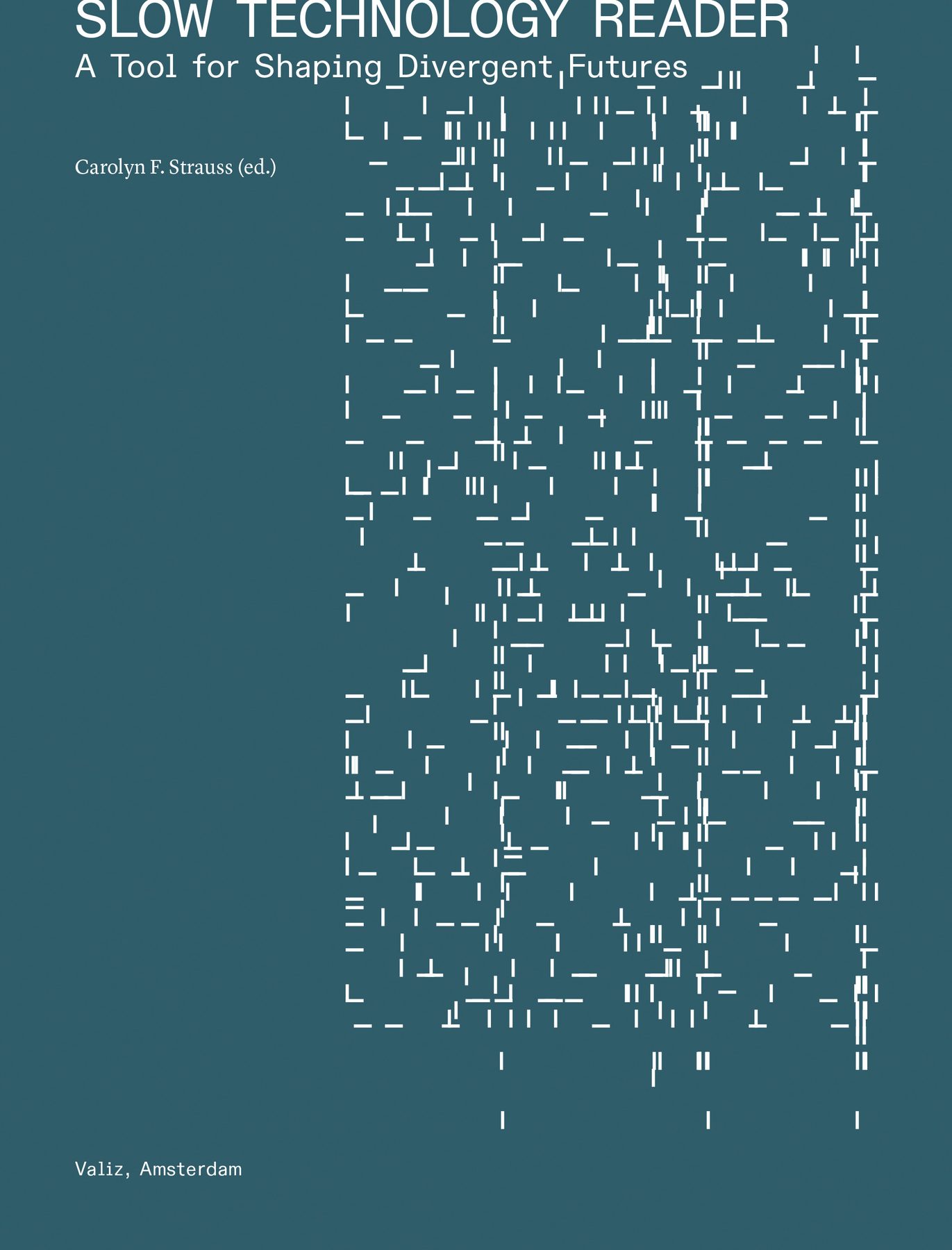
Carolyn F.Strauss
Valiz, 2026
In a world where the digital frenzy is measured by the latest gadgets unveiled at keynote presentations, what might technologies attuned to the rhythms of life look like? This is the question raised by Slow Technology Reader, edited by Carolyn F. Strauss. The book features contributions from well-known authors such as Kader Attia, Jaron Lanier and Paula Albuquerque, who share their perspectives and personal experiences. Around fifty artists, researchers, theorists and activists from across the globe (with a slight emphasis on the Flemish and Northern European scenes) explore alternative paths, some of them, it must be said, almost iconoclastic. Feminist, queer and Indigenous perspectives shift our gaze. Rather than pursuing the race for innovation, they draw inspiration from vernacular know-how and nonhuman forms of intelligence. Following in the footsteps of permacomputing, the book challenges our technomaximalist imaginaries and the power structures underpinning digital systems. Spoiler alert: containing no images and made up entirely of texts, the book quite literally invites us to take the time to read. But in this day and age, isn’t it time to revisit the old saying and admit that, when it comes to technology, “slow and steady wins the race”?
Adrien Cornelissen
Arnaud Idelon
Éditions Divergences, Juin 2026

The crisis in the cultural sector is a familiar refrain, periodically repeated by cultural professionals, warns Arnaud Idelon in his new book Culture Low Cost. Yet, for the author, journalist and programmer, 2025 marks the culmination of this gradual decline. The most visible symptom is the drastic cuts to public funding, at both the local and national levels, amounting to a “silent redundancy plan.” Idelon argues that this budget crisis is the result of a political crisis. How can we expect the public to support and fund the cultural sector when it is perceived as elitist and as serving a particular political ideology? How can we continue to defend the French cultural exception when a widespread sense of fatalism is taking hold among cultural professionals?
Culture Low Cost is, in the author’s words, a “situated, partial and activist (…) account of the gradual decline of public cultural services and what it reveals about the place of culture in French society today.” It is also an invitation to the cultural sector to hold up a brutally honest mirror to itself and question its beliefs, narratives and internal dynamics. “If the cultural sector has failed to democratize access to culture despite having substantial resources at its disposal, how can we expect it to succeed in the current climate?” Faced with this existential challenge, Culture Low Cost raises uncomfortable questions in order to explore possible alternatives.
Elsa Ferreira
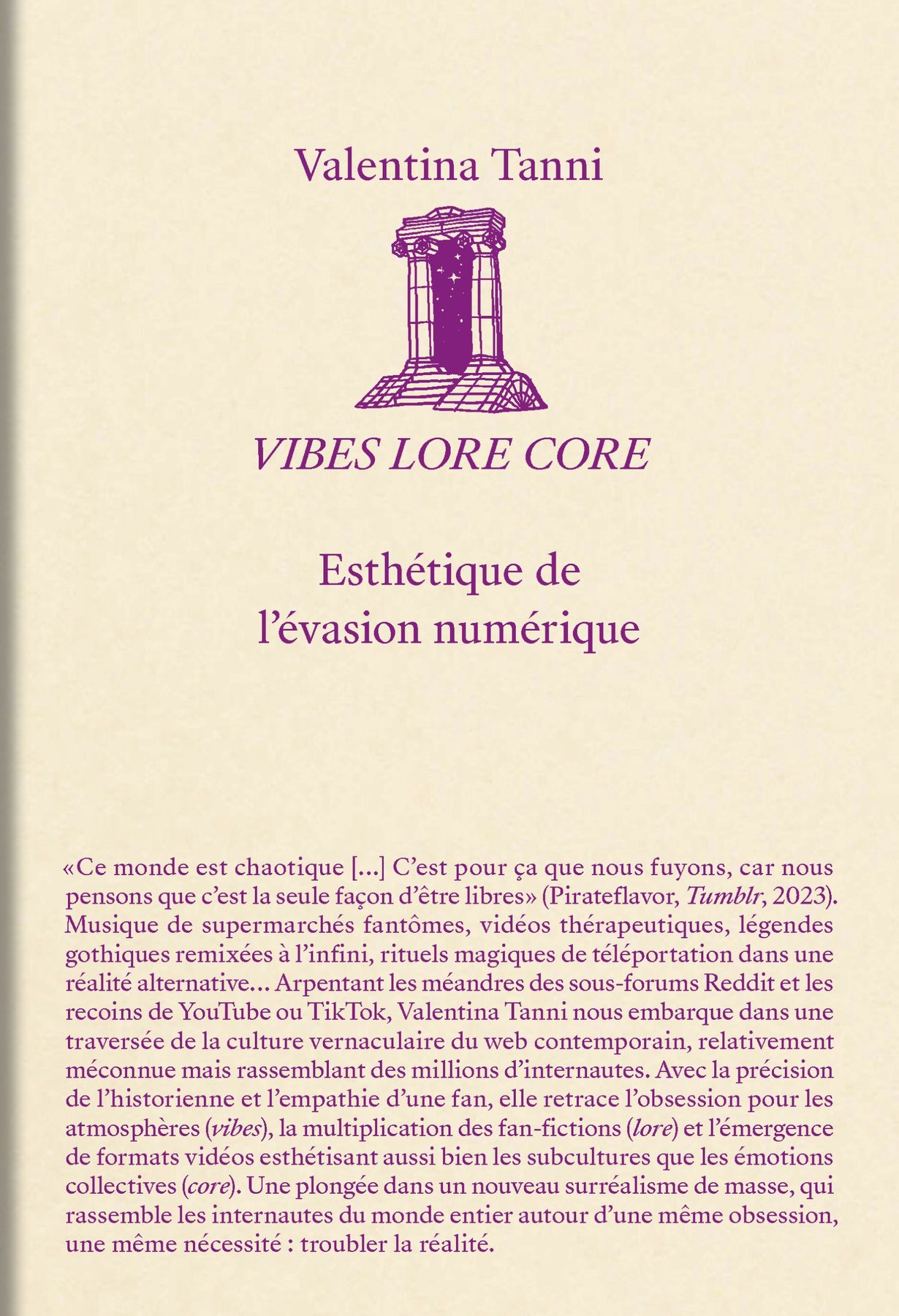
Valentina Tanni
Audimat Editions, 2025
Art historian, curator and lecturer Valentina Tanni turns her attention to digital cultures and the underground currents running beneath the surface of the contemporary internet. Some have made their way into the mainstream, but their very nature is ephemeral: as soon as they are observed, they disappear or begin to mutate. Vaporwave, mallsoft, late night lofi, future funk, VHS pop, signalwave, vibe shift, liminal spaces, backrooms, dreamcore, weirdcore, corecore… Following and understanding these developments often gives rise to a mixture of fascination and concern. I speak from a somewhat distant, detached perspective (if age is no virtue, perhaps the experience that comes with it can at least be put to some use), but that does not make the questions they raise any less compelling. First and foremost, there is nostalgia for something we have never known, or worse, for something that has never existed and never will. A nostalgia for nostalgia itself, which acknowledges the absence of a future and, therefore, of hope. “This world is chaotic (…) That’s why we escape, because we think it’s the only way to be free” (Pirateflavor, Tumblr, 2023). “Nostalgia, then, does not merely express an undefined desire to return, but a wish to transcend the limits of space and time. To satisfy this need, it draws on a fundamental capacity of the human mind: the ability to project itself elsewhere. If the body cannot travel instantaneously through space, let alone cross time, then such a desire can only come to life through the manipulation of states of consciousness. (…) The quintessential place of nostalgia is therefore not memory, but imagination.”
Unfortunately, all this leads to a dead end. Nostalgia is an immobile vehicle. Yet if we consider it as a possible archaeology of the future, a genre in its own right within technological fiction, a set of languages begins to emerge, identifying, excavating and amplifying the dysfunctions of the digital age, whatever we may think of the aesthetics that arise from them. At the heart (or core) of these practices, liminal space (like a mirror image of AI’s latent space) is particularly fascinating. It encompasses everything that lies between reality and imagination, suspension and uncertainty, fullness and emptiness, life and death. Its lack of substance can verge on pure anxiety. It is a potentially frightening transitional space, one familiar to children.
Two common features emerge across all the practices mentioned by the author: “derealization and depersonalization.” Anyone might experience these dissociative states after spending an evening scrolling through social media or browsing a platform in search of some undefined thing that will never be found. In fact, that thing does not exist. The feeling of falling endlessly is never far away. On another level, this amounts to a form of individual disintegration: “my identity was so far away that I no longer existed outside the game.” And at the furthest extreme: “there is beauty in collapse,” with corecore representing “the popular theory of extinction.” This could lead to an attempt to change realities, or “reality shifting.” One might as well bury one’s head in the sand and never emerge. “Producing and consuming media is the key ritual of the contemporary world, as well as its favorite collective pastime. The accessibility of AI programs merely adds another layer of complexity to this game, opening the door to the vertigo of automatic generation, the infinite space of combinatorics, and the fascination of limitless possibilities, along with the risk of losing control. The labyrinths of the Backrooms, the endless corridors of liminal spaces and the wide-open doors onto the deep space of weirdcore and dreamcore are symbolic images of this strange era, moving between distraction and despair, waking dreams, out-of-body journeys and games that take the form of nightmares.”
One constant blind spot of the digital remains: the body. We cannot escape it. Here, it becomes mechanized, reduced to a function. Everything is feedback, an emotional feedback loop mistakenly taken for spirituality. The body becomes the final variable to be adjusted before it is liquidated.
Luc Brou
STARTS, 2026
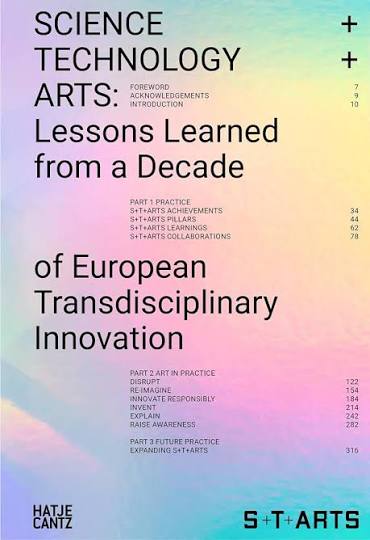
The S+T+ARTS platform was launched in 2016. Through a series of essays and case studies, the book dedicated to it explores how, over the past decade, collaborations between artists and scientists have enabled new forms of artistic hybridization, “while highlighting the essential role of artists in shaping more reflective, inclusive and future-oriented innovation practices.” Among the many texts and artistic projects presented, I would single out Art-Science-Technology: Collaborations, by S. Diakou, S. de Rosa, A. Pinotti and T. Badia. It addresses the important question of evaluation, which is “often fragmented, constrained by short-term, output-oriented criteria (…) that risk overlooking deeper cultural, social and ecological transformations. The complex benefits of Art-Science-Technology (AST) projects frequently fall outside conventional evaluation frameworks.”
It is therefore worth looking at the S+T+ARTS approach as a source of reflection and inspiration for other art-science contexts. Thinking about evaluation “from the very outset of a project, with an emphasis on the interplay between creativity, scientific innovation, technological progress and societal impact,” means considering the overall methodology of a collaboration around artistic, social, economic, technological, political and environmental issues. In order to avoid “reducing the complexity of artistic and interdisciplinary innovation to its most visible effects alone (…) it has become increasingly clear that impact assessment needs to begin much earlier than previously thought. The factors driving participation, the tools and infrastructures that enable experimentation, and the specific contextual motivations of artists and researchers all play a crucial role in shaping the initiative and its transformative potential. Impact is therefore not simply a matter of what is produced, but also of how it comes about and why.”
Three basic elements can help us “understand the unique configuration of each project”: Motivations – Objectives – Resources. We should then consider the relational dynamics involved by identifying the Initial conditions – Collaborative processes – Immediate outcomes. “For each area, traditional indicators should be supplemented by transformational indicators, which assess qualitative dimensions of change, such as shifts in perception, inclusion or sustainability practices. (…) By combining quantitative, qualitative and narrative data,” evaluation becomes more robust, “while preserving the interpretative richness and contextual specificity of art-science-technology projects (…) which can influence not only the creation of new knowledge, but also the perspectives and methodologies of the fields and sectors involved.”
All of this requires “fostering an environment of trust, mutual recognition and fair attribution of credit; ensuring balanced and open participation by stakeholders from different sectors; and allowing the established rules, standards and requirements to be renegotiated, at least in part, in response to new participants and changing needs. Properly evaluating these processes requires a transformative approach to evaluation.”
Available as a free download here.
Luc Brou
Are you an editor, author, or artist publishing a book aligned with our editorial line? Get in touch with us: we can feature it in our next Book Club article.