AI: From the Myth of Individualisation to Collective Reappropriation
Article published on 24 November 2025
Reading time: 5 minutes
Digitalis - Léa Collet
Article published on 24 November 2025
Reading time: 5 minutes
Often, interactions with AI reproduce an unbalanced interdependence, in which algorithmic power concentrates responsibility and creativity onto a single individual. This relationship contributes to the construction of the myth of generative AI as a source of productivity, speed, and individuality, a promise summed up by slogans like: “transforming productivity, amplifying your creativity.” 1. Like many artists, my practice positions itself in opposition to this narrative.
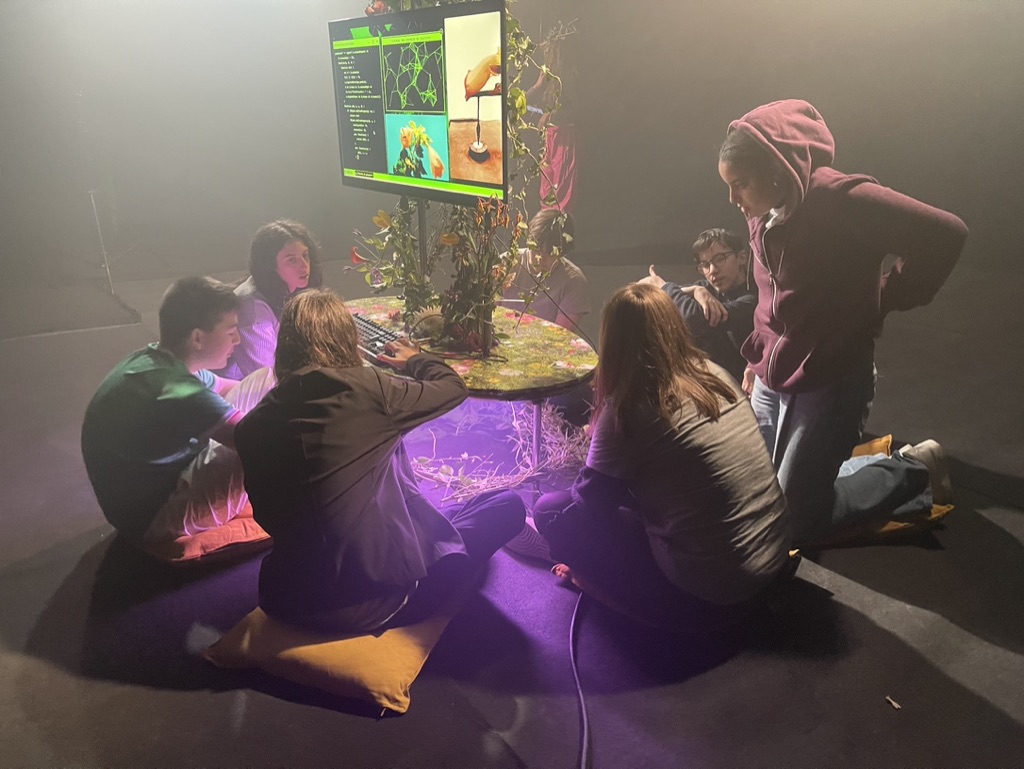
In 2022, I met a group of students from Marie-Curie Secondary School in Tourcoing. Together, we initiated Digitalis,2. an art and film project exploring hybrid imagination. In this project, we transformed ourselves into digital flowers. These chimerical mutations were made tangible through images produced by an open-source generative AI. We collectively trained the AI using photographs of flowers and images of the students’ faces. The AI then generated a series of human-plant transformation images, opening up a new mutability: an imaginary future, a protean and shifting identity, an acceptance of uncertainty. We embrace diversity. Together, we learn to co-perform with machines, to accept errors, and to play with glitches. We do not fully master this digital tool; rather, we observe and adjust it. We organise workshops, experiments, and co-create, both online and offline, within cybernetic communities and physical spaces.
In 2025, I worked with a group of high school students on a film exploring the following question: What is a migrant identity? Together, we created interactions between human movement and plant migration. Our starting point lies in the creation of counter-images and imagining new narratives. The students provided the generative AI with images from their family archives. Through our prompts, we brought these narratives to life in floral metamorphoses, triggering symbolic hybridisations. This offered a new perspective on migration stories: “The images produced by AI do not come from nowhere. If we feed it well, perhaps we might bring our missing image.”3. This notion of “missing images” became central to the project: it acquired a dimension of collective memory, woven from personal fragments shared within the group.
It is precisely through engaging with this shared collective memory that we confront the need to rethink our interactions with generative AI. Here, collective creation imposes a different rhythm: discussions, failed attempts, joint reorientations, shared solutions. We then turn to the idea of “digital kinship,”4. which transforms these interactions into spaces for collaboration and shared creativity, while allowing us to overcome the pre-existing biases of generative AI. We reject consumerist frameworks, replacing them with spaces of care: care for one another, care for our worlds, care as an embodied practice.
Co-creating with generative AI means recognising that tools are never neutral: they embody power relations, gender, race, and class. But by manipulating them collectively and critically questioning them, we regain our capacity for action, forming relational assemblages where humans and non-humans, digital machines, plant and animal worlds intra-act to co-create. This process transforms both our collective artistic practices and our perception of life and society. This shift in perspective opens up new avenues: modes of collective production where humans and machines co-act, forming alternative narratives for AI to transcend the Big Tech ideologies, and recognise technodiversity: ‘there is not one technology, but many technologies embedded within different cosmologies.5
Léa Collet
1 Pilot for Microsoft 365, A Whole New Way of Working with the Power of Generative AI, 2025
2 Digitalis, programmed installation produced by Le Fresnoy, 2023
3. Extract from the film Racines (Roots), produced by Le Bal, 2025
4 Referring to “kinship” as defined by Donna Haraway: the intentional practice of forming ethical, caring, and interdependent relationships across humans, other species, and the more-than-human world.
5 Yuk Hui, Lexicon Studium Generale 2324, Rietveld Academie, 2023