What if a citizens’ convention on AI were to take shape?
Article published on 9 February 2026
Reading time: 5 minutes
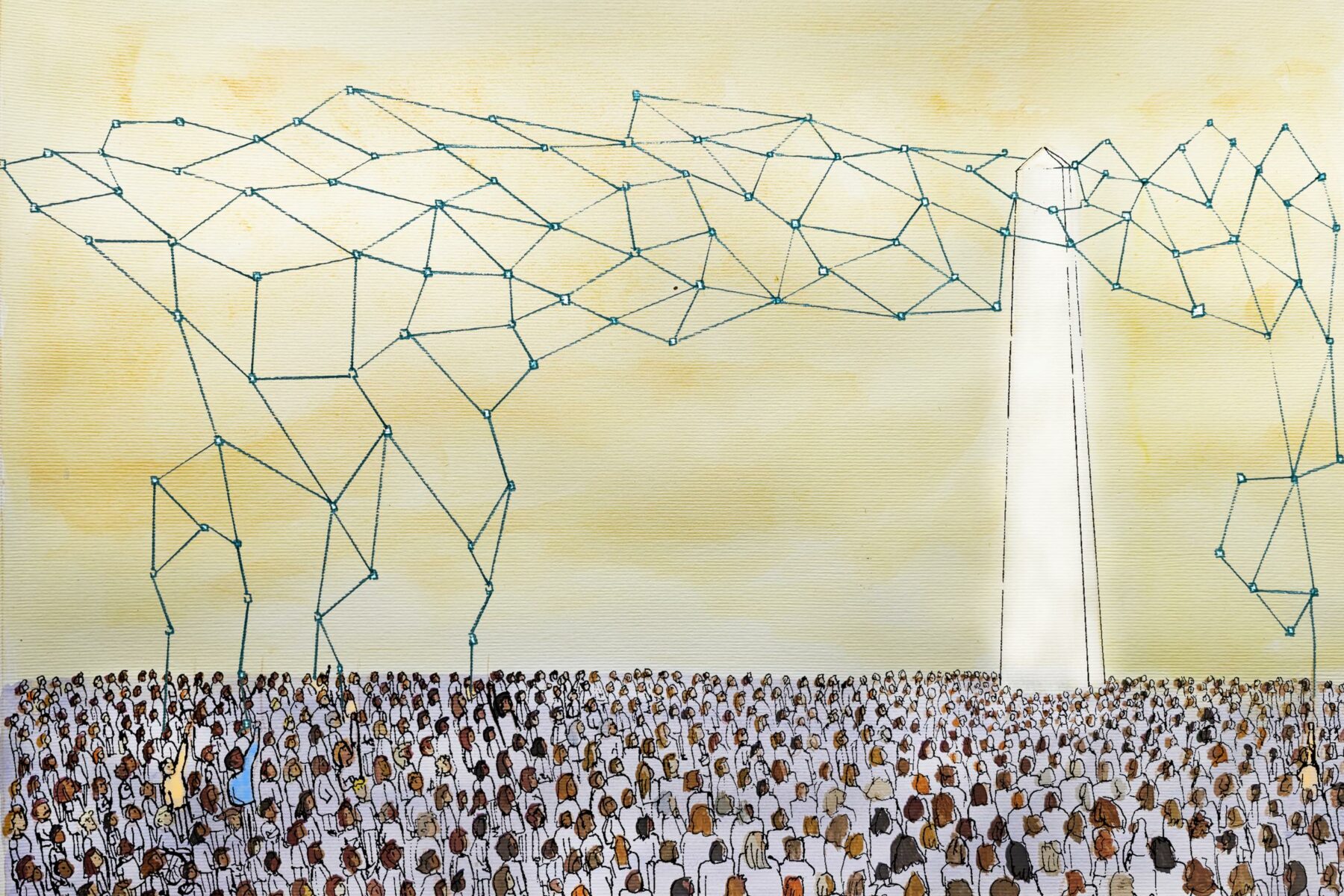
Jamillah Knowles & We and AI / Creative Commons
Article published on 9 February 2026
Reading time: 5 minutes
In our globalized economy, it is hard to ignore the fact that AI has become an object of near-devotion for its economic impact. The AI Action Summit, held in Paris in February 2025—already a year ago—made this abundantly clear: €200 billion will be invested in AI across Europe, including €100 billion in France alone, even as our shared public goods (healthcare, culture, education, community life, ecology, etc.) are being asked to tighten their belts. The only urgency being voiced is the fear of falling behind technologically and economically. In short, the goal is that “Europe must be one of the leading continents in AI” (Ursula von der Leyen).
But what about the other issues raised by AI—ethical, environmental, social, and questions of living together? What about the diversity of cultural expressions? There have been a few token statements, yes, but no real action. AI is often framed as offering new technological freedoms to artists, while conveniently forgetting that freedom always comes with responsibility for its consequences. Artistic freedom, once subjected to the AI-driven economy, is already sending out warning signs: its only responsibility, it seems, is to be profitable. As for the diversity of cultural expressions—which underpins human relationships—at this pace it risks being wiped out by the profitability demands imposed by the sheer scale of these investments.
The giants of the cultural industries and the AI sector are already moving fast, with the first commercial agreements signed: Universal and Warner Music Group with Udio in the music industry; Disney with OpenAI in animation. They were also active through the illegal extraction of creative works, as revealed (among other examples) by Mediapart, which reported that “to train its artificial intelligence model, Facebook’s parent company illegally downloaded, as early as 2022, the collection of books amassed by the pirate site LibGen,” with “the central involvement of Guillaume Lample, now one of the executives of France’s flagship AI company.”
Committed to the diversity of cultural expressions, to their equal representation, dignity, and discoverability, Zone Franche, the World Music network, cannot accept these looming threats. Grounded in the principles and values of cultural rights, we therefore call for a democratic, social, and cultural reclaiming of these issues, through the establishment of negotiation frameworks based on respect for individuals, their associations, and their organizations, and guaranteeing respect for fundamental human rights. Ethics are glaringly absent from the profit-driven AI economy.
In 2021, the Zone Franche network conducted a concrete experiment with its (mini) Climate Convention. Modeled on France’s Citizens’ Convention for the Climate, it brought together a wide range of participants around thematic workshops (artist mobility, audience mobility, food systems, digital practices) to reflect on the environmental impact of musical activities and ways to reduce it. This work led to the publication of a report containing 148 recommendations to decarbonize the music sector.
In light of these concerns—and drawing on this positive experience—shouldn’t the creation of a Citizens’ Convention on “AI, Artistic Freedom, and Cultural Diversity” now be self-evident? Its purpose would necessarily be to mobilize broadly—artists and professionals, researchers, experts and non-experts alike—so that society as a whole can be engaged and heard on an issue that is profoundly reshaping our humanity. It is urgent that AI become a political and democratic issue.
Sébastien Laussel, director of Zone Franche