Music and Digital Arts: The Perfect Match?
Article published on 15 December 2025
Reading time: 12 minutes
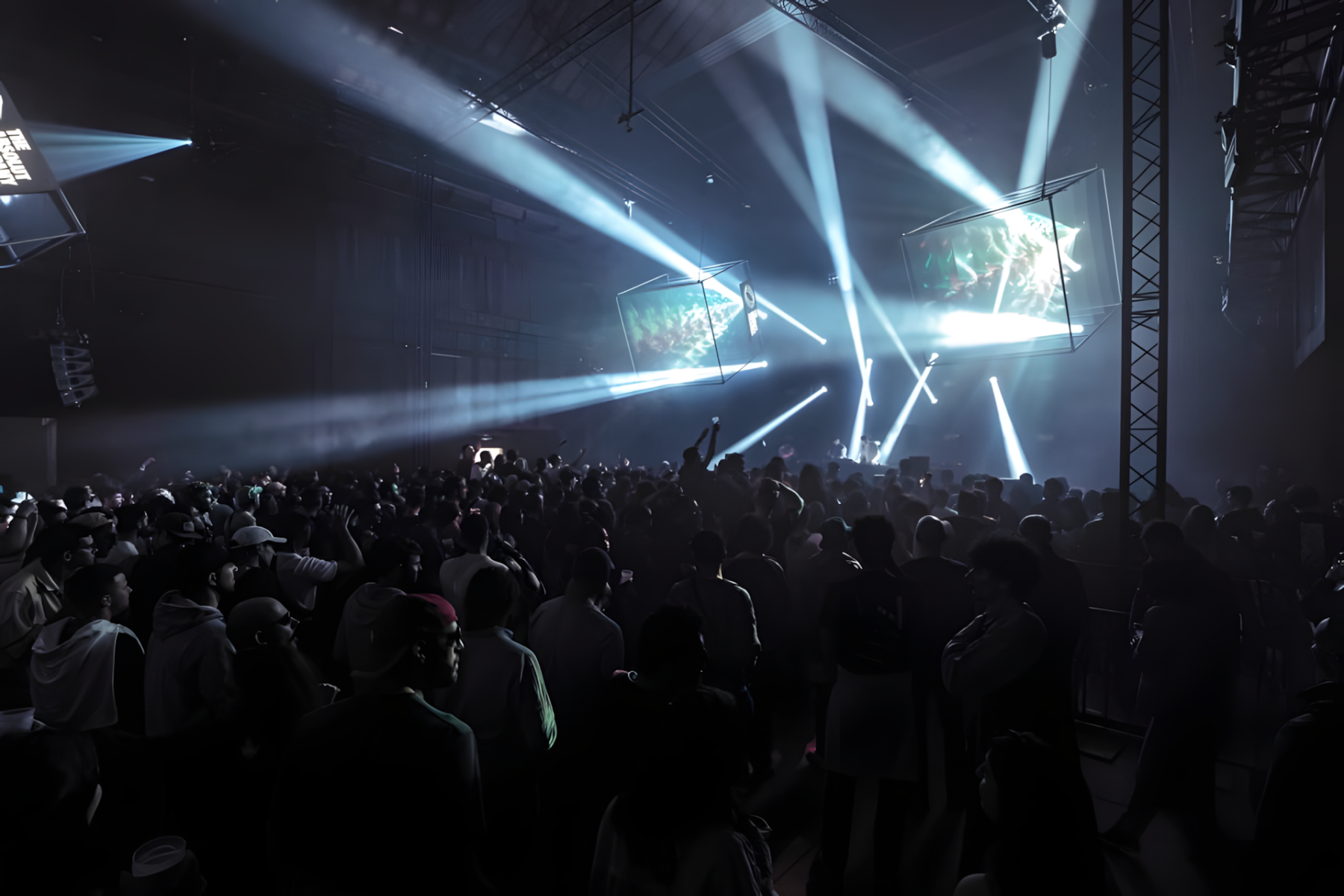
Milkorva - Symbiose
Article published on 15 December 2025
Reading time: 12 minutes
Today, concerts are increasingly evolving into hybrid experiences where scenography, real-time visuals and generative imagery redefine what “live” means. The music stage now hosts digital setups on an unprecedented scale: immersive audiovisual landscapes by Max Cooper touring the world; Molécule performing “Acousmatic 2.0” in multichannel from the Philharmonie; and the label Cercle continuing its monumental visual odysseys. This is an analysis of this special connection between music and digital arts.
When you ask the players behind these encounters between music and digital art, one date keeps coming up: 29 April 2006, when Daft Punk ushered electronic music into the era of spectacle at Coachella. A shift made all the more striking because, until then, electronic music — in particular techno — prided itself on a form of disembodiment that quickly reached its limits in a live setting. “Sure, a band on stage is beautiful; but a guy pushing faders — the movements are minimal, it’s a bit nerdy, not very spectacular at all,” summarises Étienne de Crécy. From that moment on, one thing became evident: the music stage stopped being a simple venue for performance and became a laboratory. But this lab is far from uniform. The aesthetics that emerge there follow neither the same logic, nor the same constraints, nor the same ambitions.
If 2006 often marks the starting point of these explorations, there were earlier attempts — pioneers like Kraftwerk or trailblazers like Jean-Michel Jarre and his iconic laser harp. Yet it was in the early 2000s that a first wave of artists began working simultaneously on musical and visual textures, giving birth to what would soon be dubbed “audiovisual concerts” or “A/V lives,” explains journalist and writer Jean-Yves Leloup during the 2019 exhibition Électro.
With long research residencies, institutional co-productions, collaborations with art centers, digital festivals or well-equipped theatres, the goal is not simply to produce scenography oriented towards spectacle or reproducibility. Rather, it is to explore what the stage can become when it isn’t bound by the constraints of musical narration or classical concert structure. These sometimes challenging forms deeply influence contemporary live aesthetics. The minimalist surfaces of Nonotak, architectural light works by Ryoji Ikeda, or behavioural systems developed by Antoine Schmitt in collaboration with Franck Vigroux feed an entire generation of studios and VJs — far beyond what institutional circuits may suggest.
While the experimental scene nourishes imaginations, it’s often in an “intermediate scene” that these ideas find a first semblance of stability, a first audience — and often a first economic footing. Straddling the boundaries between club, festival, and installation, the common thread in these proposals is not a style, but a way of conceiving the live A/V show as an artistic object in its own right. This is where many technologies have been explored, sometimes reinvented, sometimes simply adopted on a large scale. Where experimental work pushes aesthetics toward abstraction, the intermediate scene makes them workable: it transforms the artistic trial into a spectacle.
Outside the artistic circuits for experimental works, this intermediate zone has also been shaped by hybrid players like The Absolut Company Creation, which have financed and produced several scenographies and artists who have become emblematic over the past decade. This is the case for creator Milkorva, who sums up the challenge with his latest project: “Symbiose is clearly a project designed for a mainstream audience […]. This type of event makes digital art much more accessible than in a museum. It’s through these intermediate formats that the digital scene can truly reach a wider audience.” Innovative enough to inspire, structured enough to exist, yet still too fragile to constitute a fully stable market, it is precisely in this zone of balance that many digital artists hope to thrive.
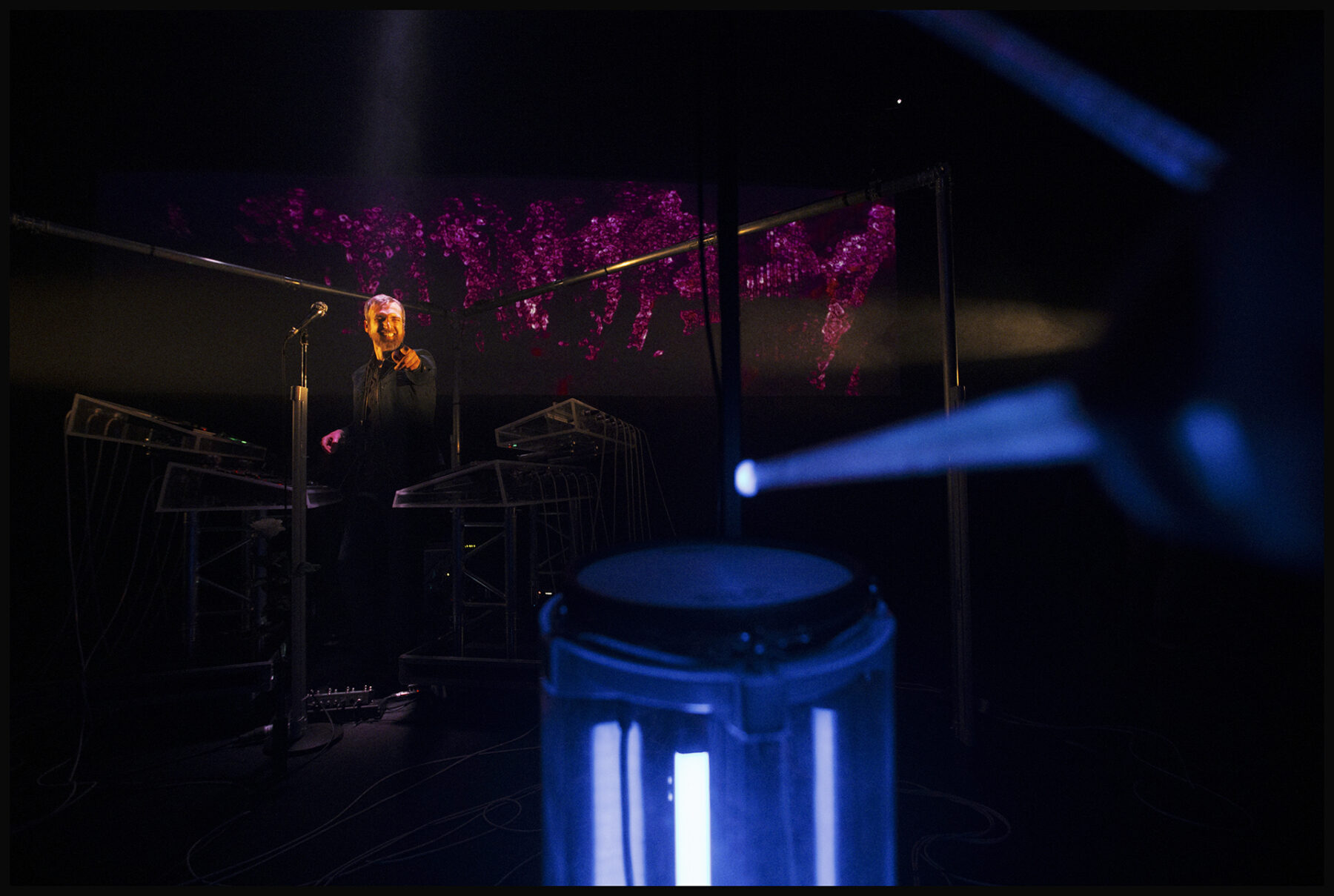
Outside this intermediate scene, the mainstream scene operates on an industrial logic, where the spectacular must be reliable and replicable. Tours by Eric Prydz (EPIC, HOLO), Deadmau5 (and his motorized cubes), or international pop shows rely on massive infrastructures managed by a few major studios (Moment Factory, High Scream, TAIT, Silent Partners Studio, etc.), whose role is less about experimentation and more about ensuring a perfectly controlled aesthetic. Yet these productions do not exist in isolation. They regularly absorb ideas from the experimental or semi-mainstream sphere, once they can be stabilized. The British studio UVA recently demonstrated this by integrating (fake) facial recognition into Massive Attack’s tour: a technology often explored in digital art installations, here scaled up to an arena. For most digital artists and emerging studios, this world remains largely inaccessible, but it serves as a horizon — the endpoint for ideas once they are stable enough to become industrial-scale spectacle.
Producing an A/V live show is not the same as preparing a classical concert. As soon as a digital scenography comes into play, development times lengthen, costs rise, and margins for error shrink considerably. Producer Verlatour describes the genesis of the IMMERSION project: “To build this show, we were fortunate to be supported primarily by SMAC Lune des Pirates during six weeks of residency, spread over more than a year. We also relied on support from the metropolis, the department, the region, and eventually secured a European grant. The budget ran into tens of thousands of euros. Developing this type of creation is long, costly, and far more complex than a ‘classical’ concert, especially here, where we were exploring many unprecedented interactions.”
Beyond the intrinsic complexity of the setups lies another, more silent but equally critical limitation: many venues are simply not equipped to host demanding A/V creations. Multidisciplinary artist Neurotypique describes this cultural shock: “The industry isn’t structured for experimentation. It’s structured to tour, to optimise, to make sure nothing breaks. When you turn up with a real-time tool or an unconventional staging idea, you blow the whole system up. And you can quickly feel that.” Digital creator Maidova agrees: “Right after my first A/V live, I doubted whether I wanted to pursue this field in my career. It becomes a lot of pressure and stress to perform live. I’ve always performed on stage through dance, but I didn’t rely on other tools like my PC, projectors, internet connection, etc.”
This mismatch is not necessarily the fault of venues — more often it stems from their organisation: tight schedules, limited set-up time, safety constraints. This is particularly true at festivals, where, as programmer Anne-Laure Belloc explains (at Stereolux), “the main constraint is the succession of artists: installations must be light or adaptable. On a single stage, you can’t host a complex scenography that requires hours of setup.” It is this structural friction — even more than technology itself — that currently limits the dissemination of the most ambitious A/V lives.
Even when works exist and venues are technically capable, one last obstacle remains: the instability of the market itself. Festivals and venues operate with fluctuating budgets, tight programming, and heavy ticketing constraints. In this context, an ambitious scenography has only a small window of viability: it needs to be novel, desirable, immediately readable — otherwise it becomes hard to sell. “With Space Echo, I wanted to create a live show that stood as a project in itself, not just the tour of an album. The scenography was extremely ambitious: translucent and rotating screens, reconfigurable light architecture, real-time perspective correction… I’m very proud of it. But Covid literally split the project in two. After the restart, festivals no longer had the means to fund such a heavy show, and it had lost the freshness of novelty.” — Étienne de Crécy
After years of experimentation reserved for a few institutions, immersive audio is finally becoming more democratized. This allows electronic and digital artists to work within a sonic space that is more sculptural, more narrative — and above all, more harmonious with audiovisual scenographies. Simultaneously, real-time generation and transformation tools are becoming lighter and more reliable. Together, these technologies shift the live concert’s centre of gravity: fewer heavy infrastructures, more artistic intent; less dependency on fixed stages, more visual plasticity. These evolutions don’t eliminate constraints, but they allow a new approach: conceiving ambitious shows that are flexible, less constrained by technology than by concept.
Faced with an unstable market, the most realistic response for digital artists isn’t necessarily grandeur — but modularity. “To make IMMERSION tour-able, we had to simplify everything without ever sacrificing the experience,” explains Mathilde Thiney, the project’s former dissemination manager. “The first version was too heavy, too fragile, too technical.” These scenographies, designed for touring, radically change the economics of audiovisual live performance. They reduce team size, cost, setup time — but also preserve a strong artistic identity, something often lacking in the generic systems provided by venues. For many studios, the real opportunity today lies in forms strong enough to assert a universe, yet light enough to travel. Étienne de Crécy’s luminous cube — designed by 1024 Architecture — has become one of these symbols: a simple scaffolding structure, a rented projector on site, yet an instantly recognizable scenic identity. A minimal logistical setup, maximal visual impact. And over time, it has become a reference for a whole generation of creators.
Beyond aesthetic and technical shifts, another movement is gradually reshaping the A/V scene: its progressive feminization. Long confined to the shadows of control booths or to peripheral roles, more and more artists, developers, and performers are now taking hold of digital tools and the stage itself. At major festivals and showcases, we encounter established figures such as Noémi Schipfer of the duo Nonotak, musician and producer Annabelle Playe, or the Quebec-based artist Sabrina Ratté. But a new generation is also emerging: Maidova, Célia Bétourné of the duo Cosa Mentale, and Lyon-based Pia Vidal embody a renewed relationship to code, light, and immersive environments. This growing presence is reshaping both production methods and the imaginaries of live audiovisual art, bringing new narratives, new sensibilities, and new ways of conceiving the stage.
A more discreet—yet likely equally decisive—evolution is the changing status of the VJ. Long regarded as a technical operator, the VJ is increasingly becoming a co-author, a visual composer, and at times a performer. This hybrid practice, blending music, code, light, and image, naturally extends aesthetics rooted in the experimental while grounding itself in the logics of the mid-scale live scene. “When I insist on being on stage, it’s not about ego,” explains Neurotypique. “It’s because two of us spend months creating a live show, and video is a form of writing. Hiding the visual artist is a misunderstanding of what an audiovisual performance really is.” This shift perhaps signals what makes the present moment unique: digital arts are no longer merely seeking a place within the music scene—they are helping redefine its very codes.
Dominique Moulon reminds us in Art Beyond Digital: “The medium of sound is transversal across multiple practices, just like the digital medium, which plays a major role in breaking down the boundaries between them. […] All media, within the machine, correspond to one another because the languages that define them are so similar.” In this continuity, live A/V may not yet constitute a stable market, but it remains a fertile space where collaboration, modularity, and emerging tools open up a new field of possibilities.
Romain Astouric