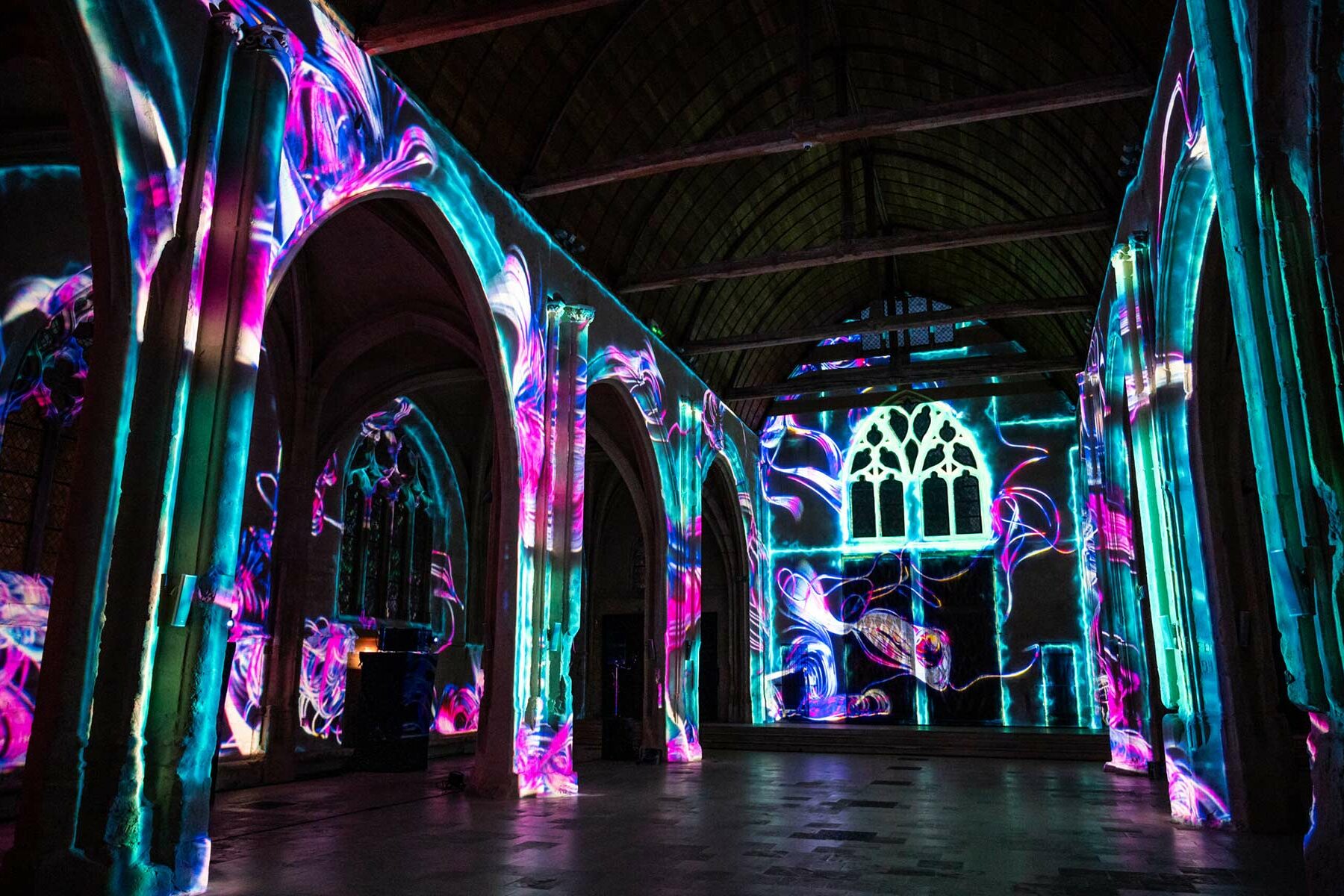
Video Mapping Festival 2022 - Senlis - Église Saint-Pierre
With the “Immersive Culture and Metaverse” call for projects—part of the major France 2030 investment plan (€1 billion dedicated to the Cultural and Creative Industries)—a total of €150 million* will support innovation and the structuring of the XR sector. The goal? Strengthen the production and distribution of immersive content, while promoting French cultural excellence internationally. Here is an overview of the call for projects…
An ambition to reveal the “rising stars” of the sector
All cultural and creative sectors (audiovisual, cinema, performing arts, gaming, etc.) can apply to “Immersive Culture and Metaverse” with the ambition of “bringing out new rising stars”as highlighted by Fabrice Casadebaig, National Coordinator for the Cultural and Creative Industries Strategy at the SGPI (General Secretariat for Investment, which oversees the cultural strand of France 2030), during an information session dedicated to video game professionals last April. This principle of excellence and ambition was reiterated the same day by Sébastien Thévenet of the DGMIC (Directorate-General for Media and Cultural Industries, Ministry of Culture), who emphasized the need for “support across the entire value chain in a highly competitive environment”“The objective is to create and develop, through this call for projects and the deployment of new immersive technologies, a structured and industrialized sovereign ecosystem” he concluded.
The immersive technologies in question include augmented reality (AR), virtual reality (VR), mixed reality (MR) and metaverses—whose explicit mention in the title of the call and whose vague definition remains surprising (see Metaverse: The Artistic Blur). Whatever the terminology, the intention is clear: “We need to help the sector scale up, because for now we are still too often operating in a prototype mindset, with each studio reinventing its own model for each project” explains Olivier Fontenay, Head of Digital Creation at the CNC (acting on behalf of the State). He mentions modalities that could, for example, lead to clearer separations between tasks (R&D, content production, distribution chain, etc.).
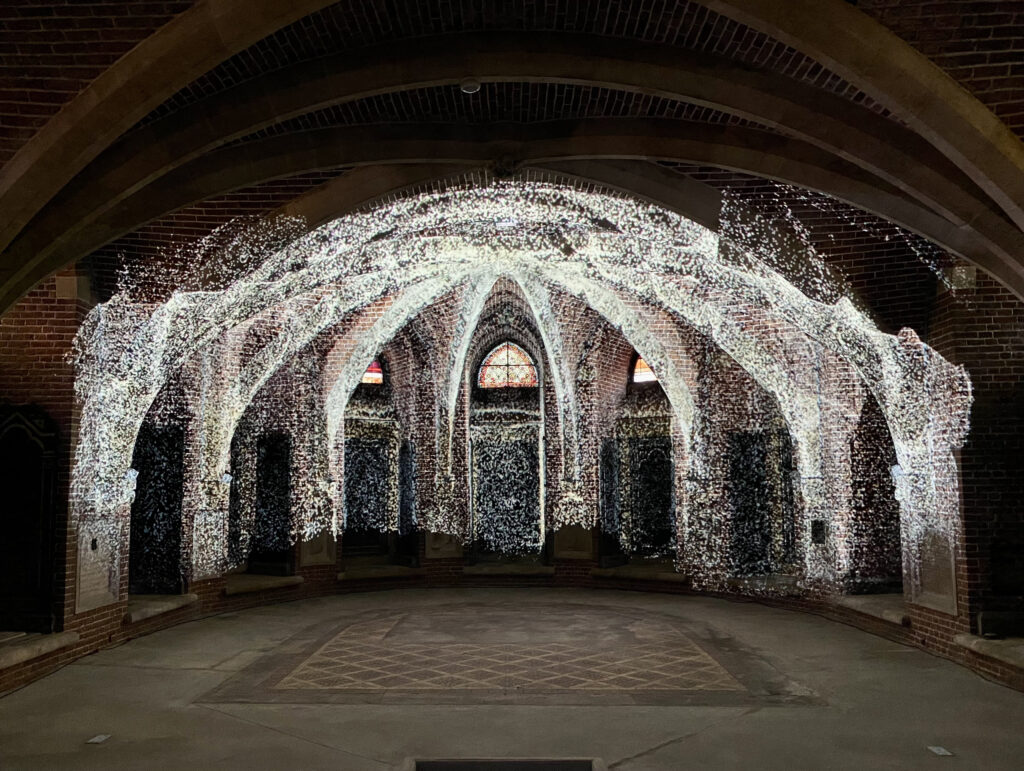
Video Mapping Festival 2022 – Lille – Crypte de la cathédrale Notre-Dame-de-la-Treille
Not support for artistic creation, but for innovation
The call aims to offer flexibility, so as not to constrain creativity. Nevertheless, Olivier Fontenay stresses that “this is not a call for creating new works, as we already support those through the CNC’s Immersive Creation Fund.” He provides two potential areas of focus. First, the development of a fully digital production pipeline: from creating a studio/laboratory to deploying software tools, integrating all relevant technological components (artificial intelligence, game engines, capture technologies, 3D modelling and animation, hardware, real-time creation tools, distribution and storage systems, etc.) to enable content creation. Second, anything related to the distribution of immersive content—again with an emphasis on structuring and innovation.
The first angle involves developing “sovereign technological bricks” that contribute to producing immersive cultural experiences:innovative components that could plug into a universal IT engine and be labeled as French technological contributions (motion capture tools, a database enabling synchronized use of 1,000 VR headsets, etc.). The distribution angle could include developing digital aggregators to distribute immersive works, a technological platform hosting diverse immersive content, a network of innovative LBE (Location-Based Entertainment) venues, or even a persistent 3D universe enabling every French public institution to showcase its heritage and collections in shared virtual spaces.
Application process and expert committee
While the application timeline is clearly defined (three sessions, the first closing on July 2, 2024), institutions are adopting a supportive approach. “Any company or public institution can request a meeting with us ahead of submission, to discuss their project or evaluate the viability of the interfaces they aim to build” says Olivier Fontenay.
Here again, flexibility is emphasized. Public or private organisations of all sizes can apply—individually, in partnership, or within a consortium. “The company’s size matters less than the structuring potential of its project. If a small five-person company proposes something meaningful, we will support it” he states. Environmental requirements and financial health are among the non-negotiable criteria. Ambition must also translate into significant budgets: minimum €80,000 for engineering assistance, minimum €400,000 for project implementation “We’re looking for emblematic projects capable of structuring the ecosystem” explains Romain Dudognon of Bpifrance (acting on behalf of the State), “hence the minimum thresholds”
A committee of 12 to 15 experts will evaluate the relevance and feasibility of projects before hearings and final decisions. Since the first round has already opened, many regret that the committee members have not yet been publicly announced—a necessary step for transparency, especially considering the scale of the call (as of publication date—10/06/24—no announcement had been made). This expectation is reinforced by past controversies, such as the November 2023 Canard Enchaîné report on the CNC’s “Immersive Creation” commission chaired by Jean-Michel Jarre. “These will be highly competent individuals, able to assess projects based on their structuring and innovative aspects, and free from conflicts of interest” reassures Olivier Fontenay. “They will come from industry or academia, with experience producing immersive works or managing production pipelines. And the same people will evaluate all three sessions, for equity and consistency”
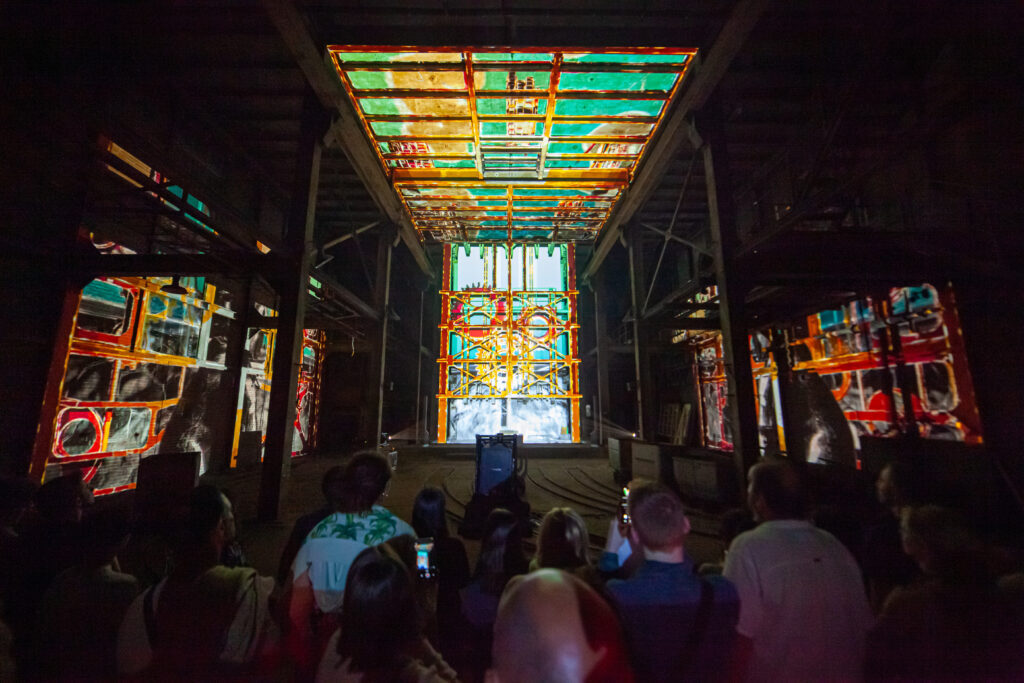
Video Mapping Festival – Arenberg
Toward a new immersive industry?
With deadlines approaching, the first projects are taking shape. Major public institutions are showing interest—for example, the Théâtre National de Chaillot, which is exploring the development of a creation, production and presentation lab dedicated to AR, VR and motion capture technologies, part of the future “Chaillot Augmenté.”
Historic players in immersive creation are also preparing proposals. At Rencontres Audiovisuelles, the team behind the Video Mapping Festival is gearing up for the July session. “We’re planning to develop a sector dedicated to video mapping, partly focused on immersive mapping” explains director Antoine Manier. “Immersive mapping represents less than 10% of our projects today, compared to monumental mapping. There is also no permanent immersive mapping facility in the region. With this call, we would like to create a lab/immersive space offering artist residencies and training for both technical and artistic profiles.”
The project seems fully aligned with the call’s objectives: sector structuring, technological innovation, and economic impact. “In the region, most mapping projects are monumental, commissioned by local authorities to offer free public events that highlight local heritage. These productions create jobs and skills. Establishing an immersive mapping space within a broader mapping sector would be perfectly complementary to our current tools.”
Remaining questions
Although appealing on paper, the “Immersive Culture and Metaverse” call raises many questions. First, France 2030 overall seeks to reduce the carbon impact of economic activity—including in the CCIs—which raises doubts about the sustainability of an immersive/metaverse industry. This deserves deeper debate. Second, the technical complexity of the call, requiring strong project-management skills and the use of explicitly business-oriented terminology (“rising star” “value chain” “content”), feels ill-adapted to the cultural field. What place will cultural actors truly have? Many organisations—public institutions, associations, companies, studios—have decades of experience working on digital and immersive creation (see list of HACNUM network members). When the results are announced, we will see who will actually be part of this new “Made in France” ecosystem…
* “Immersive Culture and Metaverse” includes €150M dedicated to culture, plus an additional €50M to support metaverse technologies outside the cultural field.