France 2030: Does the AI Call for Projects Align with Culture?
Article published on 15 October 2025
Article published on 15 October 2025
France 2030 (one billion euros for culture) continues its strategy of supporting the French cultural and creative industries (CCI) with a new call for projects titled Digital Transition of Culture and Appropriation of Artificial Intelligence. This initiative targets all cultural fields and considers a wide spectrum of technologies, with artificial intelligence placed front and center. Here is an overview of the call and its implications for cultural professionals.
After several targeted calls for projects (Augmented Experience in the Performing Arts; Digitization of Heritage or Architecture; Immersive Culture and Metaverse—see the article One Step Forward in Structuring XR?), the France 2030 investment plan aims, through its new call Digital Transition of Culture and Appropriation of Artificial Intelligence, to support—from October 2025 to June 2027—the digital transition of France’s cultural and creative industries. “It is a scheme that complements previous tools with a much broader focus,” summarizes Fabrice Casadebaig, France 2030 Coordinator for Culture at the General Secretariat for Investment. Several key issues are at play, in particular cultural democratization. “One of the primary objectives is to support a digital transition that facilitates audience development, access to new forms of expression, new modes of mediation, and new forms of relationships between artists, cultural institutions, and the public,” explains Casadebaig.
Data-related issues (databases, metadata) are therefore central. The facilitation of data sharing and mutualization—both within the French and European markets—alongside improved data collection and analysis are strongly emphasized. The scheme also foresees the creation of trusted third parties to guarantee secure conservation and exploitation of cultural data, and anticipates anti-piracy mechanisms. For Casadebaig, “technological innovation is a priority”: new economic models, sustainable governance for active experiences (mixed reality experiences, hybrid or multi-channel experiences combining in-person and remote formats). “This innovation must not be merely incremental,” he adds. “It must represent a real technological leap.” A leap, yes—but based on which indicators? Ultimately, cultural sovereignty issues appear to underpin this call. Particular attention will also be paid to the selection of international partners—European solutions are encouraged, even though funding will only cover the French components of the projects—as well as software components.
Even though AI is not the exclusive focus of this call, particular attention will be given to it, as it is considered “a central and strategic creative field.” The selected projects will be evaluated carefully with regard to their legal and ethical frameworks. Casadebaig refers to an ongoing series of consultations—requested by the Minister of Culture and the Minister Delegate for AI and Digital Affairs—between developers of generative AI models and rightsholders. “Are there dedicated human resources? Is the European AI Act respected? Are copyright rules upheld? We will examine these aspects rigorously in order to strengthen the French model of copyright and neighboring rights, and to understand how emerging technologies—not only AI but also blockchain, for example—can help us better trace counterfeits online, detect fraudulent uses and unauthorized reuse, accelerate revenue flows to rightsholders, improve the identification and traceability of works and content, and experiment with new value-sharing mechanisms involving generative AI.”
Earlier this year, prior to the publication of this call, artist Grégory Chatonsky raised concerns—particularly ecological ones—about current investments in AI-related hardware. He argued that “instead of massively investing in infrastructure, France could nurture an ecosystem encouraging social and cultural experimentation,” involving artist-researcher residencies in AI, small-scale experimental projects, and hybrid training programs blending art and technology. Such an ecosystem, he wrote, would also support research on more efficient and environmentally responsible AI models. The call seems to respond to this partially, highlighting immaterial processes—not just material infrastructure—upstream in the development chain, though the overarching lens remains industrial rather than centered on artists and researchers. “This is not a content creation scheme,” Casadebaig notes, even though Chatonsky’s argument was broader. “Nor is it a program for fundamental research. But beyond material assets (hardware, infrastructure, subcontracting, engineering, technical expenses for reducing carbon footprint), the goal is also to find new methods and procedures to achieve results that were previously more time-consuming, more expensive, and more environmentally costly—so that they become cheaper, less carbon-intensive, and faster.”
This assumption, however, warrants discussion. It is based on the idea that artistic production processes can be accelerated or even automated. But the actual practice of artists contradicts the belief in “better, faster, stronger.” For example, as Justine Emard reminded us in our article The Effects of the Dataset, while “training a model can take a few hours, the upstream and downstream phases extend over several months. One must also take the time to review hundreds of generated images. It is a layered process, far from instantaneous—unlike a prompt, which instantly produces an image.” Furthermore, assuming that technological innovation directly reduces environmental impact reflects techno-solutionist thinking. Historically, technological gains in productivity have consistently led to increased production—and therefore, mechanically, to higher carbon emissions.
In this call, direct artistic creation is not funded—except when used as a demonstrator (pilot) for a new production or distribution process, capped at one-fifth of the total investment budget. Casadebaig nevertheless emphasizes the value of projects that foster collaboration between artists and technology providers, with the aim of modeling new cultural production methods and supporting key transformation levers in the cultural and creative industries. “This is the purpose of our calls,” he insists. “An artist seeking to explore a new methodology or approach could be supported.” Such collaborations, particularly between artists and startups, may indeed lead to groundbreaking innovation—but they require strong financial and organizational structuring. The creation of consortia—private or public-public partnerships—is encouraged, with a minimum eligible expenditure of €400,000, signaling the expected scale and ambition. Grants will cover up to 60 percent of project costs, while at least 40 percent will be repayable advances. “We are not necessarily expecting only large companies,” Casadebaig notes, “but a diversity of solid actors.”
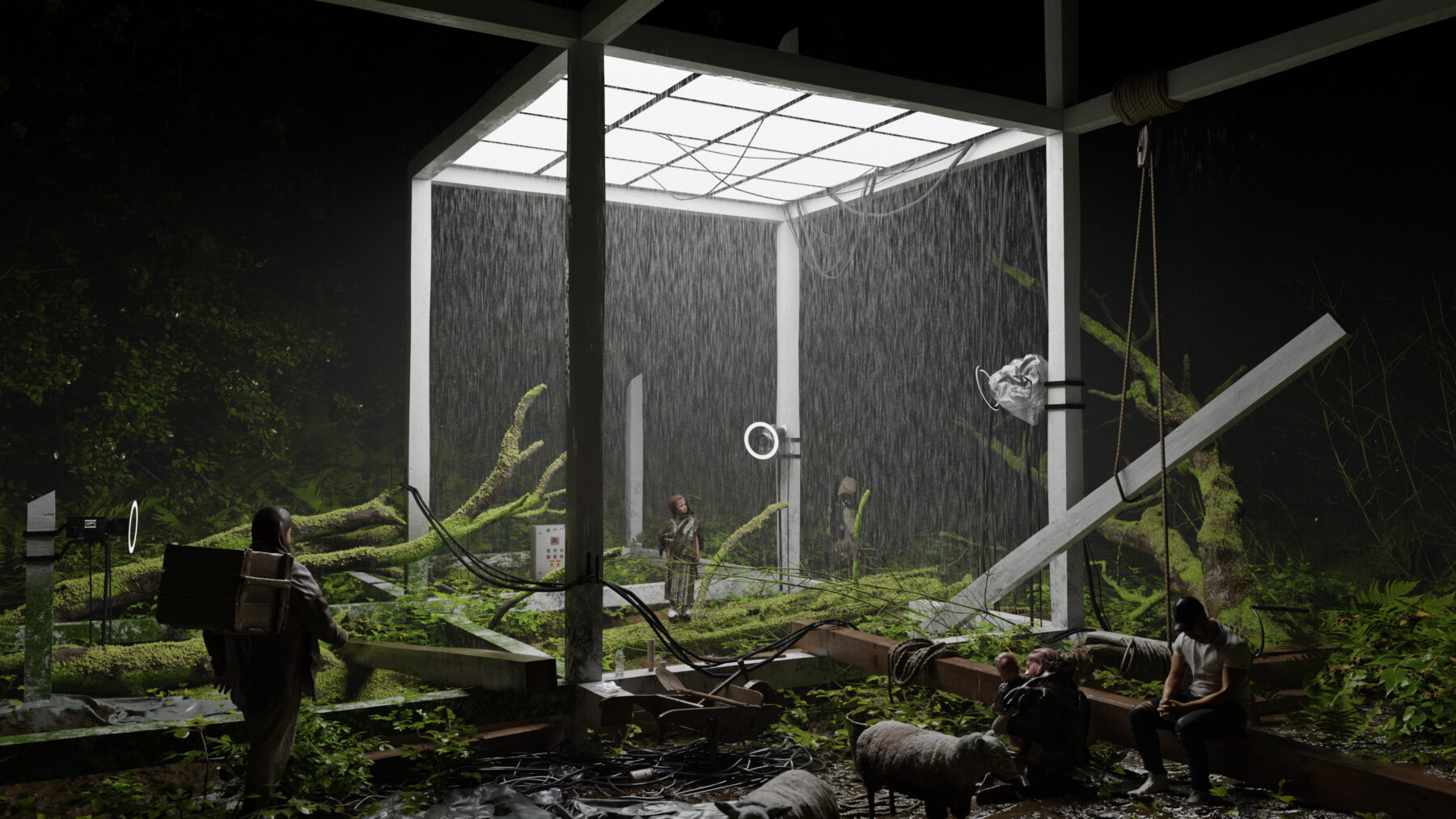
Among the candidates, the project The Feral aims to create a sensitive AI capable of learning from its natural environment—via sound, image, and video sensors placed on-site—and from interactions with artists, researchers, and the general public. This ethical, sovereign, and responsible AI would be situated in a rural area and generate collective artworks, using cameras as learning interfaces to attune the system to its surroundings. For Fabio Trotabas, spokesperson for the project, this call represents “a rare opportunity to carry out essential technological investments, including the human resources required to build our Sensitive AI model (architects, engineers, researchers, artists, project managers…), as well as the necessary equipment and infrastructure: sensitive sensors (audiovisual equipment, cameras, microphones, lighting); computing and data storage (CPU/GPU, data centers, servers, cybersecurity systems); autonomous energy systems (solar panels, geothermal solutions); data processing and modeling tools (computers, software); and information flow management (fiber optics, connectivity).” According to Trotabas, this call is ideal for supporting a responsible digital structuring of the cultural and creative industries. “We want to improve current AI models (generative AI, LLMs, agents) so that they can be trained on francophone cultural content, better respect copyright (via ethical partnership contracts—smart contracts on blockchain—to prevent data exploitation and ensure proper valorization), and rely on responsibly stored French datasets. Above all, we aim for new models that produce culturally meaningful results—something like curated AI.”
As with previous calls, the Bpifrance platform is the main hub for information and submissions. Four submission rounds are scheduled, from the first deadline on 28 October 2025 to the final one on 16 June 2027. Projects will be evaluated by a jury of independent experts—this time broader, covering all cultural fields as well as digital technologies, environmental issues, funding, and distribution. Regarding applications, Casadebaig trusts the capacity of project leaders. “We expect to be surprised by the quality of the proposals,” he says. “This is why we do not guide applicants too strictly toward one direction—such as AI—over another. The sector will likely be more creative than we could be in imagining the solutions that will be proposed.”
For Future Applicants, Here Are Some Key Recommendations:
✔️ Be concise.
“Overly verbose applications tend to sound empty,” says Casadebaig. “The golden rule is: what is well conceived is clearly stated. We must clearly understand what the applicant seeks to achieve, using precise and concrete language accessible to non-specialists.”
✔️ Highlight technological hurdles.
Focus on the obstacles that currently exist and the ways your solution will overcome them. “Innovation remains essential,” he insists. “In short, explain something we cannot do today but will be able to do tomorrow thanks to the project.”
✔️ Present a solid financing and business model.
“Projects must remain viable beyond our funding,” he emphasizes. Co-financing is therefore critical—whether in cash or in-kind contributions (human resources, equipment, etc.). “France 2030 will never cover 100 percent of costs. This is not a single-source funding mechanism.”
Laurent Catala