Ecology vs. Digital Technology: Finding Balance Amid Paradoxical Demands
Article published on 18 November 2024
Reading time: 6min
© Alexandre Fytrakis - Studio Rosa
Article published on 18 November 2024
Reading time: 6min
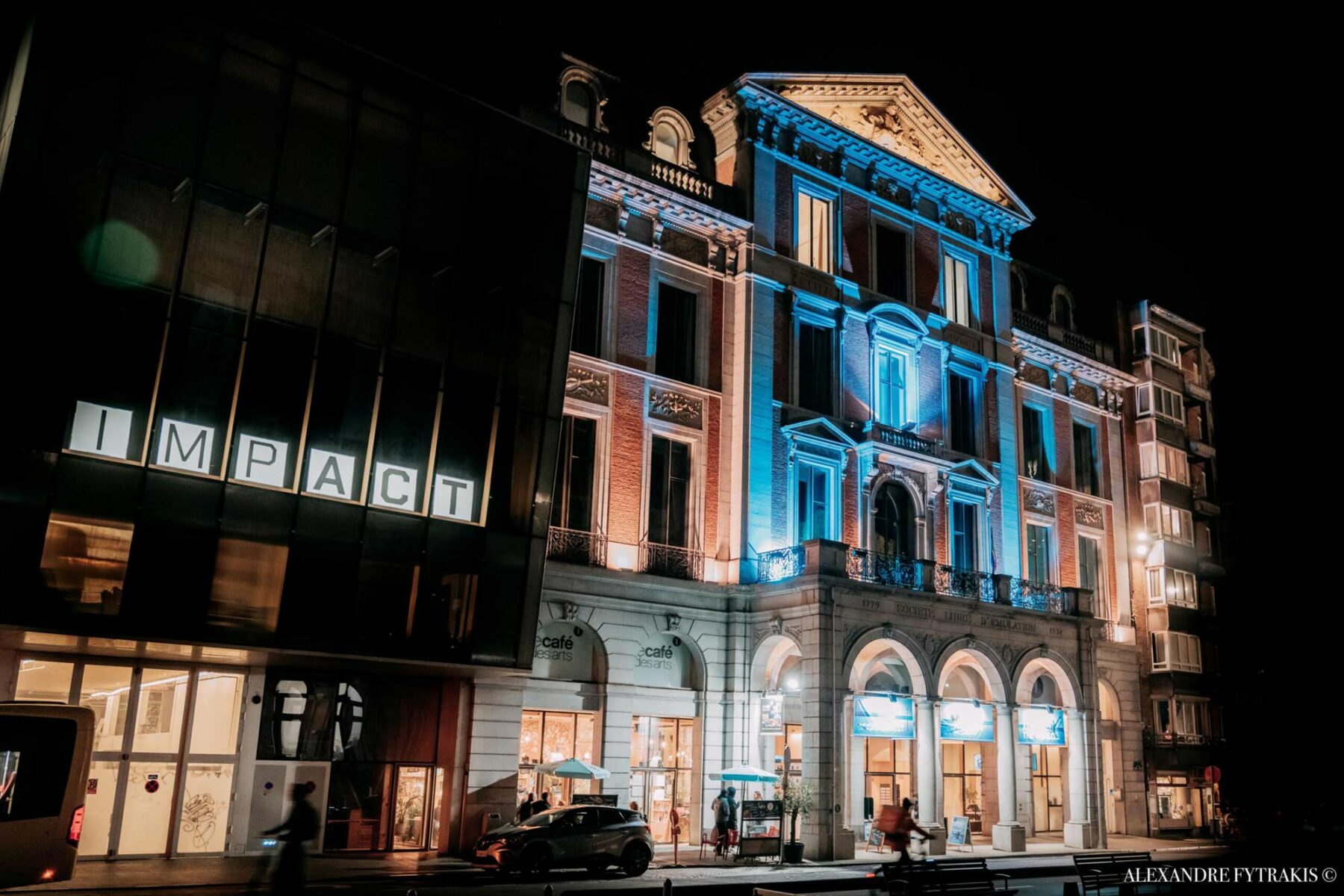

From 1 to 4 November, IMPACT in Liège brought together nearly 250 international professionals for the Impact Forum. Four days punctuated by pitches, performances and panel discussions. One of them – titled “Ecology and digital technology, lost in transition?” and organised by the French Embassy in Belgium* – brought together four European and Asian performing arts professionals to discuss the ecological and digital transitions in the cultural field. Often converging, the perspectives of the speakers highlighted how crucial it is that the debate around “transitions” be carried collectively.
“The latest data from the French Ministry of Culture shows that 15% of the French population engage exclusively in digital cultural practices (editor’s note: Cultural Practices Survey, DEPS, 2018),” begins Anne Le Gall, Executive Director of TMNlab / Théâtres & Médiations Numériques Lab. “We’re talking about consuming online content, but also creative practices and online gaming. This means that when a cultural project claims a mission to diversify its audiences, it has to face a central question: how do we connect with these audiences, who will still be numerous in the years to come?”
A reminder that helps avoid any hasty condemnation of technology. Today, the discoverability of cultural content is shaped by algorithmic mechanisms and filter bubbles; professionals must therefore understand the stakes of digital technology and the real impact of tools in order to make the most informed choices possible. “We need to focus on actual uses—those of artists and those of audiences—so we can appreciate the diversity of practices, creativity and digital cultures” adds Anne Le Gall.
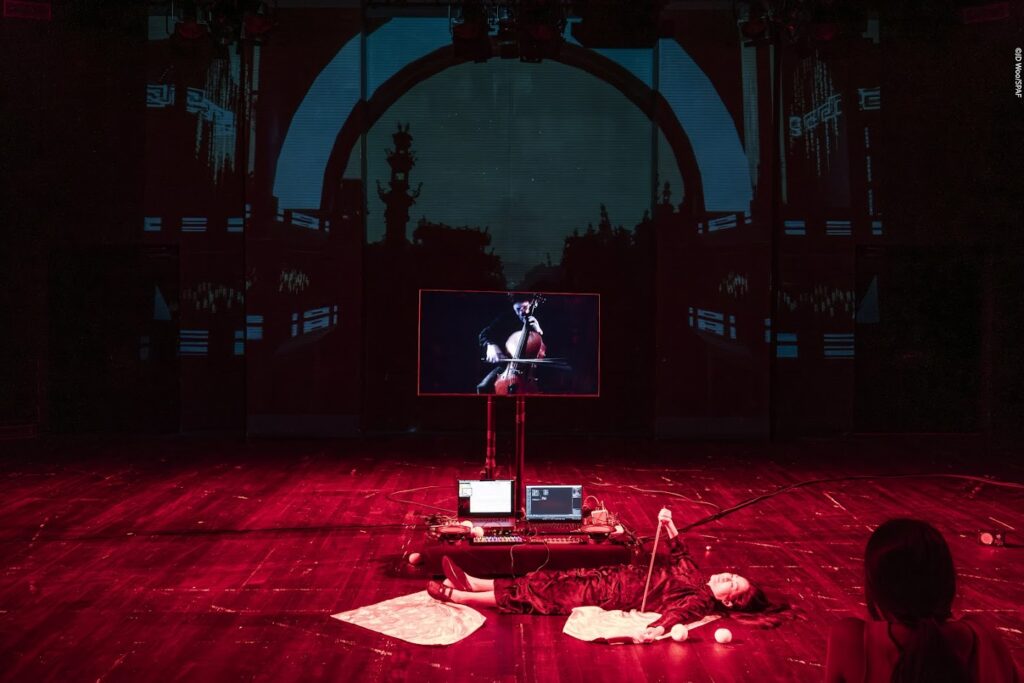
This point is echoed by Kyu Choi, Artistic Director of the Seoul Performing Arts Festival (SPAF): “The pandemic marked a major turning point in how technologies are used and transformed them in depth. The digital transition has reshaped our daily lives, to such an extent that contemporary audiences and artists simply could not resist it.”
That said, Sasapin Siriwanij, Artistic Director of the Bangkok International Performing Arts Meeting (BIPAM), firmly rejects any form of fanaticism. “The first question we must ask is about context and the usefulness of digital technology. Does a creation necessarily need digital technologies? If digital technology brings no specific insight, then it becomes accessory.” Accessory is an understatement in a world that counts, for example, around 3.5 billion smartphones, 1.1 billion DSL or fibre boxes, and 10 million 2G–5G relay antennas (source: GreenIt). Worse still, around 3.8% of global greenhouse gas (GHG) emissions (source: GreenIT, 2019) are attributable to digital technology, while projections for 2040 put that figure at around 10%. In reality, this percentage is impossible to gauge precisely, as digital technology—led by generative AI—is growing at an exponential rate. For cultural actors, navigating ecological transition becomes even more complex when the analysis goes beyond GHG indicators alone. “We talk a lot about GHGs, but there are other impacts to assess. For instance, water and electricity consumption—both for manufacturing and for supporting use—the extraction of rare earths, impacts on biodiversity… And then there’s the social foundation: the impact on labour, from the GIG economy to clic workers and digital divides” adds Anne Le Gall. Her remarks resonate directly with the framework of the nine planetary boundaries, which definitively broaden the debate. Jérôme Villeneuve, Director of Théâtre Hexagone Scène Nationale de Meylan, sums up the dilemma faced by cultural organisations and artists: “Whether we’re talking about GHGs and trajectories set by the Paris Agreements or the depletion of abiotic resources, the scenarios are simply not sustainable. For us, as cultural actors, there are no obvious solutions.”
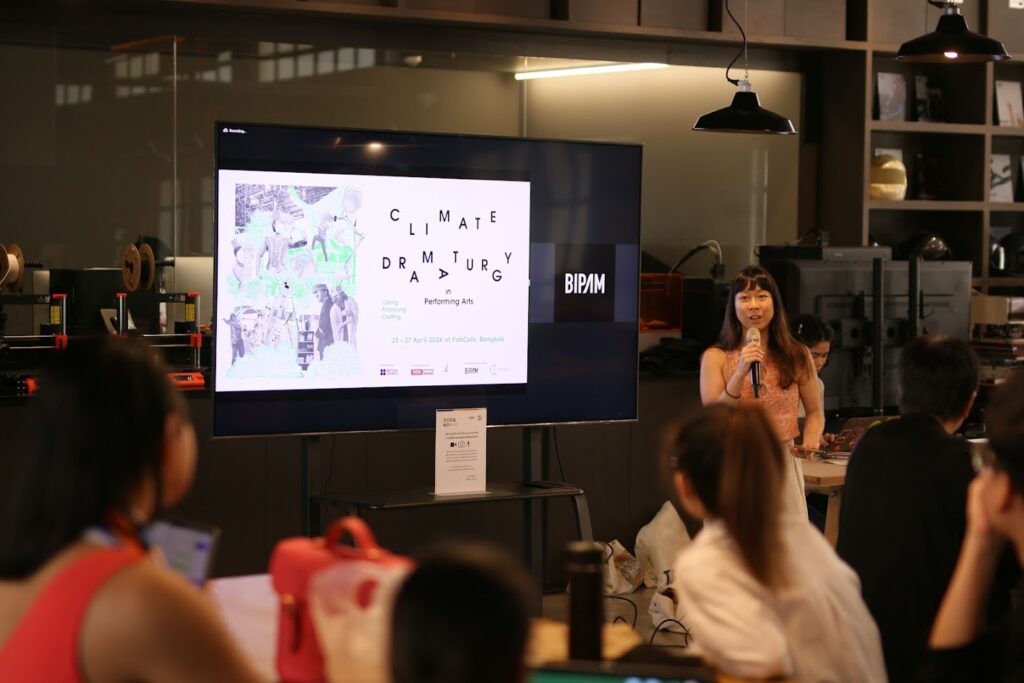
None of this has stopped festivals from experimenting with new practices. At BIPAM, “we have set up a project called the Climate Dramaturgy Lab. It’s a pioneering initiative aimed at exchanging eco-responsible practices within the Thai and British theatre communities,” explains Sasapin Siriwanij.
In concrete terms, over five days, the workshop gathers a group of theatre professionals—playwrights, costume designers, performers, directors, producers, university lecturers and other theatre enthusiasts—around environmental themes. A first example of why ecological and digital transitions need to be addressed at sector level and at every stage of a creation. At SPAF, the team is working on the Next Mobility project, a programme focused on travel, which is often one of the biggest contributors to a work’s carbon footprint (cf. CEPIR). “Next Mobility explores what exchanges and mobility in the performing arts might look like in the pandemic/post-pandemic era. It examines certain trends—such as digitisation, hybrid exchanges and green mobility—that have influenced the creation and distribution of performances,” explains Kyu Choi, who then asks: “What do we want to say to people through international mobility? What really needs mobility, and why?”
This is far from a purely rhetorical question, since travel responds to very different goals and contexts. “Europe and Asia operate in different contexts. For example, in Asia, train transport options are almost non-existent, and travel is sometimes one of the only levers to keep culture alive. Travel serves objectives of openness and even democracy for actors who are isolated on a national or international stage,” notes Sasapin Siriwanij. Here again, cross-border cooperation and an international roadmap emerge as priorities.
This necessity is all the more evident given that ecological and digital transitions do not rest solely on renewed professional practices, but also on the perspectives artists offer on our societies and the sensory experiences we, as citizens, have through their works. “Many digital artists are critical of how digital tools are used. We are far from the dominant ideologies of mainstream platforms… Artists address questions of ecological impact, inclusion, rights, sovereignty and identity. Digital technology often appears as tool, object and subject at the same time. These reflections are essential if we’re to imagine other futures,” comments Anne Le Gall.
Artists’ work also invites us to question the Anthropocene and our relationship with living beings. The notion of ecosophy—a theoretical framework in which humans are not placed at the top of a hierarchy of living beings—is explored in depth through many artistic creations.
For Jérôme Villeneuve, the diagnosis comes with a nuance: “Even if culture has a transformative power, it cannot exempt itself from a profound ecological transition. And in this perspective, digital technology is not the only vehicle for imagining the world to come. That sounds obvious, but it is too often forgotten.” At Hexagone, culture thus encounters various scientific fields—from environmental science to sociology—precisely to step aside from an overly dominant digital narrative.
So what room for manoeuvre is left to cultural professionals struggling to find a balance between ecological and digital transitions? First, defining one’s stance at an individual level: “We each have to find our own alignment, make our trade-offs—individually and within our working collectives,” sums up Anne Le Gall.
Then, to avoid being paralysed by these paradoxical demands, collective action at the level of entire sectors appears to be a suitable approach. Here, there are many levers: first, maintaining spaces for exchange and interaction between networks and professionals, in line with the mission of the Impact Forum. Next, making voices heard by policymakers to reassess existing frameworks. This applies both to eco-conditionality and to indicators of impacts that are intrinsic to culture.
“The benchmarks used in artistic projects, the specifications, are grounded in logics of profitability, increase and growth. These references must be reassessed. At sector level, we could also raise the question of a change of regime,” analyses Jérôme Villeneuve.
Structuring the supply chains of digital equipment is also a key area: in other words, extending the lifespan of products, encouraging reuse—particularly through shared equipment—and organising recycling channels (a ‘reduce / reuse / recycle’ approach already present in the social and solidarity economy). Finally, training is obviously a major collective issue. TMNlab has just published, in consortium with HACNUM (National Network for Hybrid Arts and Digital Cultures), a diagnostic study on this topic. “The ‘Skills and Jobs of the Future’ diagnostic helps us understand digital transformations in the cultural sector. It allows us to identify how jobs are evolving. The goal is to define training priorities and identify transformative practices that can support artistic creation in the digital age, in a time of transitions, notably through learning communities,” explains Anne Le Gall.
Of course, taken together, these actions will not solve the environmental crisis. But they will at least help shed some light in a landscape where many professionals are still “lost in transition.”
* On the occasion of IMPACT, the French Embassy in Belgium organised the trip of a delegation of around twenty performing arts professionals from French networks (TRAS, HACNUM, TMNlab) and hosted this roundtable.