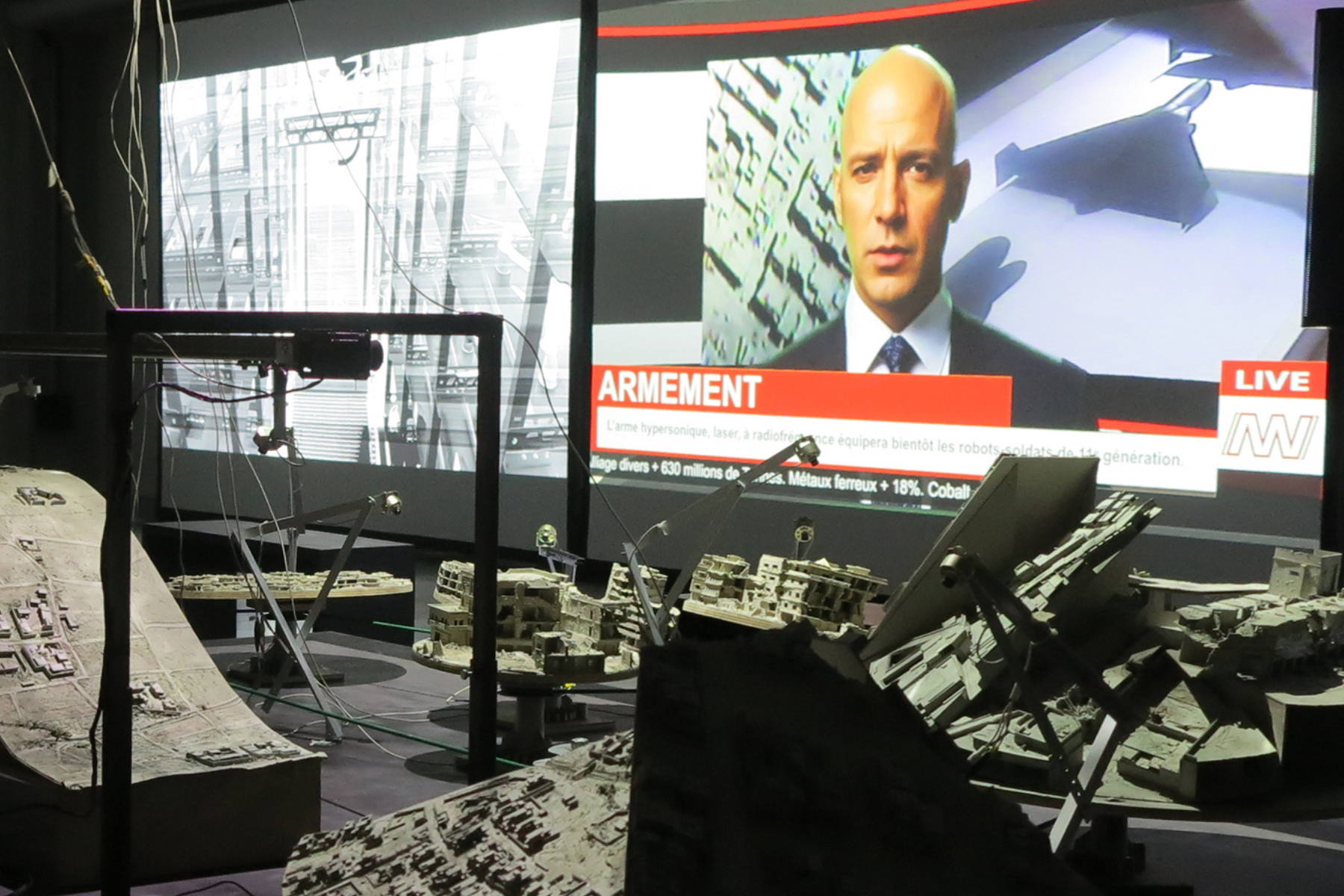
Marshmallow Laser Feast, ‘In The Eyes of the Animal’, courtesy of the artists and Luca Marziale
Since the start of 2025, CNC production support for certain digital works has been subject to an eco-conditionality criterion—meaning that applicants must calculate the carbon footprint of their project. Immersive works are, for now, exempt from these requirements, although the first building blocks are already in place. Is the sector preparing for eco-conditionality? Here’s what you need to know.
In 2023, the Ministry of Culture, through the Directorate-General for Artistic Creation (DGCA), published a Guidance and Inspiration Handbook for Ecological Transition, which forms the environmental component of its “Better Produce, Better Disseminate” strategy. This handbook translates public policy objectives into practical measures designed to support and accelerate the ecological transition of the artistic creation sector.
The ambition? By 2027, 100% of cultural actors will measure the environmental impact of their events or productions (source). Among the initiatives is the “carbon framework” approach, which enables certified cultural organisations to measure their emissions and receive guidance in reducing them collectively, as well as the CACTÉ scheme (mandatory for all structures that have signed a three-year or longer agreement with the ministry). CACTÉ provides a suite of tools to support artistic creators and facilitate dialogue with financial partners in building a shared sustainability strategy.
What About Digital Creation Structures?
Since 1 January 2024, CNC production support for live-action works has required both provisional and final carbon assessments for the production phase. As of 1 March 2025, this obligation has been extended to digital works such as video games and animation. Are immersive works next on the agenda? Not yet, says Leslie Thomas, Secretary-General of the CNC in charge of environmental responsibility. “For now, we don’t have a mature tool to measure the impact of immersive creation.” These new requirements are being developed hand-in-hand with sector professionals, she explains. “When we began looking into animation or video games, the industry unions had already started working on the subject and had financed the initial development of a tool.”
Environmental concerns are nevertheless very present in the immersive field. In 2022, XR professionals Landia Egal and Amaury La Burthe began examining the impact of their activities. “We realised there was no data at all,” recalls Landia Egal. “We didn’t know the environmental impact of manufacturing headsets, networks, data centres. There was no assessment—neither of the present nor potential future scenarios.” Through the France 2030 “Green Alternatives” programme, they secured funding to collaborate with experts such as Marie-Véronique Gauduchon (carbon accounting), Benoît Ruiz (low-carbon strategies for cultural and creative industries), Benjamin Ninassi (INRIA “Digital & Environment” programme), and teams from The Shift Project. In February 2024, the group published CEPIR — Case Study for Responsible Immersive Creation, one of the most comprehensive studies to date on the carbon footprint of the immersive sector.
The Ecological Cost of XR
Due to resource constraints, CEPIR focuses on virtual reality (VR). The results of the life-cycle analyses (LCAs) are alarming. Manufacturing a VR headset and its two controllers requires nearly 281 kg of raw materials (extraction of mineral, metallic, and fossil resources)—“333 times the final weight of the device”, the report warns. Producing this same hardware also consumes around 100 m³ of water—equivalent to the annual consumption of two French citizens—and an average of 27 litres of oil, matching the CO₂ equivalent of 350 km travelled by car. Successive headset generations, combined with new immersion-enhancing technologies—backpack PCs, multidirectional treadmills, 360° VR cameras (8 lenses instead of one), haptic feedback devices, etc.—further increase this impact.
crédit : CEPIR
Other technologies—video mapping, domes, etc.—were not included in the study. Nor was artificial intelligence, which had not yet undergone the boom of LLMs and image generators at the time CEPIR was launched. Yet these technologies are unavoidable in immersive creation and would need to be analysed within a broader study. The structural challenge is clear: such research can only be supported by public funding. For this reason, the “Green Alternatives 3” call for projects under France 2030, expected at the end of 2024, will likely never materialise—a missed opportunity to expand research across the sector.
The Calculator: The Heart of the System
To assess environmental impact, the core tool is the carbon calculator. CEPIR produced a first prototype calculator for XR, but it was never deployed at scale due to a lack of human resources. At the CNC—already responsible for certifying multiple calculators for cinema—the roadmap is clear: define technical specifications, then evaluate and approve (or not) the calculation tools proposed by various stakeholders, in consultation with domain experts. Calculators help establish sector averages, map trajectories, and build strategies to reduce impacts, explains Leslie Thomas. In the video game world, the National Consortium for Video Games and the Environment—a loose collective of environmentally engaged companies —launched Jyros, developed by the Game Only association. Partially funded through France 2030 “Green Alternatives,” the tool cost around €700,000 to develop, estimates project lead Geoffrey Marmonier. “Gathering data was extremely difficult. Video games sit at the intersection of two worlds: often forgotten in cultural reports or drowned within wider digital-sector metrics.” Some researchers are nonetheless studying the issue, such as Australian scholar Ben Abraham, who estimates the sector emits 40–50 million tonnes of CO₂ equivalent per year—comparable to the annual emissions of Norway or Switzerland.
Scope 1: direct emissions (heating gas, fuel for company vehicles)
Scope 2: indirect energy-related emissions (electricity, heating/cooling system leaks)
Scope 3: all other indirect emissions: equipment purchases, suppliers, waste, travel (business and commuting), distribution, use phase (including the electricity consumption and manufacturing of gaming devices), and end of life.
Credit : JYROS
Four indicators are taken into account: CO₂ emissions and climate impact, use of abiotic natural resources (mineral materials), impact on water, and primary energy consumption.
A Soft Form of Eco-conditionality
For now, eco-conditionality only requires the submission of carbon assessments. The CNC has no intention of enforcing results-based obligations, says Leslie Thomas. First, the calculations are highly complex and inherently imprecise. More importantly, “we are dealing with a prototype-driven economy. There is no standardised structure. Works vary greatly in cost and scale. It’s difficult to compare one project to another.” The CNC prefers an incentive-based approach. In May 2025, during the Cannes Film Festival, it announced a €28,000 RSE+ bonus for the most environmentally responsible live-action productions.
If eco-conditionality is not (yet) on the table for immersive creation, is the sector preparing for it? “It depends,” says Landia Egal. “Some industry actors are aware and ready to take bold positions and make necessary changes. But that’s by no means the majority.” CEPIR’s authors surveyed peers about their knowledge and concerns regarding environmental issues.“Many replied that they already have enough problems without adding this to the list. The period is unstable, and it takes privilege to step aside and focus on these topics.” Geoffrey Marmonier Geoffrey Marmonier agrees: “ Most studios are micro- or small businesses. They have no sustainability department. The people handling these issues are studio directors, HR teams, office managers—people with many other priorities. In a time when the video game industry is in crisis, ecology often comes second.” The XR sector is similarly composed of many small structures.
The Obligations of the CSRD
It will still be necessary to get on board. Beyond the requirements set by the CNC — a public funder, as other institutions can be — the question is also how private funders, such as producers, banks, or insurers, will align their support with the obligations of the CSRD (Corporate Sustainability Reporting Directive). This European directive, although currently weakened by ongoing reforms, requires large companies to publish an annual report on their sustainability performance. Its goal is to increase transparency on environmental, social, and governance (ESG) aspects. In the film sector, major funders who have already embraced ESG commitments are already imposing certain environmental requirements on productions in order to secure necessary funding. Eco-conditionality could therefore come through regulation via finance — at least, that is the bet of Flying Secoya. This platform enables entertainment professionals (including XR) to implement a low-carbon approach and meet the requirements of financial partners.
Whatever the path, even if eco-conditionality for immersive creation remains distant, perhaps the issue should be reframed. Geoffrey Marmonier argues that ecological transition in immersive creation “is a matter of survival.” If we reach a point where resource use or electricity consumption must be prioritised, neither video games nor immersive projects will come first. “We need to anticipate.” In environmental matters, one principle remains: prevention is better than cure.