Artificial Intelligence & Dance: a revolution in motion?
Article published on 7 March 2025
Reading time: 6 min
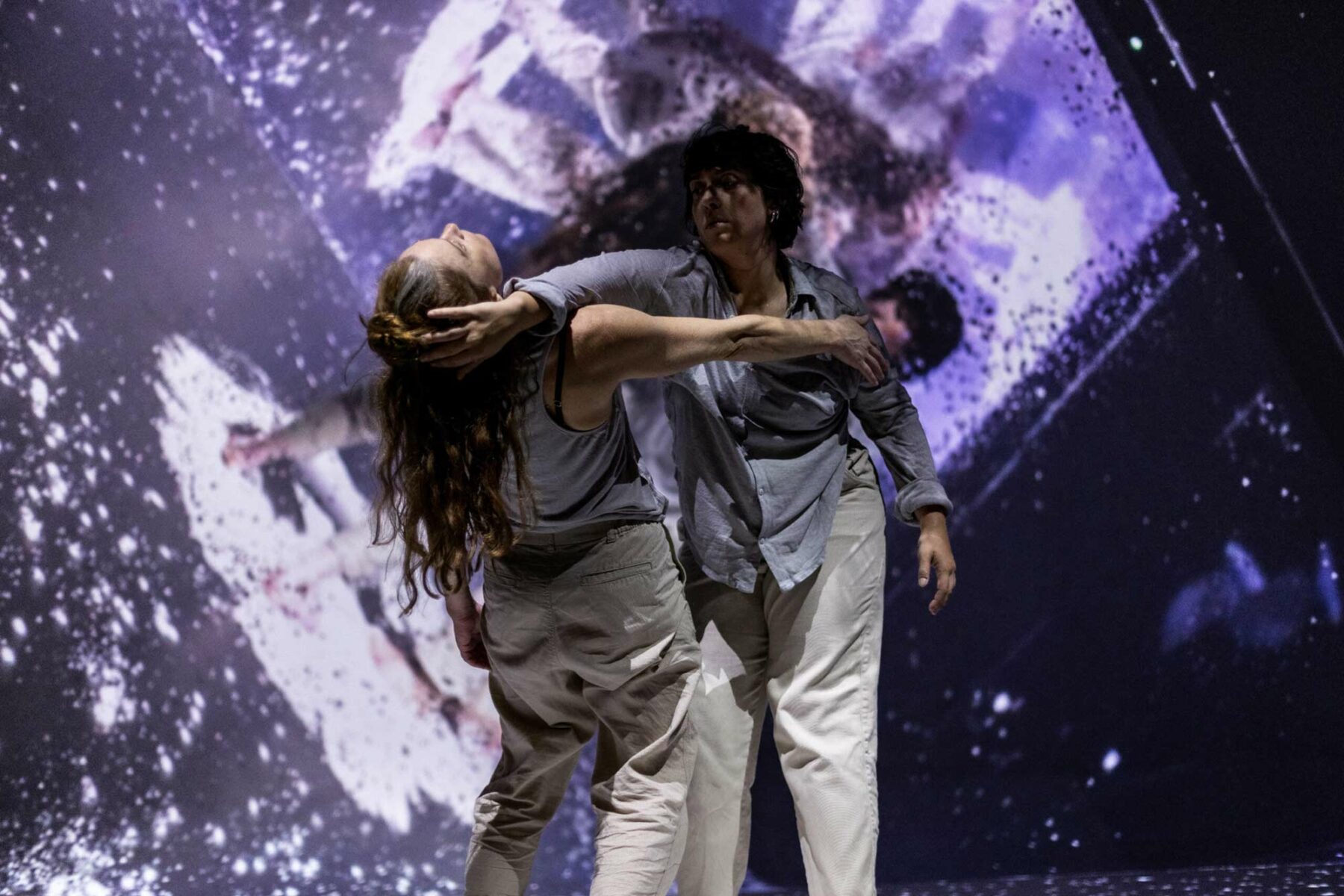
Latency © Ugo Mary
Article published on 7 March 2025
Reading time: 6 min
Debates around artificial intelligence now permeate all artistic fields. Yet, from one discipline to another, technological advances, uses and impacts of AI models differ significantly. While cinema or music are experiencing upheavals across the entire value chain, the dance sector seems relatively untouched. Why does AI remain marginal in the choreographic field? How is it being used? What challenges must be addressed to support a transformation of the sector? Through expert testimonies and artistic works, this article explores key issues at the intersection of dance and AI.
Although choreographers have integrated digital tools into their practices for several decades—whether through projections, motion capture systems or real-time interactions, echoing the famous 9 Evenings: Art, Theatre and Engineering or Merce Cunningham’s Lifeforms software—the boom in generative artificial intelligence and its media explosion in 2022 have not triggered an obvious revolution. Perhaps because the topic is not truly new. As noted by Sarah Fdili Alaoui, choreographer, dancer and professor-researcher at the Creative Computing Institute at the University of the Arts London, technology in dance has a history “almost as old as computers themselves.” She recalls that “generating sound and image through movement dates back to the 1960s, and the idea of generating movement by manipulating algorithmic parameters emerged quite some time ago.”
The search for new bodily forms and dramaturgies through AI is therefore far from new and resurfaces regularly in works presented in both dance circuits and digital art contexts. A multitude of works exemplify this. To name a few: Robot! by Blanca Li (2013); Pattern Recognition (2016), a performance bringing together choreographer Alexander Whitley and AI-star artist Memo Akten; School of Moon and Lesson of Moon (2016) by Éric Minh Cuong Castaing; Co(AI)xistence (2017) by Justine Emard with performer Mirai Moriyama; Lilith.Aeon by Aoi Nakamura & Esteban Lecocq (2024); For Patricia (2023) by Sarah Fdili Alaoui; F_AI_LLE (2024) by Jean-Marc Matos… Each of these projects, among dozens of others, contributes to defining a grammar of interactions between humans and machines. This alphabet of movement can also be illustrated by Vast Body (2020) by Vincent Morisset. This installation records the dance postures of professional dancers, including the renowned Louise Lecavalier. Facing a mirror, the audience is invited to move freely, dance and let go. Then, using a machine learning system, a digital reflection appears, drawing directly from the previously mentioned movement “dictionary.” The installation bridges the physical body with a digital incarnation, offering the possibility of inhabiting another form through movement for a brief moment.

So, nothing new under the sun? Not quite. In just a few years, we have moved from expert models executing mechanical and repetitive tasks to systems capable of solving complex problems, such as visual recognition or text and image generation (Large Language Models, or LLMs). “Back then, we talked about HMMs (Hidden Markov Models), classifiers used to group and analyse movements,” explains Sarah Fdili Alaoui. “They enabled a machine to recognize movements in real time.” At the time, research focused mainly on gesture analysis: What is a movement? What effort does it require? In what space does it unfold? Until the 2010s, this research relied on machine-learning models, before the rise of deep learning reshaped the technological landscape. However, “AI is a catch-all term that covers multiple realities, including LLMs, those text generators now familiar to the general public,” she adds. In the field of dance, generative AI does not typically rely—except in rare cases—on LLMs. Today, a key reference model remains the one conceptualized by Luka and Louise Crnkovic-Friis in 2016. Nearly ten years have passed—an eternity in digital terms!
This timeline is largely due to limited investment in the dance sector, far lower than funding allocated to cinema, animation or gaming. “There is no investment from public authorities nor from industry, because the dance market is more niche,” notes Sarah Fdili Alaoui. As a result, research in the field remains limited, and resources for experimentation are scarce. A few exceptions exist, mostly in the private sector. In 2019, a collaboration between Wayne McGregor and Google Arts & Culture gave rise to Living Archive, one of the most iconic performances combining AI and dance, capable of generating movement sequences (via the CHOR-RNN model) based on the choreographer’s repertoire. Yet these investments remain isolated and do not contribute to building shared tools. Another major obstacle: unlike other sectors where AI progress has been fueled by access to large-scale datasets, dance presents specific challenges that complicate data training processes.
Everything starts with the very nature of the discipline. While language models rely on text and image generators on pixels, what exactly constitutes data in dance—and based on which references? According to Anne Le Gall, general delegate of TMNlab (Laboratory for Theatres & Mediation in the Digital Age), which supports performing arts actors in their digital transition, “these art forms are ephemeral and not always well documented. Of course we can use videos or photos to capture movement, but that is often insufficient.” This is echoed by choreographer Jean-Marc Matos (Cie K. Danse), who explained his movement analysis process during an interview at the “Le corps en mouvement” event at the Centre Pompidou’s Hors Pistes festival in 2024. Video could be a major source, as platforms like YouTube and TikTok contain thousands of dance recordings, particularly urban dances. “The issue is that this data is neither sorted nor cleaned. And how do we build a dataset truly representative of the diversity of dance? It’s practically anthropological work,” analyses Sarah Fdili Alaoui. Other data types could enrich datasets: idiochromatic data (texts, poems, descriptions), or even better, motion-capture recordings. Yet such protocols remain difficult to scale despite the democratization of motion capture and the opening of specialised studios such as Studio 44 MocapLab, initiated by Gilles Jobin. Certain notation systems, like Laban kinetography, could also help transform movement into usable data. In any case, converting choreographic gesture into data remains a challenge of remarkable complexity.
Some artists turn this difficulty into the very core of their work. In Latency, a piece by Natacha Paquignon, Quentin Bozon and Maxime Touroute (currently in creation, with a tour planned for 2026), the machine feeds on the dancers’ movements, but also on images provided by the audience. In a reception area, spectators are asked to record movements using their own smartphones (via Live Maker software). Eventually, the AI grows tired of reproducing human movements and creates its own language. After an initial phase where dancers believe they control the machine, the AI’s responses become unpredictable. It gains autonomy and becomes an interlocutor capable of improvisation.

While artistic initiatives are numerous, few institutions have fully embraced the topic. How can we create spaces for research and experimentation, bring communities together, structure documentation, and support the emergence of new practices? Some residencies and research projects exist, such as the European project MODINA (Movement, Digital Intelligence and Interactive Audience). At Chaillot, the C.A.L.I.P.S.O laboratory (Choreographic Arts Lab for Immersive Publics and Spaces) will explore gesture capture and AI as a tool. “This lab, run in partnership with INREV and TMNlab, will serve as a platform of shared expertise and knowledge for artists and the choreographic sector,” explains Anne Le Gall. At the European level, the MOCO community (Movement + Computing Community) has become an essential reference. Bringing together renowned researchers such as Frédéric Bevilacqua, Kristin Carlson and Daniel Bisig, it operates through recurring scientific gatherings, conferences, workshops and publications. “Every two years, a university laboratory hosts MOCO. In 2026, it will take place in Montpellier,” says Sarah Fdili Alaoui, a member of the community. Whether or not AI constitutes a revolution in dance, some resources already exist—now they must be made visible and accessible to the artistic community.