Digital technologies have profoundly reshaped the nature of conflict. While the first installment of this article highlighted the technological ties between art and the military industry, as well as the various ways artists have participated in these ecosystems, this second analysis focuses on the virtualization of warfare. By exposing underlying systems or critiquing military strategies, many artists interrogate the narratives and infrastructures of war. A survey of those revealing the tensions of a world in which technological innovation sometimes outpaces public debate.
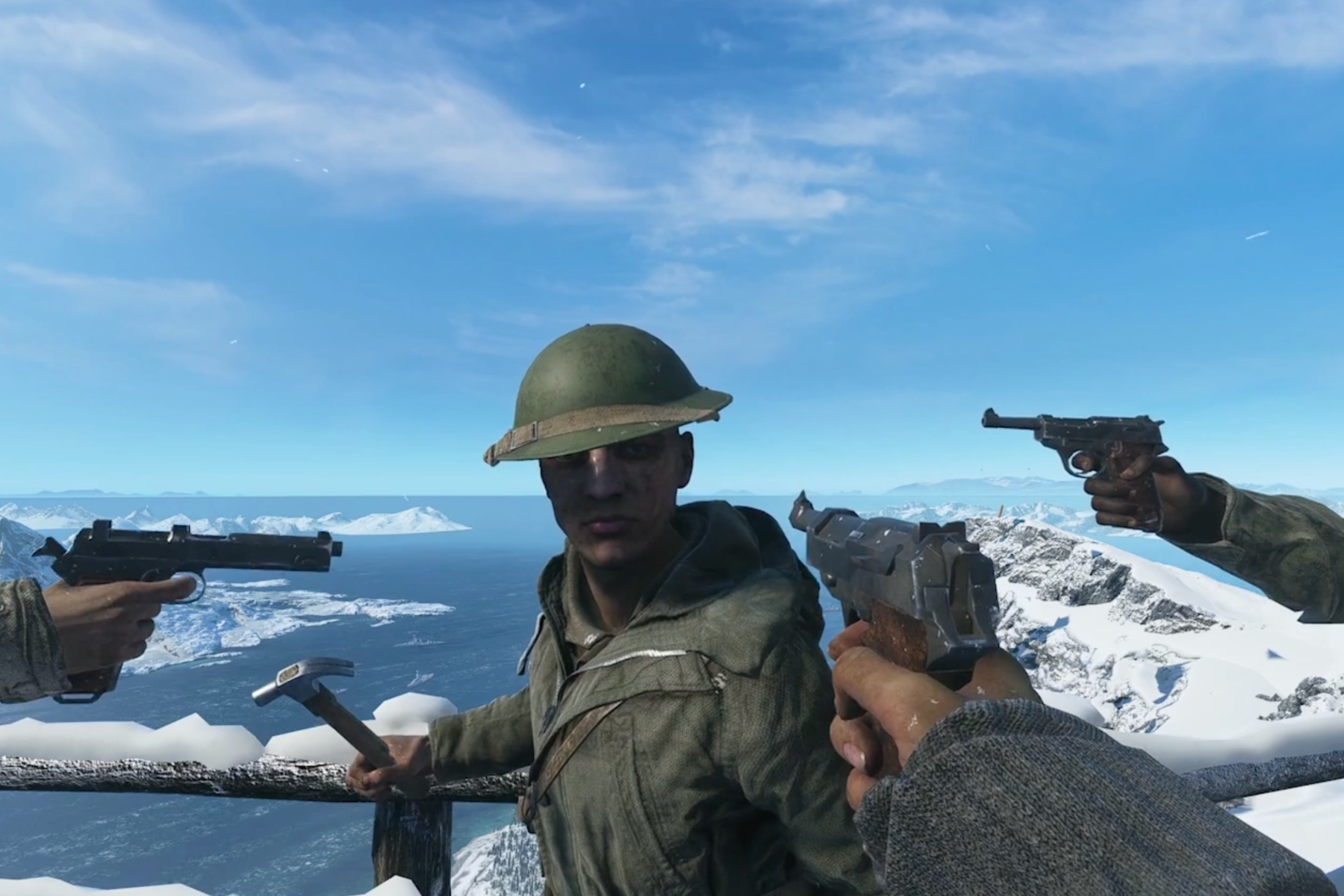
Historically, cinema has maintained close ties with the military sector (see “national security cinema”). Video games, too, appear to have developed a particular affinity with this universe. As early as the 2000s, publishers such as Bohemia Interactive, based in Prague and known for the ARMA and Operation Flashpoint franchises, developed simulation software for the U.S. Marines. These industrial collaborations point to a broader evolution: the progressive virtualization of war. Operations are now conducted remotely, through screens, and increasingly incorporate mechanisms of gamification. A report published by Politico described the existence of a “drone army bonus” intended to reward Ukrainian pilots through a point system: 20 points for damaging a tank, 40 for destroying one, 50 for a mobile rocket launcher system, 6 for killing an enemy soldier. The implicit hierarchy of values—where the destruction of a machine can count for more than a human life—reveals a shift induced by such accounting logics. The collective Total Refusal, which describes itself as “post-Marxist,” offers a critical lens on these war simulations in How to Disappear, a video in which players attempt to desert from the game Battlefield. The opening seconds clarify the ambiguity of simulators: “War cannot be played. By definition, a game is played voluntarily, and for most participants, war is anything but voluntary in the real world.” The introduction leaves no room for doubt: war is intrinsically bound to the control of bodies and the dispossession of individual freedoms.
Analyzing the Effects of Virtualized Conflict
French artist Alain Josseau has taken a particular interest in this derealization of conflict. His film Guerre Alphatest highlights the evolution of the combatant figure: “The soldier of the future has been born, but more than connected, he has become the interface itself. What is lost is not reality as such, but the principle of reality. These soldiers are no longer interested in reality; they stand at the threshold of another world, made of calculations and numbers, already with one foot inside.” The film concludes with a reflection on MARPAT pixelated camouflage, now worn by U.S. soldiers. For Josseau, “this pattern signals the soldier’s transformation into an image. It reflects the screen, the definition of the image, the disappearance of the principle of reality, and a generalized image-based logic. It is no longer about blending into the environment but blending into the image of the video game—the ultimate process of derealization, of becoming an image.”
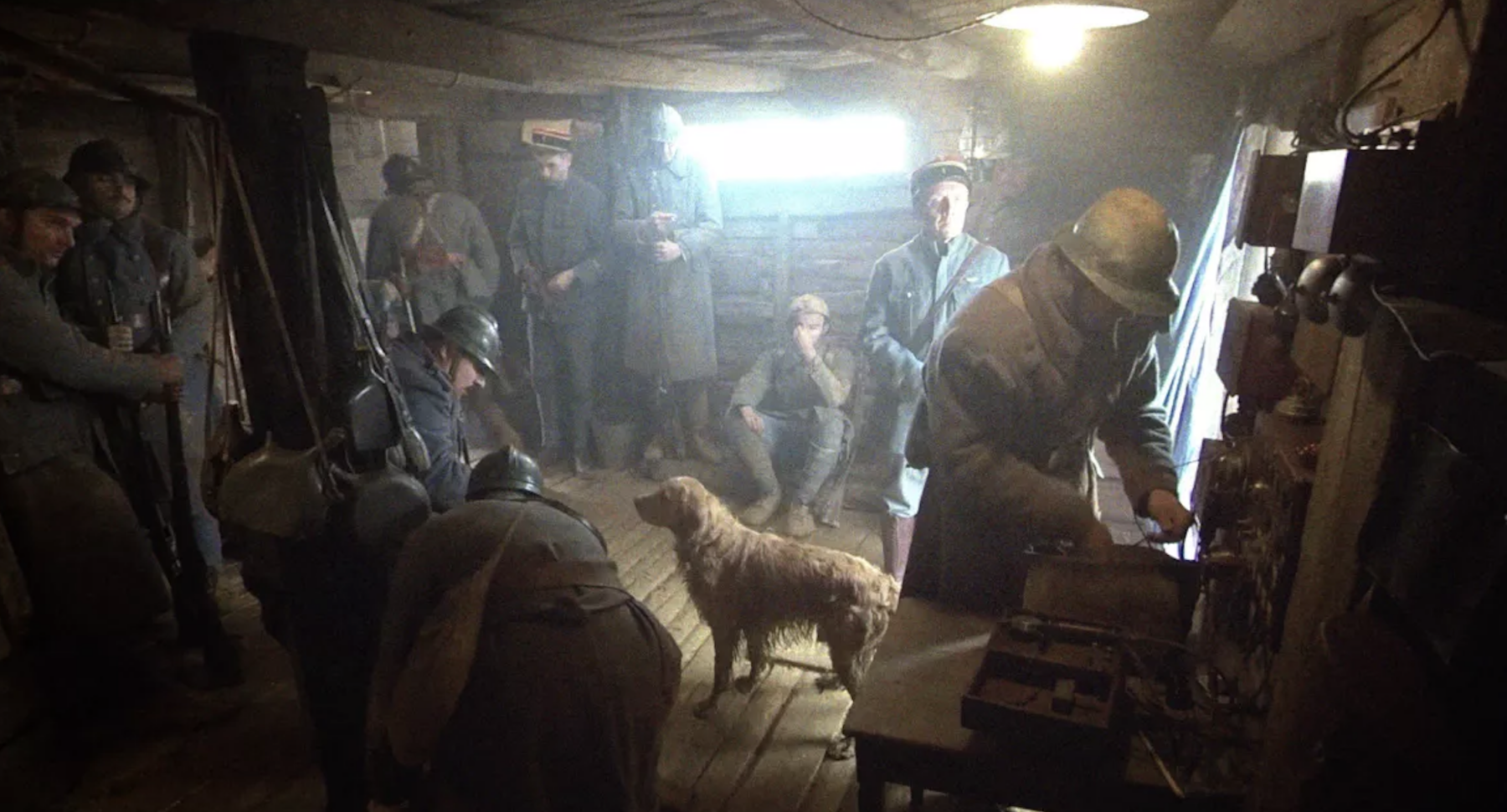
Champ de Bataille – François Vautier
In their 2025 article Military Demonstrations as Digital Spectacles: How Virtual Presentations of AI Decision-Support Systems Shape Perceptions of War and Security, researchers Robin Vanderborght and Anna Nadibaidze analyze virtual demonstrations conducted by Palantir Technologies and Anduril Industries. They show how virtualization reshapes our perception of conflict: on screen, war becomes a clean, controlled, abstract operation, detached from the experience of victims and the materiality of territories. A similar observation applies to certain European drone manufacturers such as Helsing.ai, whose communication strategies adopt the sleek, minimalist design codes of Silicon Valley startups. From this perspective, the issue with video games may not be the violence they allegedly produce—contrary to claims made by Emmanuel Macron—but rather the regime of virtualization they install. This question also runs through the field of immersive experiences, which place the viewer at the center of the narrative. Works such as Omaha Beach or Champs de Bataille by François Vautier, filmed in live action, participate in these effects of virtualization, even as they are developed in close collaboration with historians, serving as a safeguard against spectacularization.
The Drone Revolution
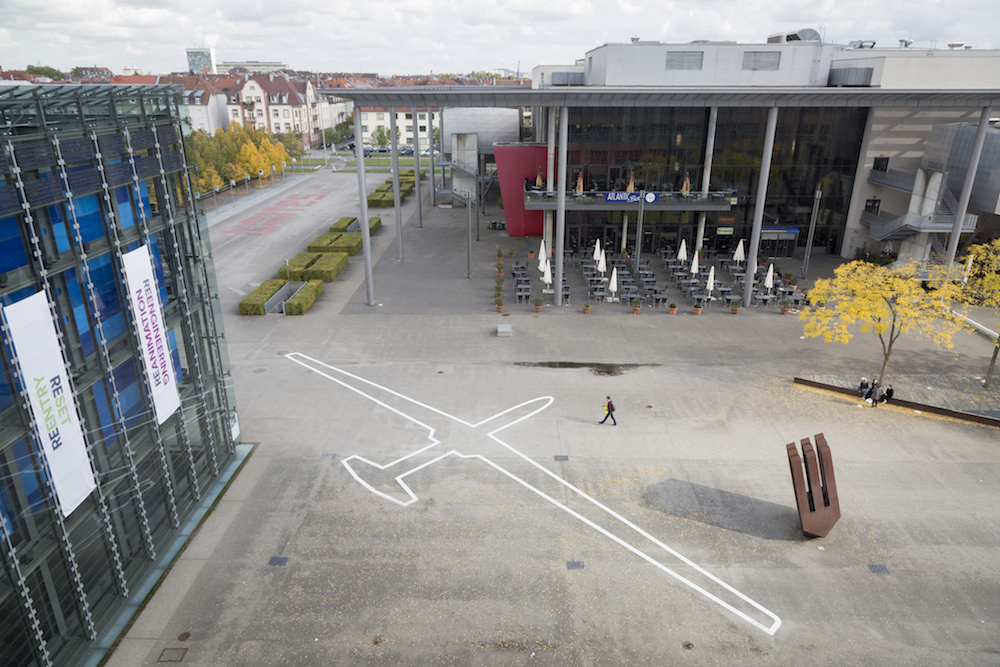
This virtualization finds its most tangible expression in drone warfare, now central to contemporary conflicts and widely promoted by the companies that design these systems. In Drone 2000 by Disnovation.org, these machines occupy the core of a striking performance. Piloted by unstable algorithms, drones coexist with the audience while maintaining a diffuse threat. The work establishes a dystopian atmosphere, recalling both the military origins of these devices and their recent deployment by law enforcement. Similarly, in his series Drone Shadow, James Bridle shifts our perspective and reveals an obvious yet overlooked fact: we now live in a world saturated with drones, yet most of us neither see nor feel their presence. By tracing their outlines on the ground, Bridle restores their materiality, anchoring them in physical space and rendering visible what usually remains unseen. This transformation of airspace is also documented by Shona Illingworth in Topologies of Air, accompanied by a publication of the same name. Drawing on long-term research, her projects interrogate the psychic and environmental effects of the military, industrial, and corporate reshaping of the sky. Drone warfare is part of this global reconfiguration, enabled by the continuous refinement of surveillance technologies and intelligence systems. In this sense, the work of Paolo Cirio and other whistleblower-artists resonates strongly with these issues: it is through data capture and control infrastructures that so-called “precision” drone strikes become possible.
Drone Shadow 009 – James Bridle – ZKM
Critiquing the Military-Industrial Complex
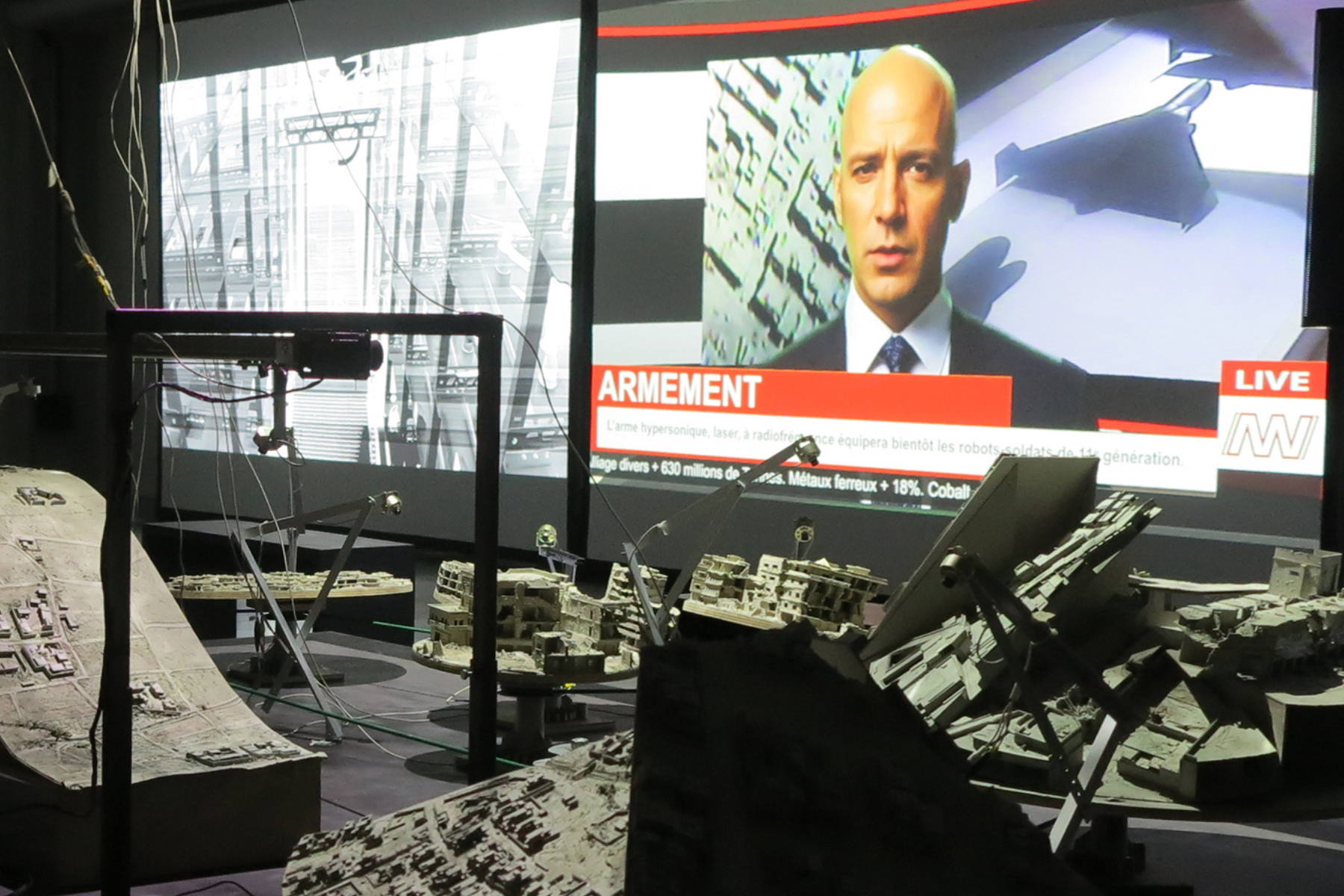
Other technological narratives are likewise dismantled by artists who point to the gradual normalization of these weapons in everyday life. The robots developed by Boston Dynamics—originally funded by the U.S. Defense Advanced Research Projects Agency (DARPA) for military purposes—are emblematic. Frequently showcased at major tech events such as the CES 2025, they are presented as the pinnacle of a desirable future, despite their military lineage. In 2021, the New York–based collective MSCHF staged Spot’s Rampage, inviting participants to remotely control a robot equipped with a paintball gun. Through this participatory setup, internet users could steer the machine, fire shots, and transform a gallery into a field of ruins. The satirical gesture was not appreciated by the company: buyout attempts, legal threats, and the remote deactivation of the robot followed. In response, MSCHF exhibited the “mechanical corpse,” weighed down with as many weapons as it could carry—a biting irony underscoring the device’s primary purpose. Other international artists have revived this memory. In 2025 at Art Basel Miami Beach 2025, Beeple presented Regular Animals: robot dogs fitted with hyperrealistic heads of tech billionaires, explicitly linking the digital industry and the military-industrial complex. Japanese artist Takayuki Todo, in Dynamics of a Dog on a Leash, staged a robotic dog poised to attack, restrained by a chain—an image suggestive of a weapon held on a leash by state powers. More broadly, these works articulate a critique of the industrialization of conflict. With UAV Factory, Alain Josseau stages Shahed 136 drones on conveyor belts simulating their assembly, destruction, and reconstruction—a seemingly endless loop mirroring an interminable war. In Automatic War, exhibited at the Biennale Chroniques and the Scopitone Festival, the artist goes further by analyzing the media power attached to the military industry: “It’s an installation that produces fake TV news broadcasts. All the images are AI-generated. The only real elements are the virtual journalists’ speeches—actual audio excerpts from war reports.”
Exposing the Damage of War
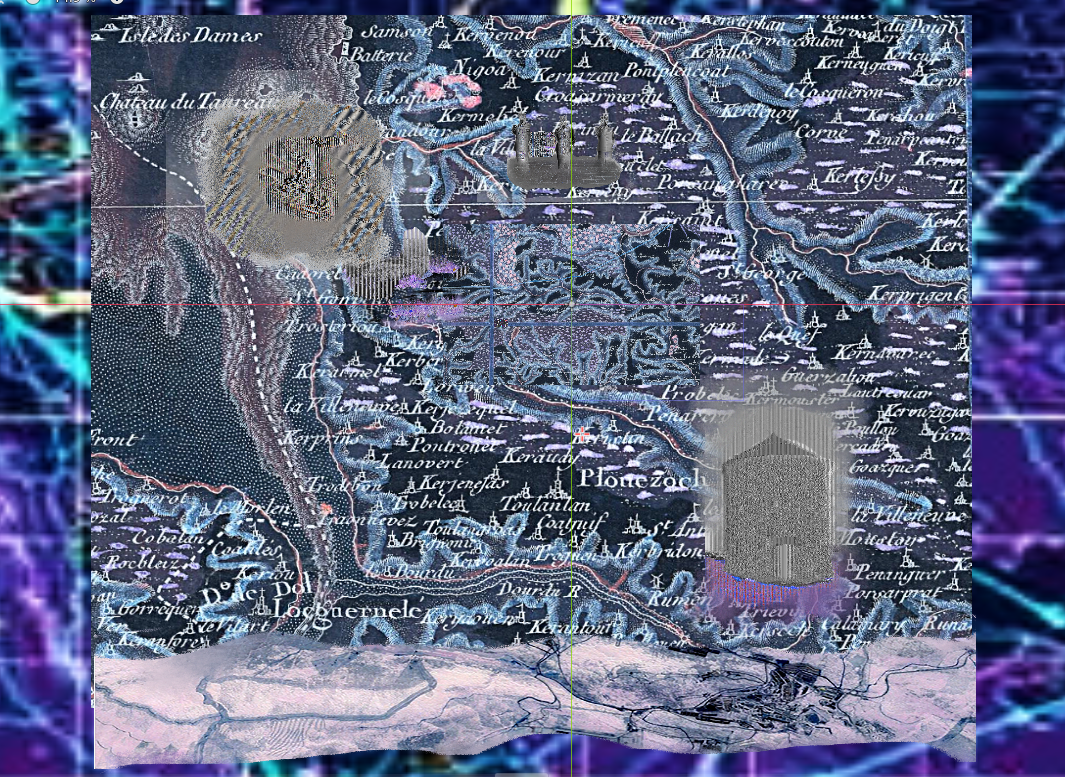
A direct consequence of this industrialization is the harm inflicted on populations—not only deaths, but also less visible damages. This is precisely the focus of Iron vs Clay by Jeanne Yuna Rocher, in collaboration with sound artist Hugo Mir-Valette, soon to be presented at Le Cube Garges. The work explores links between expropriation and military propaganda, drawing on the Coëtquidan military camp in Brittany. “The aim is to connect propaganda systems around patriotism and sacrifice for the state with the concrete consequences of land expropriation—both physical and digital,” the artist explains. “How has history normalized the disappearance of entire villages in favor of military camps—part of a French industry that has produced imperialist wars for centuries? And with the rise of AI, how are digital territories themselves being expropriated and privatized?”
Iron vs Clay de Jeanne Yuna Rocher
Military infrastructures also have devastating effects on the environment and public health, as shown in Bueno Vacanze by the collective transhumanza. In another register, artist and musician Steve Goodman, aka Kode9 and author of Sonic Warfare, denounces the use of acoustic weapons, including sonic attacks designed to terrorize civilian populations. In an episode of Tracks broadcast on Arte, he cited the 2005 use of low-flying aircraft over the Gaza Strip to generate sonic booms and instill fear. The report shows him leading workshops with war victims, seeking to initiate processes of trauma repair.
The effects of war are also visible in massive population displacements. In Incoming, photographer and filmmaker Richard Mosse documents refugee camps in Europe following the wars in Syria and the Middle East. Using a thermal imaging camera typically employed by the military, he inverts black-and-white color values, giving silhouettes a spectral aura suspended between worlds. Between virtuality and hyperrealism, these images ultimately re-center the narrative: war—and its devastating impact on human lives.
Through his experiences, Adrien Cornelissen has developed expertise in issues related to innovation and digital creation. He has collaborated with a dozen French magazines, including Fisheye Immersive, XRMust, Usbek & Rica, Nectart, and Revue AS. He coordinates HACNUMedia, which explores the changes brought about by technology in contemporary creation. Adrien Cornelissen lectures at higher education institutions and creative organizations.